
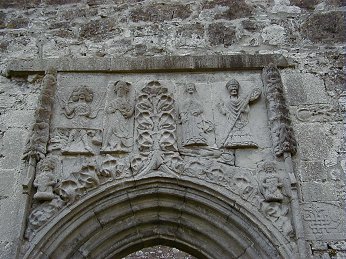
The Decorated West Doorway
Flanking the doorway are several carved panels including a monogram knot, a star, a mermaid holding a star, two intertwined beasts, two other beasts, a pelican feeding her young and a very fine rose. Inside the doorway is a holy water stoup under carvings of St Catherine and St Laurence. The church has a north transept with a three-light traceried north window. There is a very fine three-bay vaulted rood screen. It has been much restored but a lot of the original structure is still evident. The bases and capitals of the arcade have some carving and there is a rose at the centre of each of the vaults.
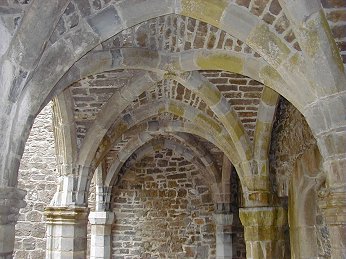
The Vaulting Of The Rood Screen
A south window opens beneath the vault and it bears a carved triangular knot. There is a very fine five-light traceried east window in the chancel. In the south wall is a tomb-niche with a decorated hood. There were three decorated finials but only the right and centre finials remain. At the base of each of the outer finials there is a flat carved mask. On the hood there are four panels. Three of them are roundels and the fourth is a sprig of foliage. One of the roundels has a round interlaced knot. Beside the tomb-niche is a sedilia, which is encroached on by the tomb-niche. There is also a piscina with two quatrefoil basins. Also in the south wall are two plain round-headed lancets. There is a fragment of a lancet in the north wall, which had some decorated moulding. There are traces of lancets in the east wall, which were replaced by the large traceried window.
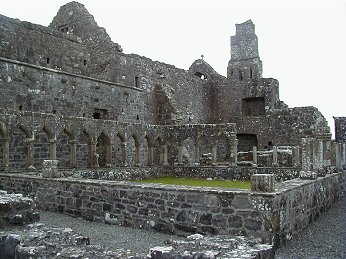
View From The South West
There is a memorial dated 1646 in the south wall with raised lettering. To the south of the church the north arcade and part of the east arcade of the cloister has been erected as well as several other fragments. There are some carvings in the cloister including a mask, a dog and two very small masks. The building to the east of the cloister had fireplaces at the ground and first floors. St Baedan (d.809) founded a monastery here but there are no remains. The Augustinians arrived in the 12th century and the church was built in the 13th century. The monastery was completely burned in 1413 and most of the present building dates from the later 15th century reconstruction. The west doorway was erected in 1471 by Matthew MacCraith and Patrick O’Neachtain. After the Dissolution the monastery was passed to the de Burgos.
