|
|
|
by Joshua Gryniewicz |
|
A
Vision of Salamander |
 The
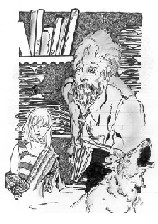
old man’s gravel voice scraped the words into my head long before I
had a fictional framework to house him. He spoke an encrypted poetic
command: “Find the flame that burns on water.” I had no key to
decipher this riddle, let alone an answer to the puzzle itself. Stories
come to me this way--a descriptive snapshot, a character, or a snatch of
dialogue that evokes a reality around it. This, however, occurred a
little differently; the old man and his instructions offered the origins
of a narrative, but the place in which I found it unfolded in a somewhat
more unusual fashion. The
old man’s gravel voice scraped the words into my head long before I
had a fictional framework to house him. He spoke an encrypted poetic
command: “Find the flame that burns on water.” I had no key to
decipher this riddle, let alone an answer to the puzzle itself. Stories
come to me this way--a descriptive snapshot, a character, or a snatch of
dialogue that evokes a reality around it. This, however, occurred a
little differently; the old man and his instructions offered the origins
of a narrative, but the place in which I found it unfolded in a somewhat
more unusual fashion.I
was meditating on changes that I needed to make in my life, practicing a
series of deep relaxation and breathing exercises that I do nightly,
when I was suddenly induced into a vision. In the course of the
meditation, a salamander would scurry into my mind, traipsing over
smooth mossy stones and rocks along a riverbed reflecting memories of my
childhood. The revelation and recognition of the significance of place
would be slow in coming, as I feel the analytical voice of cognition is
suspended for the functions of vision. However, the riverbed was one
that was readily identifiable from a family vacation spot in my
childhood--Hueston Woods in Oxford, Ohio--significance I will reveal
later. I chased after the scampering amphibian, as though perceiving him
before me with my own sight and then, in chase, I became aware that I
was in fact the salamander leaping and skittering along the flow of the
rushing water. A narrative voice spoke over the scene, announcing that
there should be a cave just ahead. There is no actual cave in my memory
of the place, nor, so far as I know, in the actual Woods itself. This
cave exists only in my psycho-geographical impression of the location. I
entered into the cave in my vision, greeted by a cascade of memory like
uneven spools of film cut together in presentation: images linked in a
fashion that would only make sense to me. I climb aboard a large,
hollowed-out canoe of birch wood, massive and composed of completely
natural bindings. I begin a journey in the canoe through a thick fog
that parallels similar mental journeys that I have taken before. Here,
the river that I am paddling down leads me to a flight of stone,
temple-like stairs, which ascend into a dense, dark mass of deep green
foliage. After climbing the stairs, I see a hut made of bone and
fastened together with sinew bindings. There is a primordial sensation
that nearly overwhelms me as I approach this scene. I am physically sick
with fear (in the waking world) as I approach the hut. I enter into the
sacred place, into the flickering torch-light. Across from the entryway
I witness an altar, upon which sits a bowl of bone, filled with blood. I
am instructed by the narrator to drink the blood and as I begin to raise
the dish to my lips, the sensations are nearly overpowering. “This is
the house of death that you’ve made,” the voice booms. I snap to
alertness, my hands shaking as badly in the waking world as they had
been in the vision. I
regard the symbolic content of my meditative visions in the same fashion
as I would my dreams, first analyzing the details for personal
significance, then applying historical and cultural properties to grant
a greater level of insight. Only in the research that followed my vision
did I learn the symbolism of the salamander in it. I know that there was
no prior conscious knowledge of the imagery that existed before I began
my analysis. It seems even more amazing that the meditative vision was
laden, almost ad nauseam, with images of birth, death, and rebirth--as if to
reinforce the interpretation and assert the symbolism. For example, even
the location where the salamander first appeared is a place of personal
origins. I was born in Oxford, Ohio and our family trips to the
location, in my child’s mind, always denoted some feeling of personal
importance and significance. The images of the cave as womb, the house
of bone, the drinking of the blood--each reasserts these impressions and
complements the symbolism of the salamander. It
was only after I had decided to compile some of the notes and
impressions of the experience with hopes of turning it into an essay
that I had one of the more interesting revelations of the lot. The
salamander itself is the missing metaphor for the flame that burns on
water. The very symbol for rebirth is intimately tied to a personal
symbol for balance, which happens to loan itself equally to the story I
had been working on, as well as to the issues that had provoked the
meditation in the first place. |
||
|
"There are two ways of getting home; and one of them is to stay there. The other is to walk around the whole world till we come back to the same place ..."
G. K. Chesterton
¤º°`°º¤ø,¸¸,ø¤º°`°º¤ø,¸¸,ø¤º°`°º¤ø,¸¸,ø¤º°`°º¤ø,¸¸,ø¤º°`°º¤ø,¸¤º°`°º¤ø,¸¸,ø¤º°`°º¤ø,¸¸,ø¤º°`°º¤ø,¸¸,ø¤º°`°º¤ø,¸¸,ø¤º°`°º¤ø,¸