|
A
New Dawn Rises |
|
In the hopes of keeping the promise of possibility alive, Happy
Feet Productions -- an interactive folk art “museum” of dance,
craft, story and culture, begins the New Year, with a new monthly
column, Mythic Heritage, which
proposes for us both, writer & reader alike, a journey. Together, we
will travel past the inundation of health club commercials, the how –
to – self – help – in – less – than – thirty – days –
with – great – looking – abs industry and other superficial jaunts
into self improvement to the very concept of renunciation, rebirth and
resolution. Happy Feet holds the belief that by exploring cultural
traditions, rituals and stories we can gain a better appreciation of
ourselves, our community and the world. To grant a stronger
understanding of the significance of the New Year, we begin with the
origins and traditions of the New Year itself, and make suggestions for
how to review your own origins in making a resolve we can commit to.
New Year is the oldest observed
holiday; initially, it was celebrated on the Vernal Equinox, the
first day of spring – it can be traced back some 4,000 years ago to
the ancient Egyptians and Babylonians. At this time the
calendar placement of the holiday fell into synch with the environment
– it was a time of new growth and new crops; everything underwent a
seasonal rebirth with a full floral vibrancy as everything was in bloom.
The Nile flooded the lands around Egypt enriching the soil for the next
year’s crops. In Babylon the king set the festivities in motion
stripping of his robes and leaving the city for a few days, (I’m not
sure if he actually left naked or not); the celebration lasted eleven
days total – each day marked with its own party theme. These events
culminated in the return of the king, dressed in his sharpest threads,
who lead an extraordinary parade that would prove the final hurrah
before going back to routine.
It was the Roman Empire who
decided to mix things up a bit and arbitrarily choose a date with no
astronomical or agricultural significance to mark the start of the
calendar year. Archeologists' debate that this may also be the period in
history where the first home gym was invented and, subsequently, the
first infomercial. They made up for it with the name of the month,
however, January – is named for the god, Janus, depicted with two
faces. One peers back looking into the past, the other forward in the
future – representing a symbolic break from the old and a celebratory
welcome of the new.
The Babylonians believed that
whatever was done at the start of the New Year would set into momentum
the precedent for the year as a whole, this is most likely what gave
rise to the tradition of setting resolutions. Though in Babylon most
resolutions centered on returning borrowed farm equipment.
Greece established the symbolic
use of the baby to represent the New Year, in honor of Dionysus, god of
wine and fertility – a tradition that was brought to the United States
by German immigrants and is still used today.
The tradition of using noisemakers and fireworks to note the
celebration may be Asian in origin, to chase away bad spirits and
welcome good fortune. The Japanese, for example, spend weeks
preparing for the New Year celebrations and forgetting year parties are
held to let go of the past. The year is rung in by the chime of a bell
sounded 108 times to chase away evil spirits, cards are also sent out in
advance to offer and ask forgiveness for misunderstandings of the past.
In Vietnam, Tet Nguyen Day or Tet, is an opportunity to show
respect to the gods that leave in each home, and to make peace with the
dead who wander the earth in a three-day ceremony. Similarly, the Chinese
New Year involves showing respect to a single god who lives in each
home, while using fireworks to drive away bad luck spirits. Gifts are
given out and a lavish costume parade welcomes the new calendar cycle.
Birds and turtles are released in Southeast Asia to assure themselves
good luck in the twelve months ahead. In India, Hindu’s leave shrines
beside their beds, so that they can wake up to beautiful objects on the
first of the year.
The theme of looking back to the past
and forward to the future, of setting the precedent of rebirth and
growth is articulated in a variety of fashions throughout the world –
but, how can we bring them into the present? How can we use the metaphor
implicit in these traditions for ourselves?
A good place to start is a review of
our own past in the form of a gratitude list – beginning with the
accentuated highlights of the last year, and working backward listing
those things for which you are most thankful. Most likely, you will
achieve a variation of this in the form of nostalgic ramblings and
reminiscent anecdotes anyway. But, things have a tendency of being more
significant when they are written down. By listing those things, which
you are grateful for over the past year and throughout your entire life,
you have the capability of changing your perception and creating a
binding contract with yourself to appreciate things more in the year to
come. Overall, choosing to better appreciate life is probably one of the
best resolutions that you can make – and a starting point for
everything else. |
|
"There are two ways of getting home; and one of them is to stay there. The other is to walk around the whole world till we come back to the same place ..."
G. K. Chesterton
¤º°`°º¤ø,¸¸,ø¤º°`°º¤ø,¸¸,ø¤º°`°º¤ø,¸¸,ø¤º°`°º¤ø,¸¸,ø¤º°`°º¤ø,¸¤º°`°º¤ø,¸¸,ø¤º°`°º¤ø,¸¸,ø¤º°`°º¤ø,¸¸,ø¤º°`°º¤ø,¸¸,ø¤º°`°º¤ø,¸


 A
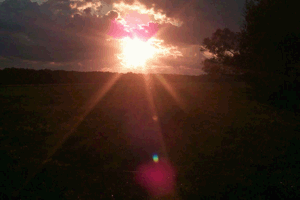
new dawn rises upon us – a golden day ripe with the promise of
adventure, of magic, and of wealth ... but most of all, filled
simply with promise itself. It is a new dawn felt the world over and,
though its placement on the calendar may vary, the promise of
possibilities, the release from antiquated ways of being and the
celebration of transition have a universal human quality that links
throughout cultures and across the span of history. This is a
celebration akin to the symbol of the Salamander reborn in flame, and
the Phoenix emerging anew from ashes. For most Americans, however, this
perspective often fades before our first hangovers; we pop our first
Aspirin of the New Year and slowly give to the grind of old routine.
A
new dawn rises upon us – a golden day ripe with the promise of
adventure, of magic, and of wealth ... but most of all, filled
simply with promise itself. It is a new dawn felt the world over and,
though its placement on the calendar may vary, the promise of
possibilities, the release from antiquated ways of being and the
celebration of transition have a universal human quality that links
throughout cultures and across the span of history. This is a
celebration akin to the symbol of the Salamander reborn in flame, and
the Phoenix emerging anew from ashes. For most Americans, however, this
perspective often fades before our first hangovers; we pop our first
Aspirin of the New Year and slowly give to the grind of old routine.