
She also waited until I was deep in a book and would wave cat’s fur under my nose. This day when she did it, I snatched it out of her hand and threw it on the fire. It was her Sunday lace handkerchief. I had some explaining to do.
On Sundays the only books or papers we were allowed to read were Sunday papers. Mother would put the books away, but I would always find a place to read, unless Gladys saw me.
When we went to the beach, Glacton on Sea, it never seemed to be warm. We sat in the deck chairs and built sandcastles or paddled our feet in the water. We were never in bathing suits.
After leaving the Air Force, I still had to do war work and I found work without going to the Labour Exchange. It was the Army and Navy Club. The Air Force came after; this was a very old club, only the oldest and richest got into the club. You had to be voted in and if for some reason they thought you were not up to standard, like scandal, the voters would put a black ball in place of a white one. Only one black ball was needed.
It had never had women in the place but war changed all that, so I was one of the first. They only allowed you to speak when spoken to, so there was no conversation with the clients unless they spoke to you. It was interesting because all the bigwigs in the war came there. Most of their ancestors did, and foreign officers, etc., of course were guests. General Eisenhower, Field Marshall Montgomery, Winston Churchill not very often. He was needed in lots of places.
One day there was an incident with one of our waitresses named Woody (Mrs. Wood), who was a good waitress when sober (she was too old to be called up, nobody over 45). Woody used to have fun with her boyfriend by going to the pub and then when she had enough, going home she would lose him on the underground trains by mixing with the crowds that got off and then dashing to the club where we all lived, and of course her boyfriend couldn’t get past the night watchman. So Woody was often drunk on duty, but stayed within the bounds of politeness. All this changed one New Year’s dinner. Woody was to take the most important table - Admiral Pierce and guests including the King of Edjebt. All was going fine when the King was on a special diet and wanted Melba toast (toast with the crust cut taken off, and thin). Woody wasn’t listening and brought ordinary toast. When the King gave her the toast back, she threw it at him and said, “Take it or leave it.” What a commotion! The headwaiter took over the table and fired Woody right there. By the time we finished our duty, about 11:00, and went upstairs to bed, Woody was gone. The next day the housekeeper looked at the cubicle and found rows of quart beer bottles behind the dresser. The housekeeper thought they were ours. We kept hearing someone peeing in the pot but it was Woody drinking beer.
She would pick on me. The housekeeper would tell her to be quiet when she arrived in the room late and the only one awake was me, reading. She would dash into my cubicle, grab my lamp and throw it on the floor because the housekeeper said we were only young and needed our sleep. So that was the end of our association with Woody.
While I was at the club there were two men who acted like sissies. One was called “Maybell.” I liked him. The other one used makeup and wouldn’t talk to us. They were called fairies by the English and the girls “streetwalkers.” I met and waited on most of the club members and their wives. Some were nice, others stuck up. I think the headwaiter had never experienced anything like us, who treated them like ordinary people and did not bow or scrapped over them.
While I was there, one night after work Mary, Sally and I were leaving the club. It was a blackout, so no flicker of light was allowed to show. Air raid wardens marched the streets of London all night. All were older men and women who were unable to be called up for the services. They were called fire watchers or wardens. We were laughing and talking when we bumped into three servicemen who wanted to know where the Army, Navy and Air Force Dance was. We started to show them the way. So we started to pair off. As I was one of the tallest I wasn’t going to walk with the short Navy man, but one man had an Essex Scottish hat on, a balaclava with black ribbons dangling down the back and black, red and white tiny squares on the edges turned up. So I wangled my way to walk beside him. His name was Ernie Martin.
So we all paired off and were supposed to show them the way. We tried to but ended up in a milk-bat (ice cream store). There we sat and talked and then they walked home where each of us lived. After that he asked me out for the next day. I found out that he was in the Essex Scottish Regiment, from Windsor, Ontario, Canada. Then we asked about birthdays and found we were both born June 27th, but he was six years older than me. We went together for eighteen months. The banns were called in St. Gabriel’s Anglican church for three Sundays. That is, letting everyone know we were getting married in my church in North Lopham and St. Gabriel’s in London to see if anyone had just come to know if we were already married.
Ernie came down on weekends when he could. When he was in the Essex Scottish, he was working on the Bren Gun. Then as he stayed about two or more years in England down by the south coast and Aldershatt, which was the starting place of departure of all Canadian soldiers, he applied to learn cooking. His mother said Ernie always loved to cook when he was home. So he went to cooking school and left the Essex Scottish and went to 24 Transport Company after he got his papers for cooking, and cooked for the Transport Company. He was disappointed because he wanted to stay with his own Windsor regiment, the Essex Scottish. It was one of the finest regiments - several Victoria Crosses were given out during the war for exceptional bravery.
Grocery was hard in England during the war. We got one egg a month, two ounces of butter a week and four ounces of margarine a week. Twenty clothing coupons a year. That included stocking coats, which practically took the works. Ernie brought, to my room in London, a cooked chicken. The only place I could keep it before I ate was under the bed.
After eighteen months we decided to get married. I had already been engaged for a year. Ernie’s mother sent me a parcel. A pink dress and several pairs of stockings; also some tea bags. I had never seen tea bags before, so I didn’t know what you did with them. I tore the tea bags open and put the tea in the pot. We never had tea bags in England, only loose tea in half-pound packages.
One of the things I had to do to get married was a V.D. test. I didn’t know what it was. I also did not know anything about how babies were born, or how it happened. Living in London, even the doctor couldn’t believe it.
We tried to get married on our shared birthday, June 27, but it was on a Sunday and churches don’t do weddings on Sundays, so we got married June 19th, 1943. It was a small wedding, only the best man, one of my girlfriends, and my mother, who I was ordered to see home after our wedding. Which we didn’t - my friends said they would take her home but she didn’t arrive home until the next day. My stepfather must have been steaming as I didn’t do as I was told.
We weren’t going to have a honeymoon but one of Ernie’s friends had a cottage down on the south coast called Bogner Regis. It was a small cottage with only single beds in each bedroom. It was right on the ocean, which had barbed wire all around the coastline. Rolls of it. It covered all the sand coastline to the sea. We stayed there for two days. It was a very short and quiet honeymoon and then Ernie went back to his regiment. He came to London about two weeks after and then I did not hear from him for quite a while. I had some mail on Christmas Day and found out he was in Italy. He wasn’t allowed to see me or write before they left.
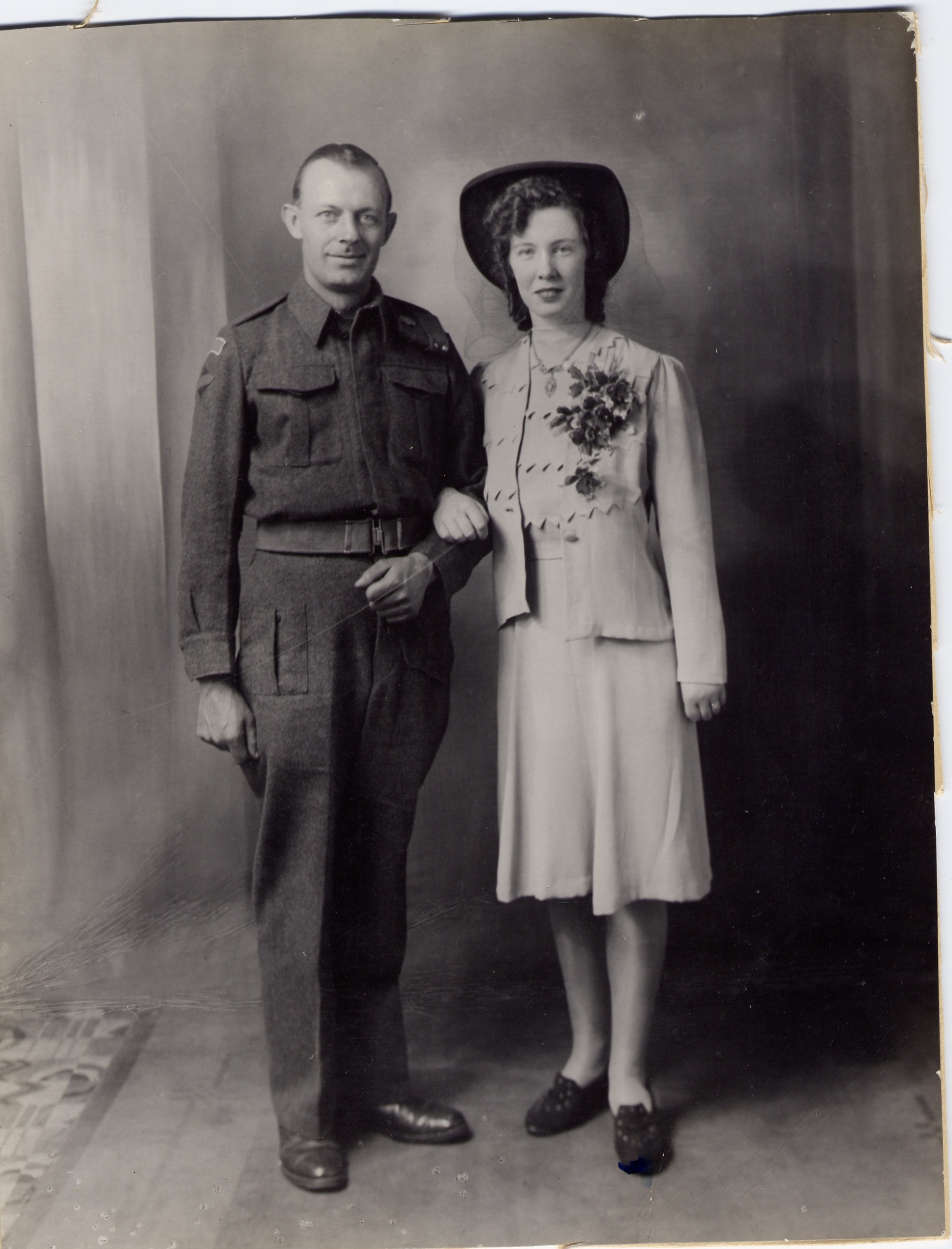
Ernie and Dorothy Martin, on their wedding day
