
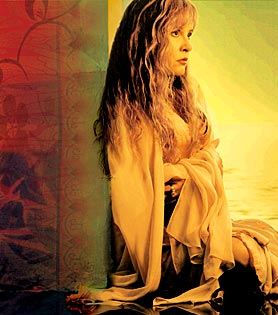
Stevie Nicks
 Gold Dust Woman Returns

Rock's fairy godmother hooks
up with Sheryl, gets
compliments from Lindsey, and invites us into her Shangri-La.

 Stevie
Nicks has always considered herself a songwriter first, performer second, but
try telling that to the acolytes who flock to New York's
"Night
of 1000 Stevies"
to honor the
woman, her wondrous voice, and last but definitely not least, her wardrobe. One
of the most charismatic figures of rock 'n' roll, Nicks has enchanted audiences
for more than 25 years with her unique ability to convey both power and
vulnerability. As a solo artist and as part of Fleetwood Mac, she writes songs
that elevate the feminine to a sacred place without alienating the male
contingent; everyone feels honored to share her secrets and spells. In the words
of friend and collaborator Sheryl Crow, Nicks is "the woman men want to be
with and women want to be." Listening to Fleetwood Mac's Rumours at
the age of 11, I too was enchanted by her silvery tones and languid phrasing,
and spent hours poring over the photos of this tousled blond beauty in flowing
chiffon and platform boots. She was, quite simply, the coolest chick I'd ever
seen.
Stevie
Nicks has always considered herself a songwriter first, performer second, but
try telling that to the acolytes who flock to New York's
"Night
of 1000 Stevies"
to honor the
woman, her wondrous voice, and last but definitely not least, her wardrobe. One
of the most charismatic figures of rock 'n' roll, Nicks has enchanted audiences
for more than 25 years with her unique ability to convey both power and
vulnerability. As a solo artist and as part of Fleetwood Mac, she writes songs
that elevate the feminine to a sacred place without alienating the male
contingent; everyone feels honored to share her secrets and spells. In the words
of friend and collaborator Sheryl Crow, Nicks is "the woman men want to be
with and women want to be." Listening to Fleetwood Mac's Rumours at
the age of 11, I too was enchanted by her silvery tones and languid phrasing,
and spent hours poring over the photos of this tousled blond beauty in flowing
chiffon and platform boots. She was, quite simply, the coolest chick I'd ever
seen.
Now 52, Nicks is as vital an artist as ever, and her recent collaborations with
Sheryl Crow, Macy Gray, Sarah McLachlan, and Natalie Maines are a testament to
her continued cool. Trouble in Shangri-La, Nicks' first solo record since
1994's Street Angel, represents a huge leap for the singer. A concept
record that asks the question "what is paradise?" Shangri-La
features songs from as far back as 1970, as recent as this year. From the title
track to the driving "Sorcerer," Nicks has added a bluesy depth to her
vocal repertoire. The five songs produced by Sheryl Crow introduce looped drums
and a light country twang. The record also includes a guest appearance from
Nicks' former lover, bandmate, and sometime-nemesis Lindsey Buckingham, which is
a good sign for all the Fleetwood Mac fans who've been wondering about a
reunion.
Speaking to VH1.com from
her California home, Nicks discusses the process behind what is easily one of her best solo albums, her determination to overcome
stage fright, and the creative bond she still shares with her Fleetwood Mac
cohorts.
behind what is easily one of her best solo albums, her determination to overcome
stage fright, and the creative bond she still shares with her Fleetwood Mac
cohorts.
VH1.com:
The new record is great, congratulations. Billboard said you're in your
finest musical form since Bella Donna.
Stevie Nicks: Really? Well, I am actually in my
finest form since Bella Donna. Bella Donna was made up of all the
songs that didn't go on the Fleetwood Mac records between 1975 and 1980 - which
was many - because when you're in a group with three writers you only get
two or three songs per album. It's the same with Trouble in Shangri-La: I
started writing these songs in 1995 right after the big earthquake in California
[in 1994]. And the other three were from the mid-'70s.
In
your bio you mention that you needed to replenish the creative well - go out and
live your life for a while to get some new ideas.
After the earthquake, in 1995 I went to Phoenix, and I never thought it was
gonna take five years [to make an album]. So what happened is exactly what you
said: In order to write the nine new songs on this record I had to really live.
I can't just make up songs, I can't just make up poetry. I don't write a poem
unless something catches my eye and I go home very inspired or I meet somebody
that really impresses me in some way. I would love to have written these songs
during the first year and put this record out and be on to my second record by
now, but I couldn't. I wrote "Love Is" at the end of 1995 and I wrote
"Trouble in Shangri-La" at the end of 1996, so it took one year to
write those two songs. And I had to fit the three old songs and the new songs
that I would come to write in between those two, because I wanted to stick to
the concept of "trouble in Shangri-La."
 How
do you define Shangri-La? Was that your time with Fleetwood Mac?
How
do you define Shangri-La? Was that your time with Fleetwood Mac?
Pretty much, yeah. You know, if you live in a huge house and have a fabulous car
and lots of money for 20 or 30 years, pretty soon paradise becomes your world.
And it's nothing special. And that's the saddest part of all. I think you must
always have trouble in Shangri-La to keep yourself from becoming complacent. If
you stop searching you'll get lost. Once you've attained paradise, people say,
"Well, you don't have to write any more songs. You've got lots of
money." It's like, but does that mean I'm finished? So you can never feel
that your work is done. You can never say, "That was the best song I ever
wrote," because hopefully you'll write an even better song.
Did
you do a lot of reckoning with the past while making this record?
I had just done the Fleetwood Mac reunion, which I loved, and then I did my Enchanted
box set. With Trouble in Shangri-La, I really felt that I was making a
step away from the past. The box set really was all about the past, and the
Fleetwood Mac reunion was all about the Rumours songs. I really felt a
necessity to go into the future. Because when you're in a great old band that
still exists, you can always live on that ... you can always be that. Or you can
go ahead and do your own thing along with doing that.
It
seems like you've really embraced the role of rock 'n' roll matriarch, inspiring
and collaborating with a younger generation of female artists.
It's awesome for me, it really is.
There's
some very interesting production on the record, and you delve into country and
reggae a little bit as well. Were a lot of your new sounds inspired by working
with Sheryl Crow and Macy Gray and Sarah McLachlan?
Actually, for the five songs I did with Sheryl Crow [as producer] we used her
people. And so yes, she was very responsible for the instrumentation of those
songs. "Candlebright" was written in 1970; it was one of the demos
Lindsey and I moved to L.A. with, and so I have an incredible demo of just me
and Lindsey. And it's exactly like what's on the record except that it's me and
Sheryl! Singing with Sheryl is very much like singing with Lindsey: She's a real
great duet singer and so we had a great jumping-off point from the beginning. I went in, it was her band and a couple of extra people that she
brought in for different sounds - violins, Chamberlin, all her little visions. I
pretty much let her run with it. I said, "Here's the demo, now you put your
magic on it. All you have to do is make it so that we both think it's better
than the demo." And we did.
beginning. I went in, it was her band and a couple of extra people that she
brought in for different sounds - violins, Chamberlin, all her little visions. I
pretty much let her run with it. I said, "Here's the demo, now you put your
magic on it. All you have to do is make it so that we both think it's better
than the demo." And we did.
How
did it feel to have Sheryl Crow write "It's Only Love" for you and
about you?
Well, she came up the stairs carrying her guitar and she just sat down and
played it for me. And she told me, "I went home and I just was really
thinking about all your stories and all the stuff you've been through" -
because now that we've been friends for four years I've just about told her all
the great stories, she knows them all - and that's really what she wrote the
song about, all my different relationships and the men that I was with and the
men that I'm still good friends with and really care about. They're all still
out there and around me, and she finds that pretty amazing. I think that's what
inspired her to write the song - you know, "sometimes lonely is not only a
face that I have known." And she sees my life: I am not married, I don't
have children, and I made that choice. I knew if I had children I would have to
take care of them and I couldn't hand them over to a bunch of nannies. So I knew
if I had a baby I would stop making music and I would start being a mom. And I
decided in my life, that my mission was to make people happy. It was more
important. I only just got a dog two years ago, and trained her myself. And
that's the motherliest thing I've ever done.
 How
did the Natalie Maines duet, "Too Far From Texas," come about?
How
did the Natalie Maines duet, "Too Far From Texas," come about?
That was a song that a friend of mine sent me a couple years ago, and when I
first heard the Dixie Chicks I marked it in my brain that this was a song that I
could probably sing with this girl Natalie Maines. I didn't know her; I wrote it
in my journal, turned the page down, put a little star by it, and never thought
about it again. In the studio I told Sheryl about it and that thought it would
be incredible [to cut it] with the girl from the Dixie Chicks. We recorded it
live.
Do
you have a personal favorite song?
My personal favorite is "Bombay Sapphire." When it says, "I can
see past you to the white sand," that sentence right there is the whole
reason for "Bombay Sapphire." It means that I'm really trying to get
over something, and though I'm freaked out about it I'm looking to the green
ocean and can see past all of these problems to the incredibly beautiful white
sand and the ocean beyond it. I'm gonna be OK because I am movin' past you.
And when "Bombay Sapphire" almost got pulled off the record because it
wasn't recorded right, I was horrified that one line was not gonna be on the
record. It's really important for me to tell people that if they're in an
unhappy situation they should not stay forever and be miserable.
How
was it producing the song yourself and singing with Macy Gray?
It was easy, because it was exactly what I wanted to do. It was done in one
night. I really did have a vision for that song, and [on earlier attempts to
record it] nobody else saw my vision. The first time it was too R&B, the
second time it was too Wagner, dirge-like. The third time it was back to its
little funky reggae self. I'm managed by the same people who manage Macy, and in
the spur of the moment I just said, "You know, I bet Macy could sing the
high part on that chorus." Two days later she was in the studio. So none of
this was very thought out. It was all perfect accidents.
You
used seven producers on this record. Was it your intention to work with so many people?
Well, I couldn't really find one producer who could do the whole record. The
whole idea of the concept record is pretty much gone, and I really wanted to
keep my concept going even though there were different producers. When I
recorded, say, "Fall From Grace" with John Shanks, Sheryl Crow was
there that night at the studio. So it was like, all the producers kind of
blended a little bit and became friends because they all really cared about this
record and they all really wanted it to be great. I told Chris Lord-Alge, who
mixed it, "You have to be the master seamstress here, because I don't want
the mood to be changed." So he really worked hard on that.
Sheryl
Crow has said, "There's always a male producer who wants to make [Stevie]
into something that is maybe not as intimate as what she sees her music as
being."
Sometimes people want to change things just for the sake of change. Not because
they need changing. That's a problem that I have. It's like, we're all in the
studio rockin' out, everybody loving the track, and then [after a break] I come
back in and the drumbeat has been changed. What is that? You have to be very
tough with these producers or it will be their record. I decided that there was
not gonna be a song on this record that I did not love. There were two that
didn't come out right; I pulled them and gave them to Lindsey. We're gonna put 'em
on a Fleetwood Mac record, probably next year.
Could
you talk a little about that?
Sure. Lindsey and Mick were here two weeks ago. I went back through the song
vaults and I pulled 17 songs from a hundred years ago all the way up to now. We
listened to Shangri-La, and we listened to the 17 demos, and Lindsey was
knocked out. He really hadn't heard all these songs; I guess I just never really
played them for him. He had no idea that I was going to present him with 17
songs; he thought maybe we were gonna work on a song. So he called me the
next day and said, "I'm driving up the coast and I'm taking notes and I'm
very happy with all these songs." So that's about the nicest thing he ever
said to me, really. "I'm very happy with all this music" was like,
"Oh my God, I can't believe he said that!"
So you know, I will follow my Trouble in Shangri-La through as long as it
goes, and Lindsey and Mick will work on [the new Fleetwood Mac songs] when I'm
gone and I'll come back and we'll go in the studio and polish it all up. And
hopefully a Fleetwood Mac album should be out by the end of next summer. It's
very easy to sit down and plan this all out because you never know what's gonna
happen. But in the perfect plan that's what I would like.
 What
about the song "Sorcerer"? Although it was written many years ago it
feels like it comes from the perspective of a wise woman.
What
about the song "Sorcerer"? Although it was written many years ago it
feels like it comes from the perspective of a wise woman.
"Sorcerer" was written in 1974, a year before we joined Fleetwood Mac.
It was really about the city of Hollywood and how strange it was to us. It was
all about models and rock 'n' roll and drugs and scary people. I was a very,
very prudish little girl from San Francisco who had strict parents, I had not
had a lot of freedom, and coming into this town was freaky. "All around the
black ink darkness, and who found the lady from the mountains." The lady
from the mountains was me. I did a [nude] photo session for the Buckingham
Nicks album and I was horrified about that cover. I did not want to do that
and I was really made to feel like, "Don't be a child, don't be a baby,
this is art, this is your future." And I did do it and I never forgot that.
It was the one time in my life that I did something that I felt was not morally
right for me to do.
Do
you think it was inevitable that you and Lindsey would make up or did it involve
a lot of work and effort on both your parts?
It involved a lot of work and effort on both of our parts. And now we are good.
We are actually friends. He has two children, a little girl and a little boy.
Needless to say, going from a selfish rock 'n' roll god to having two babies,
it's very much changed his life. He can't be selfish anymore. And he is thrilled
with these little kids; they are precious. He never thought he was gonna have
children, so he is surprised every day. He is a much softer, sweeter man and I
love that, because I knew that softer man a long time ago. So I'm seeing my old
friend back again.
Christine
McVie is not going to be part of this reunion?
She can't do it. She has moved back to England and she is really happy. Chris is
57, she has the rest of her life to live, and she doesn't want to do this
anymore. There's really nothing that can be said to her to make her change her
mind. She wants her life to be in England and she wants to be with her family
and all her friends. She sold her house, her car, and her piano and went to
England three years ago. And I haven't seen her since! And it's OK because I
understand that she really cannot do this. So I'm not gonna ever ask her again. And she wants us to play. Just because she's not there, she didn't die. She's
living a fabulous life. She has a castle with 20 acres of gardens, she has an
apartment in London, she knows everybody. And if you went over there and saw her
life you'd say, "OK, I understand." It's very lonely on the road. It's
especially lonely for the girls. As Christine has said to me many times,
"Stevie, this is your passion. It is not my passion."
And she wants us to play. Just because she's not there, she didn't die. She's
living a fabulous life. She has a castle with 20 acres of gardens, she has an
apartment in London, she knows everybody. And if you went over there and saw her
life you'd say, "OK, I understand." It's very lonely on the road. It's
especially lonely for the girls. As Christine has said to me many times,
"Stevie, this is your passion. It is not my passion."
Do
you think you'll always feel like a gypsy or do you find yourself being more
inclined to stay in one place?
I don't think the gypsy part will ever go away. When I was little we moved every
two years, so that kind of nomadic life is just what I was used to. I have a
house in Phoenix, I rent a house here in Los Angeles, and I go to a hotel
sometimes just because I like to move. I don't think that part of me will ever
change. If I'm in a bad mood I'll get up and go somewhere, because I can always
get out of that if I just change my environment. So where other people would
turn to a really strong, straight glass of vodka, I get in the car and go
somewhere.
Are
you looking forward to going out on the road this summer?
Right now I'm very nervous about the experience, because I get very bad stage
fright. I get terrible butterflies and it's not pleasant. It has always happened
to me. Once I walk out onstage it's fine; all the nerves go away. But the six
hours leading up to the shows are very hard for me.
And
that's consistent throughout the tour?
That's consistent since the fourth grade; that's consistent since the first time
I twirled my baton in a talent show. My mother reminds me of this: "This is
not new, Stevie. This has been happening since you were in the fourth grade and
did your first performance in front of people. You were sick all day; you were
sweating."
 So
what's the impetus to keep getting back on the stage?
So
what's the impetus to keep getting back on the stage?
Because luckily my stage fright stops when the lights go up. I don't exactly
know this for sure, but I think that Barbra Streisand is someone who is terribly
nervous all day long and then it doesn't go away when she walks out onstage.
Mine goes away. So I'm really lucky, because then, in fact, my two hours onstage
is when I'm the happiest in the whole world.
Who's
in your touring band?
I don't really know yet, because I'm getting ready to do a showcase and some TV
with one band, but I'm going to lose the drummer and the guitar player. Which is
another nerve-racking thing. Because when you're putting together a band you
have to put it together so far before the actual thing that happens. It's very
difficult to say all of a sudden, "I'm going on tour and I know you guys
have just been sitting around for the last 10 years waiting for me to call
you!" But it'll be great. I might even do some auditions for a couple
people.
Do
you think going out on your own as a solo artist will make for a better upcoming
experience with Fleetwood Mac?
I think that my cohort in crime Lindsey Buckingham thinks that my album is
really good, or so he told me. He told me that this is the best thing that I
have ever done, and he said it with a look on his face that I believed him. I
think that he has a little more respect for me now, and I think that when we
start working next year it will be better. You see, he was so angry with me for
leaving him that he hated me and lost all respect for me, and that made it very
hard to work on my songs. He's beyond that now. And I think the fact that Chris
won't be there is very interesting, too. It'll be just Lindsey and me singing
again, so that really goes back full circle to where we started in San
Francisco.
When
you guys get together, is there just a palpable chemistry and creative flow? Is
it still there?
Yes. I mean, how else could we possibly listen to 12 songs from Trouble in Shangri-La and 17 demos?! You know, Mick walks into the room and I still
look up. He's awesome. And I love being in an awesome band. I will always love
the fact that I am in Fleetwood Mac. And the chemistry will always be there. I
think when we're all in rocking chairs it will be there. Which is really nice to
know. It's nice to know that something lasts.
Shangri-La and 17 demos?! You know, Mick walks into the room and I still
look up. He's awesome. And I love being in an awesome band. I will always love
the fact that I am in Fleetwood Mac. And the chemistry will always be there. I
think when we're all in rocking chairs it will be there. Which is really nice to
know. It's nice to know that something lasts.
Back to the Fireflies
Homepage
