



 Legend and Tradition
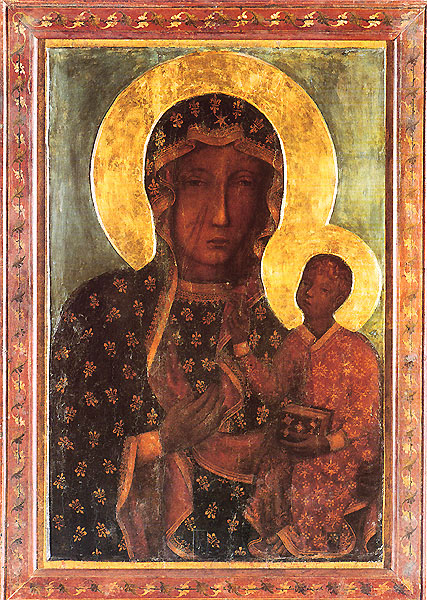
The Icon of Our Lady of Czestochowa is venerated, as it has been for centuries, in the Lady Chapel of the Basilica of the Nativity of the Virgin Mary which crowns the hilltop known as Jasna Gora in the city of Czestochowa, Poland. The haunting, mystifying beauty of the Holy Virgin, captured on the Icon, has transfixed countless pilgrims who have knelt in homage before her whom the Polish people have declared, Queen of Poland.
But what is the origin of this Sacred Image? Prior to the year 1382 the Icon is shrouded in mystery, legend and tradition.
Legend has it that St. Luke the Evangelist was the artist; that in the year 326 St. Helena, the mother of Emperor Constantine, found the Icon in Jerusalem and brought it to Constantinople where it remained for centuries.
It is believed that the Icon was passed among the royal houses of eastern Europe until the fourteenth century. It is at the castle of Belz, (Russia), in 1382, that legend ends and historical fact begins.
Recorded History
In the year 1382, Prince Ladislaus of Opole found the Sacred Icon of the Virgin at the castle of Belz during the war with the Ruthens. He then took the Icon to Poland, to the town of Czestochowa, whereupon the Prince invited monks of the Order of St. Paul the First Hermit to come from Hungary to Poland and entrusted the Icon into their care.
A small wooden chapel was constructed and devotion to the Virgin of Czestochowa took root in Poland.
In 1430, the Icon was damaged when theives broke into the chapel. Loading their stolen goods into a horse-drawn cart they were bewildered when the horse refused to move. Thinking that the cart might be overloaded and thus too heavy, the theives began to unload the cart. To their amazement they discovered that only when the Icon of the Virgin was removed from the cart, was the horse able to move.
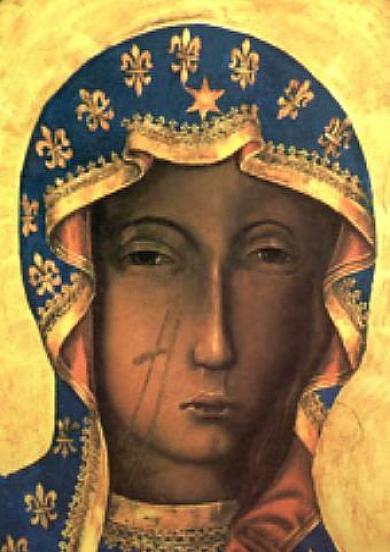 In anger, one of the theives hurled the Icon to the ground whereupon it broke into three pieces. Drawing his sword he slashed twice at the face of the Virgin. Raising his hand to strike a third blow, the thief fell to the ground, dead. Horrified, his companions fled the scene of their crime and sacrilege.
A third, smaller scar was made when the Icon was pierced by an arrow.
All attempts to repair the damage to the face of the Virgin Mary has proven to be unsuccessful. Could this be taken as a heavenly sign?
In 1655, the Swedish armies swept over Poland. The Swedes, encroaching upon the fortified walls of Jasna Gora, were confronted by the Pauline monks, led by their Prior. An apparition of the Virgin of Czestochowa appeared overhead. Rallied by this the Polish army drove the Swedes back.
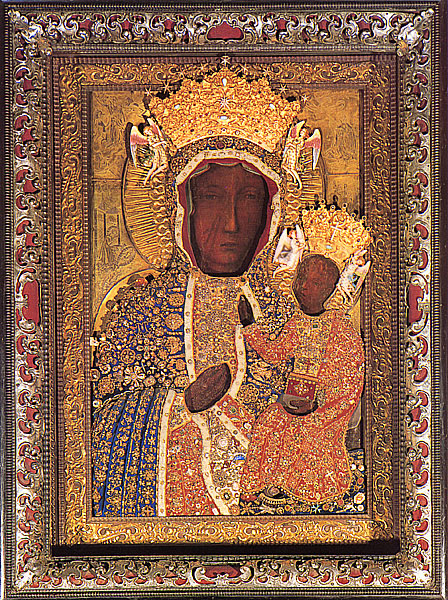 In 1656, King John Casimir proclaimed the Mother of God of Czestochowa, Queen of Poland, and vowed to spread devotion to her throughout his realm.
In 1717 the Sacred Icon was solemnly crowned.
During the pontificate of Pope St. Pius X, the sanctuary of Czestochowa was vandalized once more. The crowns which rested upon the heads of the Virgin and her Divine Infant, as well as a priceless dress of pearls which covered the Icon, were stolen.
When Pope St. Pius X heard of this sacrilege he had two new crowns of gold, embedded with precious gems made. The Holy Icon was crowned anew in 1910.
A third coronation took place in 1966. On this occassion the women of Poland presented a dress, and the men made a gift of a crown to pay homage to their sovereign Queen.
During a visit to Poland in 1976, Archbishop Joseph L. Bernadin, the president of the United States National Conference of Catholic Bishops, solemnly entrusted the United States of America to the Virgin of Czestochowa.
As in the past, so too today, the heavenly Queen of Jasna Gora continues to draw countless pilgims to her shrine wherein she leads them to her Divine Son.
Source: