
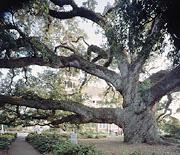
 Live Oak |
Let |
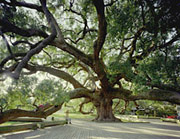 Live Oak |

Let
A-1
United Tree Experts ®
as an authorized Dealer for the
Nationwide but Florida Based
TreeTech
Company®
treat your trees for healthier beautiful
Central Florida landscape
 One thing we can't control is
nature
One thing we can't control is
nature
But we will be there for you
to help save the tree or take it down
if damaged beyond repair
We will assist you filling out the proper forms
for the Insurance companies
 |
 |
 |
|---|---|---|
 |
 |
 |
 |
 |
 |
 |
 |
 |
 |
 |
 |
 |
 |
 |
 |
 |
 |
 |
 |
 |
Tree Health Care for the 21st Century and Beyond! |
||
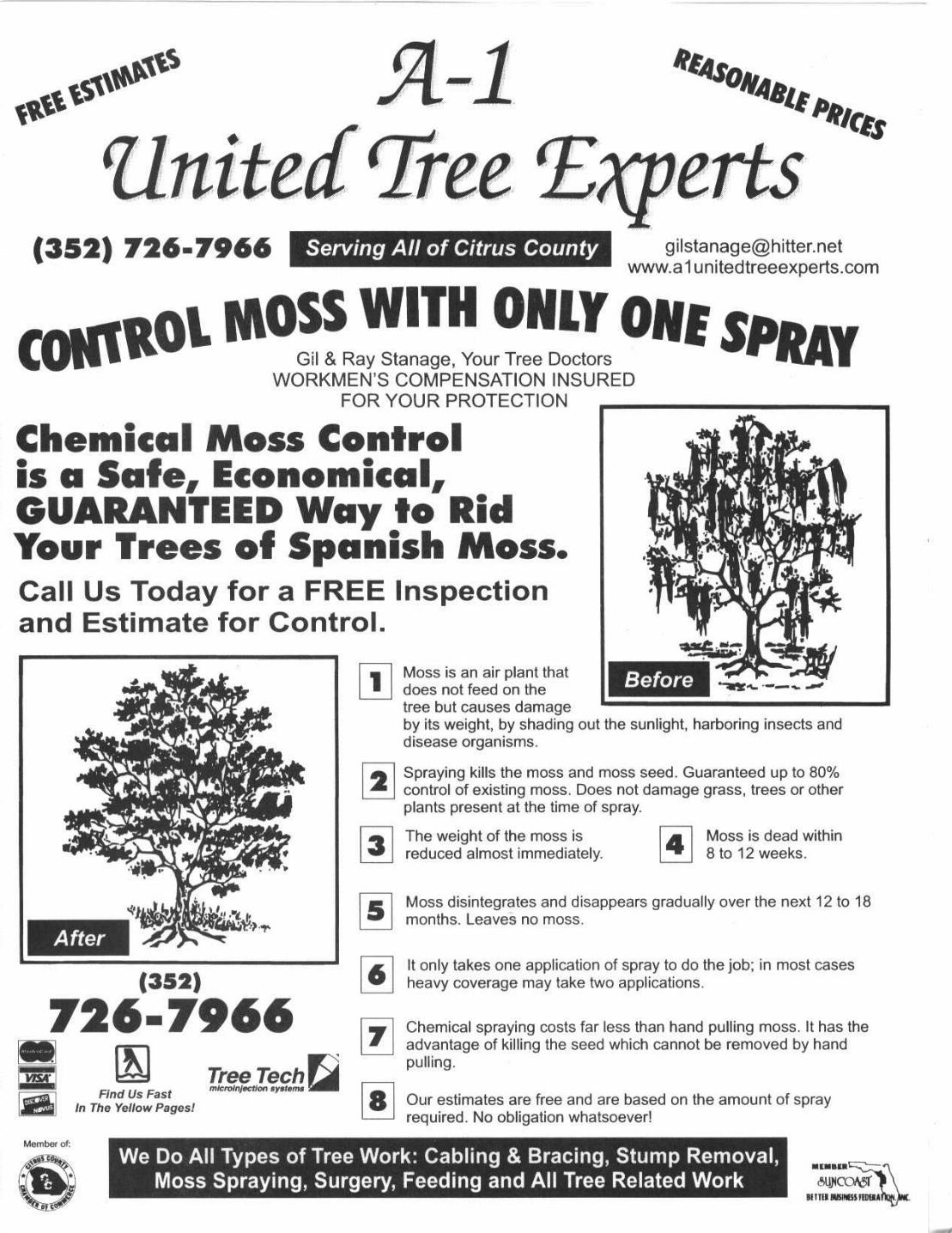
Chemical Control of Moss on Trees and Shrubs
Chemical control of mosses on
trees and shrubs is not commonly attempted by the average homeowner because
these products are fairly toxic and require use of special protective equipment
when handling them. You may want to hire a professional if you desire to remove
mosses from trees and shrubs using chemicals.
Control of mosses is generally achieved using either copper sulfate or lime
sulfur. Professional tree care companies and the Oregon State Extension Service
recommend these chemicals as effective treatments. Chemicals are sprayed on the
mosses during the winter dormancy period. They can damage leaves if applied
during active growth and can also damage evergreen leaves and needles. They are
corrosive, so care must be taken to keep them from drifting onto painted or
metal surfaces. These chemicals should only be used according to the label and
should only be used on plants that are listed on the label (Davison and Byther,
1999).
Copper Sulfate
Copper sulfate is often used as a fungicide or algaecide, but it can also work
to control mosses if used during the dormant period when the plant is not
growing. It is available as a dust, wettable powder and fluid concentration. It
is used primarily by farmers and may not be available at all stores. Tri- Basic
copper sulfate and Bordeaux (copper sulfate formulated with lime) are
formulations that have been used to control mosses on trees and shrubs. There
are a lot of products available and you should consult labels before attempting
to use any of them. A sprayer is generally used to apply copper sulfate on to
trees.
Effectiveness
Copper sulfate is effective at killing mosses when used properly. It works by
disrupting photosynthesis. It will also damage plants, especially if they are
in active growth. You will have to continue applying it every few years if you
don't improve cultural conditions like sunlight and air circulation because the
mosses will return. The dead mosses will also persist after spraying for a
while before they weather and fall off the branches.
Side Effects
Copper sulfate is a moderately toxic product and care should be taken when
handling this pesticide. Poisoning and even death has been attributed to
ingestion of copper sulfate (EXTOXNET web
site). Protective equipment including long sleeve clothes, mask and safety
glasses should be used (Meister, 1996).
Chronic effects that have been documented include liver disease and anemia due
to long term exposure to applicators over several years. Refer to
EXTOXNET web
site for more details. This product can also be harmful to wildlife, especially
aquatic organisms like fish. Copper sulfate should not be used near creeks or
bodies of water.
Lime sulfur
Lime sulfur is used as a fungicide but is also effective in controlling mosses
when used during the winter months that mosses are actively growing and the
trees or shrubs are dormant. It is used primarily by farmers and may not be
available at all stores. You should consult labels before attempting to use it.
You will use a sprayer to apply it to trees. It smells like rotten eggs.
Effectiveness
Lime sulfur is effective for controlling mosses on trees and shrubs. You
will need to reapply it every few years if you do not address the causes of
moss growth.
Side-Effects
This product is very toxic. It can cause permanent damage to the eyes.
Protective equipment including a respirator, safety glasses and long sleeve
clothes should be worn (Meister, 1996).
This product is corrosive and will cause damage to painted surfaces. There is
less information available on the effects to wildlife. This product is also
used as an insecticide and may harm beneficial insects like honeybees. It
persists on the plant for a while by leaving a sulfur residue after it dries.
This will wash off after winter rains.
Physical Moss Control for Lawns
The best way to effectively and
permanently control moss in the lawn and garden is to correct the conditions
that are favoring moss growth. Moss grows better than most types of grass
in areas with heavy shade, poor drainage, and compact soils (Douglas, 2000).
Physically controlling mosses is often used along with chemical control to increase the chance of completely eliminating mosses from the lawn and garden. Physical control methods can also be used as an effective, chemical-free alternative to chemical control. Most physical control methods are inexpensive and take only a short amount of time to implement.
Furthermore, physical control is more likely than chemicals to remove moss permanently because it targets the cause of moss growth (Scott and McCarty, 2000). However, there are also some negative side effects to some physical control methods. Removing trees to reduce shading and using a power-driven core aerator can be dangerous. Other physical control methods, such as installing subsurface water drains can be expensive and time consuming.
Spanish Moss is a beautiful, lacy, romantic symbol ofthe South. It grows in humid coastal areas of the Southeastern United States. You will find it mainly in Louisiana, Mississippi, Alabama, Georgia, the Carolinas and Florida. It is very dense in bogs and swamps, and is usually seen along rivers and bayous and in Coastal areas where I live.

| |
It is neither a moss nor a parasite; rather, it is a tropical, epiphytic herb which grows on another plant upon which it depends for mechanical support but not for nutrients. An epiphyte, or air plant, has no roots. Having through evolution broken all connection from the earth, it is self-sustaining in its manufacture of food and absorption of nutrients from aerial roots. It just uses trees as its substratum on which to grow.
It belongs to the pineapple family, Bromeliaceae. It is also called greybeard (because it looks like an old man's beard), or Tillandsia, or Florida Moss.

| |
The Spanish Moss's slender, threadlike leaves are connected to tiny strands of black, hairlike fibers that form the core of this plant. The leaves as well as the black core are covered with silvery grey scales.
Believe it or not, Spanish Moss belongs to the group of "flowering plants". Its individual stems bear leaves with tiny, inconspicuous flowers that are yellowish-brown with long narrow sepals and petals that are no more than 1/4" long are are easily overlooked.
The moss turns greenish silver after a lot of rain, and is grayish-silver at other times. It is able to absorb moisture from dew, mist, fog, or rain. It hangs from tree branches (especially Live Oak and cypress trees) in strands up to 20 feet long.
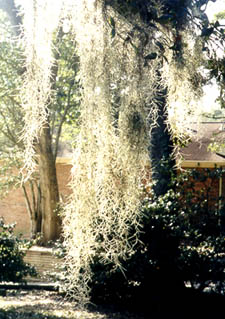
It's apparent lack of leaves and flowers is responsible for its popular misconception as a moss.

| |
As an air plant, it depends upon nutrients that are carried by the wind and rain. The green parts of the plant produce simple foods (sugars) by photosynthesis.
Spanish Moss is now used mostly in decorating and flower arranging, although it used to be used in furniture upholstering and for stuffing mattresses.

| |
All of my life I
have been fascinated by Spanish Moss. As a child I
lived 35 miles form Natchez, a charming Southern town located on a high bank
overlooking the Mississippi River and known for its stately antibellum homes
and trees dripping with the mysterious moss. I used to pick a strand off trees
and bring them home to put on a tree in our backyard. It always died because we
lived too far away from the moisture of the River. Now that I live on the Gulf
Coast,I am privileged to have it growing in my own yard which overlooks the
. It gracefully hangs from the
branches of the large Live Oak tree in our front yard. I never grow tired of
its beauty and charm.

For visiting our site
| Home |
Copyright © 1965-2002 Ray Stanage and
Gil Stanage.
All rights reserved.
If you have question about the site Address the Webmater at ...
Webmaster
@true.com
