

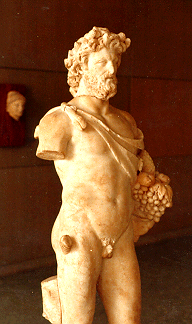
Silvanus was the Roman god of the woods and uninhabited spaces. Apparently the Romans were afraid of him and he was said to have conncections with corpses and other things of the night. His sacred animal was the stag. Here we see a link that later developed in Gaul with the god Cernunnos. Silvanus, like Osain, avoided civilized areas and was only to be found in the wild and uninhabited regions. There is not much historical data with regard to his worship and he was considered a minor god. This is quite different from Osain who was considered from the very beginning as an Orisha of great importance. Perhaps this due to the fact that with their emphasis on the Major gods and goddesses, that were really imported from Greece and given Roman names, the Romans lost contact with the earlier gods of the Etruscans that were native to the area. Also, with the advent of Greek medicine and the use of new ways of healing, the old dependence on herbal remedies seems to have faded in importance among the Romans. Silvanus seems to be a representation of a force or energy that the Romans did not understand and which inspired fear among them. In the picture above, one notices that an arm is missing, but this is due to time. Silvanus appears to have been normal in appearance, unlike Osain. Osain had only one leg, the right one and only one arm, the left one. Osain only had one eye. This apparently was caused by a war that was going on with Osain and Orunla. Osain, for some unknown reason was doing witchcraft to Orunla and complicating his life. Finally, Orunla, discovered who the enemy was and enlisted the help of Chango to resolve the problem. Chango, in a battle, threw thunderbolts at Osain, striking him in one leg, in one arm and in one eye. There are many different versions of the story of how Osain lost his body parts and this is only one of them.


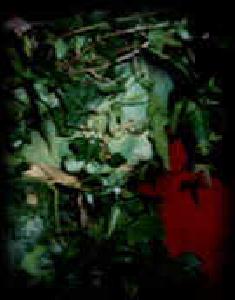
The Green Man is found all over Europe, worked into the walls and windows of cathedrals. It is said that the pagan builders of the great cathedrals placed him there as a rememberance of the old religion. He represents the masculine side of Mother Nature. The Green Man does indeed equate with our conception of Osain. More than that, at times, the Green Man IS the forest. In the early centuries, Europe was covered with vast forests, just as Western Africa was covered with the vast rainforests. It is only natural that the spirit of the forest would make itself known. There is no recorded records of any cult activity or ceremonies performed to the Green Man. He is so ancient to that part of the world, that all that has been lost in time. We consider the Green Man to be the true European expression of our African Osain. Who knows, maybe there were priest in the far past that knew his secrets and worked with him for healing and practiced magic with his name. Who can say that the Druids were not descendants of those who knew his secrets.
