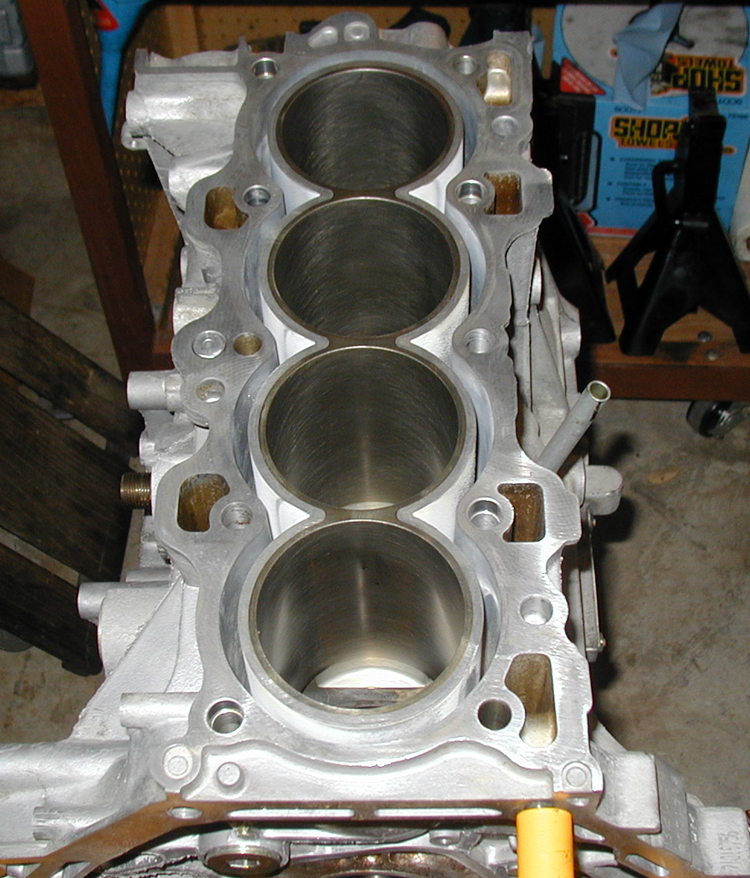
Machine Work:
Here are the Wiseco piston rings. In order from left to right. Primary compression ring, secondary compression ring, oil scraper, oil spacer, second oil scraper. These need to be gapped as follows: .012" for the primary and secondary, and .011" for the oil scrapers.
If they arent properly gapped, you will either destroy your cylinder walls, or experience "blow-by" both will cause loss of power and compression.
The gap is set by using a fine tooth file in a benchvise. You simply squeeze both ends of the ring together and run it from the outside in away from your body several times. Then you can use some fine wet sandpaper to touch up the edges and corners.
Here is what plastiguage looks like.
With rod bearing clearances, I was shooting for .0015" as perfect, but anywhere from .0017"-.0015" is acceptable. As for the Main bearing clearances I was shooting for .0015" for all but the #3 journal, on the #3 i was looking for .0016"-.0017"
It is best to start with the color code calculated by the block code and crank codes(refer to HELM). Then, if you need to adjust your clearance, start by swapping out the bearing half in the cap with the next closest size/color bearing and retain the upper bearing.
First I checked the rod bearing clearances. To do this you must support the crankshaft at both ends. I just left a few flywheel bolts in mine and used the vise to hold onto the flywheel bolts on one end, then the other end was held up with a short length of 4X4 wood.
Then you just place your new bearing halves in both sides of the rod and hold the actual rod up to the bottom of the corresponding journal and throw on a strip of plastiguage, then put the cap on the top and torque the bolts. I chose to use a permanant marker to number my rods so i know which journal they belonged to.
After you torque down the bolts at this time you loosen them about 1/8" and keep the socked on one of the bolts, while holding the rod in one hand hit the top of the socket with a swift but accurate blow from a hammer. Dont over do it, you just want to separate the rod cap from the rod. Now you can check your clearances.
Here is a closeup shot of one of the rod caps with a strip of flattened plastiguage in it. In this pic you can also see how i numbered my rods with marker to keep things organized.
Then, when i was happy with my results. I recorded the correct size for upper and lower for each rod and placed an order at the local HONDA dealer.
Next I started on checking the clearances of the 5 main journals. To do this, you simply insert the upper bearing into the block and set the crankshaft down into the block. Then set a strip of plastiguage over each journal and install the caps, then torque and check the clearances. IT IS IMPORTANT WHEN TORQUING THE MAINCAPS TO DO IT IN THE CORRECT ORDER AS PER HELM MANUAL.
Here is a blurry pic of flattened plastiguage on a main journal just to give you an idea what Im talking about.
This pic shows the difference between the main bearings. The bearing on the right with the groove is the upper and the bearing on the left that is smooth is the lower main bearing. The upper fits onto the block and the lower fits into the main cap.
Lastly it was time to polish the crankshaft. This is done by obtaining 2 different grit wet sandpapers. I chose to use 800grit and 1500grit. You just cut a strip 800grit of appropriate size to fit around the journal, then use a little WD-40 as you lube, instead of water and wrap a shoe string around the journal 2 full times. Then you just pull on the shoe string from side to side to get the sandpaper to spin on the journal. Dont get carried away, with a motor this new, it doesnt take much. Then, clean the journal off and repeat the process with the 1500grit until it is nice and shiny.
Here is a pic of the crank polishing.
Here is a pic of the polished crank, you can see yourself in that thing. The reasons for micro-polishing....less friction between crank journal and bearing. Less friction, less parsitic loss= more power, and possibly a longer service life.
Well, time for final assembly.
|