

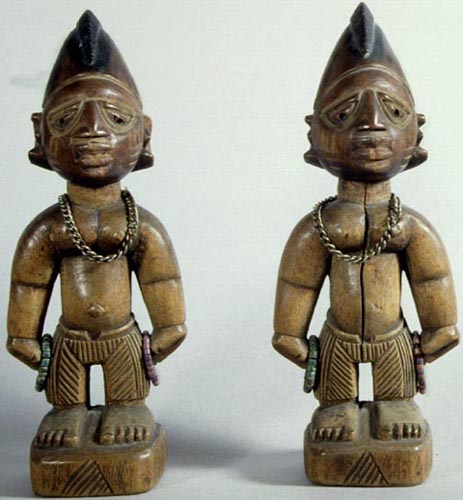
Melli is another name for the Ibeji. It is pronounced MAY-yee for the English speaker. In Africa, wooden statues are made and consecrated to represent both the Orisha Ibeji and also for twins. If one twin dies, the other must attend his spirit for life. Everytime the surviving twin eats, he must leave a share of the food for the departed twin. This is because in African, the spirit of a departed twin is much feared and these steps are taken to keep the spirit of the departed twin happy so that he or she will not wreak havoc on the surviving twin or the rest of the family. Twins are viewed as being two parts of a whole. That is why parents of twins try to treat them equally, never doing for one and not the other. When one receives the Melli or the Ibeji in the Santeria tradition, one receives small ceramic urns that contain the shells and stones of the Orisha, but also twin dolls are prepared in the ceremony to represent them also.

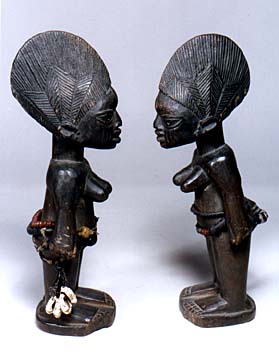
In Nigeria, the twins are named Taiwo and Kehinde, but in Cuba their names evolved into Taebo and Kainde. In Cuba they are considered to be the children of Chango and Ochun. However they were raised by Yemaya. For that reason they are placed next to either Chango or Yemaya. They must never be seperated or it will result in a loss of magical power. When wooden dolls or images are made to represent the Melli, they are made of the same piece of wood. There is another Orisha named Ideu that is called the Third Twin. This Orisha is definitely the child of Chango and Ochun. This Orisha is received apart from the Melli and has its own ceremonies that must be observed.
