
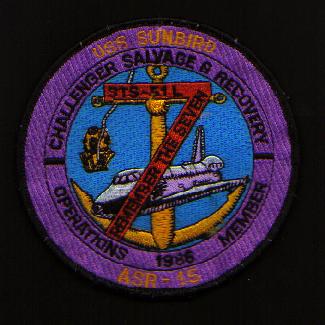
USS Sunbird (ASR-15) was one of six Submarine Rescue Vessels maintained by the United States Navy. Submarine Rescue Vessels, by tradition, are named after birds of the sea.
SUNBIRD was built at Savannah Machine and Foundry Company, Savannah, Georgia. Her keel was laid on 2 April, 1945 and she was launched one year and one day later. Upon her acceptance by the Navy, she was inactivated and placed in reserve. At the time,the concept of USS Sunbird and her sister ships was unique, specifically as a submarine rescue ship.
On 23 June, 1950, SUNBIRD was recommissioned and assigned homeport at the Submarine Base New London, Conn. Since then, the ship participated in numerous search, rescue, salvage and support operations.
While undergoing initial refesher training in Cuba in the fall of 1950, SUNBIRD rescued the survivors of a plane crash and thereby recieved her first official commendation. Many others followed for an assortment of actions including: rescue and assistance to the stricken USS VALCOUR (AVP-55); refloating, with USS SKYLARK (ASR-20), the grounded destroyer USS WILLIS A. LEE; refloating of the grounded submarine tender USS APOLLO (AS-24), search for the survivors of the collapsed Texas Tower Number Four, and the search for the lost submarine SCORPION.
In 1976, SUNBIRD participated in the search for and recovery of a Phoenix Missle, lost from a downed F-14 fighter jet. For her efforts, she was awarded the Navy Unit Commendation.
Following regular overhaul, completed in 1979 in Boston, Ma., SUNBIRD returned to her role as sea trials escort for submarines and primary support ship for the Research Submarine (NR-1).
In June of 1981, SUNBIRD provided primary escort services to the first TRIDENT submarine, USS OHIO (SSBN-726).
SUNBIRD deployed to the Eastern Atlantic in September 1981 in support of Submarine NR-1. During deployment she participated in two special operations and made three calls on the port of Holy Loch, Scotland. With her return in December 1981 to homeport, SUNBIRD'S crew qualified for the Sea Service Deployment Ribbon.
During the period 12 February through 22 April 1986, Sunbird, in company with NR-1, participated in the search, location and recovery off debris and wreckage from the ill-fated Space Shuttle Challenger (STS-51L). During this operation, SUNBIRD conducted numerous dives, recovering several pieces of shuttle debris, and providing surface support to NR-1, who ultimately located a part of the solid rocket booster suspected as the cause of this tragic casualty.
From July to November 1990, Sunbird participated in Operation Desert Shield, providing salvage and rescue support within the Suez Canal sea lane entrances. During this time, Sunbird was the only Salvage Ship of the US Fleet within the Eastern Mediterrean Region.
SUNBIRD has been awarded the Battle Efficiency "E", Engineering "E", Damage Control "DC", Communications "C", Supply Blue "E", and FY 91 and FY 92 Surface Ship Safety Award for Diving Rescue Class.
USS SUNBIRD (ASR-15), the ship, like all Submarine Rescue Ships, is named for a bird.
The Sunbird is a species of the songbird family Nectariniidae that have brilliant plumage. They are long tailed and live chiefly on nectar. Unlike hummingbirds, sunbirds rarely hover while feeding, but perch instead on the flower stalk. Sunbirds are most numerous in Africa but occur eastward to the Pacific Islands.
Builder: Savannah Machine and Foundry Co., Savannah, Georgia
The colors red, white and blue represent the national colors.
USS Sunbird (ASR-15) like all ASR-7 Class Rescue Vessels carried a Mc Cann rescue chamber, referred to in the trade as a "Submarine Rescue Chamber" or SRC. Sunbird's SRC was designated SRC-19. This chamber resembeled a large super strong diving bell, which would be utilized to rescue the crew of a downed submarine in depths of 850 ft. The SRC traveled from the surface to a downed submarine via a messenger wire attached to a bouy which was attached to the disabled submarine. By means of cables and hoses, the rescue chamber was supplied with air, lights and communications from the "mother vessel". Ther chamber was divided into three compartments, one for the operators and passengers, and two for ballasting with air or sea water. With each journey to the bottom and back, the two operators in the SRC could remove six crew members of the trapped submarine.
In order for the ASR to position herself over a stricken submarine, she dropped a "four point moor". This moor consisted of four 4000 pound anchors, attached by varying lengths of chain, depending on the water depth, to four 20 foot long bouys painted international orange refered to as "spuds", which were dropped at the four corners of a rectangle above the stricken submarine. By attaching herself with seven inch mooring hawsers to the bouys, the ship could position herself around the inside the rectangle very accurately and securely hold herself directly above the submarine.
A typical rescue mission began when a diver or remotely operated vehicle attached a stainless steel wire to the submarines messenger cable. This wire would then be taken onboard the ASR where the bitter end of the wire would be threaded into the winch reels inside the SRC's lower chamber. After adjusting water ballast in the rescue chamber until it was 1000 pounds positively buoyant, the operators reel in the wire messenger cable (now refered to as a downhaul cable) causing the SRC to pull itself down onto the submarine's escape hatch. Through the use of high pressure air, the water would be blown out of the SRC's lower chamber, and then vented to the surface.. Thereby a watertight seal was created and the submarine's personnel could safely transfer to the chamber. With the passengers safely inside the SRC, the seal between the submarine and SRC would be broken, and as the downhaul cable was payed out, the positive bouyancy brought the chamber back to the surface. This round trip was repeated until all survivors were safely back on the surface.
In addition to the mooring equipment and SRC, the ASR-7 Class vessels carried onboard a large variety of diving equipment. The divers onboard had available: SCUBA, Mk.1 Lightweight, Mk.12 Deep Sea, and the then new Mk.21 Superlight air and mixed gas diving equipment. This equipment allowed the divers to dive to 380 feet to rescue disabled submarine crews or to salvage equipment lost on the ocean floor. Also onboard were two re-compression chambers.
All ASR-7 vessels had a Allman-Johnson Auto Tensioning Towing Machine located on the fantail which made them capable of towing vessels anywhere in the world. This capability was usually utilized to tow the manned nuclear research submarine (NR-1) to areas of scientific exploration. This had provided the scientific community with vast amounts of information on the ocean floor.
All ASR-7 Class ships also carried a large quanity of fixed and portable firefighting and damage control equipment to assist vessels which were on fire or taking on large quanties of sea water due to flooding. By using the diver's tunneling pump, Sunbird could send firefighting water onto a ship's superstructure at over 1000 gallons per minute and almost 750 psi!!
Also, the ASR-7 Class carried a plethora of beaching gear and ground tackle which could be used to recover grounded, stranded or beached ships.
Commissioned: 23 June 1950
Length: 251 ft. 4 in.
Beam: 43 ft. 9 in.
Displacement: 2291 Tons
Draft: 19 ft. 6 in.
Shaft HP: 4000 Horsepower
Propulsion: Diesel Electric/ 4 Catepillar D399 Series Marine
Max Speed: 15 Knots
USS Sunbird (ASR-15) Crest
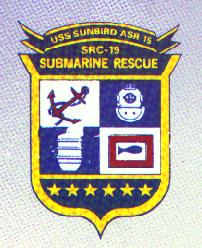
The colors blue and gold represent the Navy's colors.
The color black is in honor of our ASR divers and crewmen who have died in the line of duty.
The anchor represents the seamanship inherent in salvage operations.
The diving helmet represents the deep diving mission of the ASR.
The rescue chamber represents our primary mission of submarine personnel rescue.
The black fish insignia is found on all ASR's worldwide and is the symbol of unswerving submarine support.
The six gold stars represent the original six ASR's on the Atlantic Coast.
![[HOME]](/fl/crazydave/images/pghome.gif)
![[PREV PAGE]](/fl/crazydave/images/pgprev.gif)
![[ CPO Community Lifeline! ]](/fl/crazydave/images/goatlock.gif)
Click for the
[Previous]
[Random]
[Next Site]
[Skip Next]
[Next 5]
[Like to join?]
