
Introduction
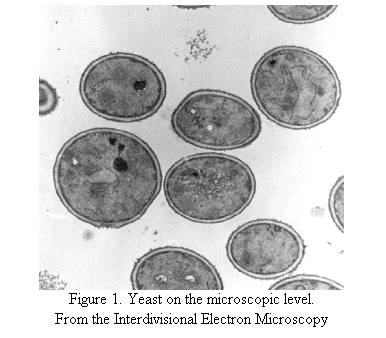 In the 1950’s, little was known about the
chemical composition of biological systems or the way in which information is
transmitted from one organism to another.
During the past few decades, great advancements have been made in the
field of cell and molecular biology.
Some of today’s scientists map DNA while others conduct experiments on
cloning organisms, yet one thing remains the same – yeast is, and has been, one
of the most widely used microorganisms for scientific experimentation. The objective of this paper is to research
and discuss the history of yeast, determine at what amount of sugar yeast grows
most optimally, and to offer insight for the future of yeast and its possible
benefits to humanity.
In the 1950’s, little was known about the
chemical composition of biological systems or the way in which information is
transmitted from one organism to another.
During the past few decades, great advancements have been made in the
field of cell and molecular biology.
Some of today’s scientists map DNA while others conduct experiments on
cloning organisms, yet one thing remains the same – yeast is, and has been, one
of the most widely used microorganisms for scientific experimentation. The objective of this paper is to research
and discuss the history of yeast, determine at what amount of sugar yeast grows
most optimally, and to offer insight for the future of yeast and its possible
benefits to humanity.
To begin, ‘yeast’
must first be identified. With over six
hundred different known species of yeast, though only a few are commercially
used, it is very easy to get them confused.
For this paper, and most people in general, Saccharomyces cerevisiae is
what is usually referred to as baker’s yeast, or just plain “yeast”. Being responsible for fermentation, yeast
allows people to make bread, beer, and even wine, by use of their enzymes to
convert glucose to alcohol and carbon dioxide.
Background
 Archaeologists digging in Egyptian ruins have
found grinding stones and baking chambers, as well as drawings of
4,000-year-old bakeries and breweries.
Over the centuries, bread making became an art. It wasn’t until the late 1600’s, when the
first microscope was invented, that microscopic organisms, like yeast, were
identified. Mankind has been exploiting
yeast for centuries, yet it’s been in just the past few decades people have
been interested in exploring the cells of yeast individually.
Archaeologists digging in Egyptian ruins have
found grinding stones and baking chambers, as well as drawings of
4,000-year-old bakeries and breweries.
Over the centuries, bread making became an art. It wasn’t until the late 1600’s, when the
first microscope was invented, that microscopic organisms, like yeast, were
identified. Mankind has been exploiting
yeast for centuries, yet it’s been in just the past few decades people have
been interested in exploring the cells of yeast individually.
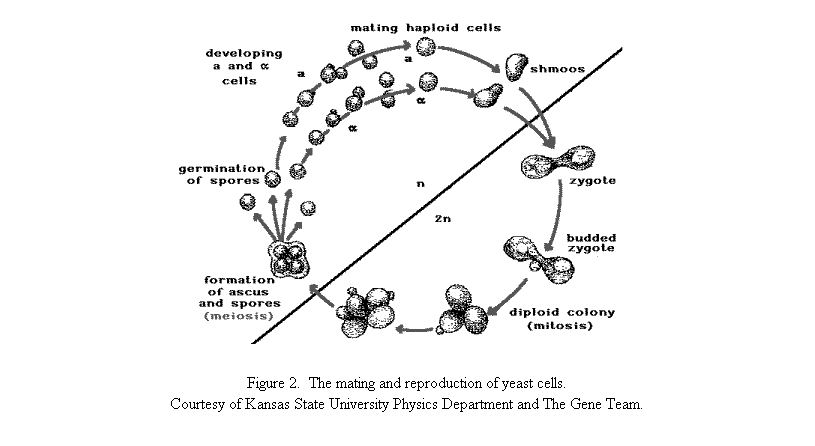
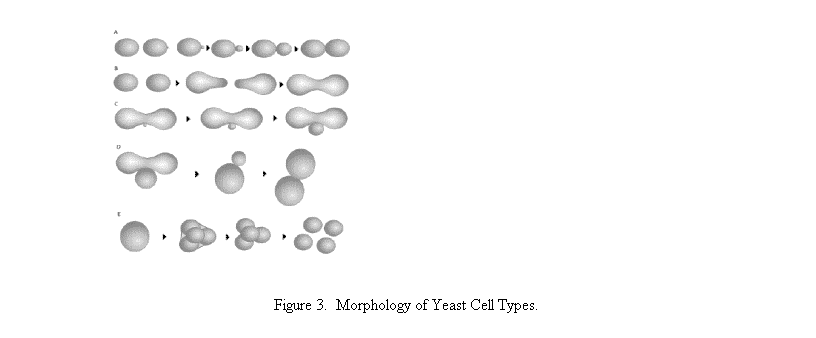
Dividing by budding, rather than by binary fission, a small bud emerges from the surface of the parent cell and enlarges until it is almost the size of the parent, as shown above. Yet, yeast has very simple nutritional needs. Since it is unable to carry out photosynthesis, it requires a reduced carbon source, which can be as simple a compound as acetate. Yeast also requires a nitrogen source such as ammonium sulfate, while the only other complex compound required is the vitamin called biotin. Of course, a variety of salts and other trace elements are also required.
The growth behavior of a yeast culture is very similar to that of bacteria. Like that of all higher organisms, the yeast life cycle includes a step known as meiosis, where pairs of chromosomes separate to give new combinations of genetic code. When a growth medium is inoculated, the cells require a period of preparation time before they actually start to divide. It is after this period, which may take up to several hours, the cells enter the exponential phase during which their number and mass double at equal time intervals. After growing at a relatively constant and exponential rate, some conditions become limiting so that the rate diminishes and growth eventually ceases. The culture remains stationary and the cells are viable for several hours; if the culture is refrigerated, the cells may remain viable for months.
 Normal yeast can either grow aerobically or
anaerobic. Under aerobic growth
conditions, they can support growth by oxidizing simple carbon sources, and
will completely oxidize their carbon sources to carbon dioxide and water. While under anaerobic conditions, yeast can
only convert sugars to carbon dioxide and ethanol, recovering less of the
energy. Yet if in a liquid media, the
faster yeast replicates, the cells become physically smaller and lighter. As multiplication comes to an end, they
gradually return to their normal size and weight. During proliferation, the cells will cluster together, fall to
the bottom, and form sediment. Though,
on solid media, yeast can grow any of three types of colonies. Surface colonies have circular contours;
internal colonies are small and lens-shaped; and near-surface colonies are also
lens-shaped, triangular or rectangular.
Normal yeast can either grow aerobically or
anaerobic. Under aerobic growth
conditions, they can support growth by oxidizing simple carbon sources, and
will completely oxidize their carbon sources to carbon dioxide and water. While under anaerobic conditions, yeast can
only convert sugars to carbon dioxide and ethanol, recovering less of the
energy. Yet if in a liquid media, the
faster yeast replicates, the cells become physically smaller and lighter. As multiplication comes to an end, they
gradually return to their normal size and weight. During proliferation, the cells will cluster together, fall to
the bottom, and form sediment. Though,
on solid media, yeast can grow any of three types of colonies. Surface colonies have circular contours;
internal colonies are small and lens-shaped; and near-surface colonies are also
lens-shaped, triangular or rectangular.
Current Research
Ascomycetes, such as baker’s yeast, are popular for genetics research because the ascospores they produce in each ascus are the products of meiosis. Both haploid and diploid yeast cells divide by budding, and there is a period of time before cells start dividing, followed by an exponential growth phase where mass doubles at equal intervals, and this leads into a growth limiting stage where the rates of increase diminishes and eventually stops. With time, the cells will die and if left at room temperature they literally digest themselves, reducing their proteins and nucleic acids to simpler components.
The study of genetics in yeast and other microorganisms became interesting when it was discovered that different genes could determine the same, or very similar, traits. This brought about questions on what a gene really is and how you can tell if mutations are in the same gene or in different genes.
When a substance produced by one organism influences the behavior of another individual of that same species, we call it a pheromone. In more complicated, multi-cellular organisms, when one cell produces a substance that influences the behavior of another, we call it a hormone. Haploid yeast cells secrete small peptides mating pheromones that have strong similarities to peptide hormones in mammals. These yeast pheromones stimulate cells of the opposite mating type to differentiate into gametes, which have a distinctive pear shape that makes them easy to identify.
Projections for the
Future
Of particular interest for some people are ultra-violet rays, which are the shortest visible waves in the light spectrum, and its affect on yeast. Many substances that are exposed to ultra-violet radiation behave differently than when exposed to visible light. If humans are exposed to ultra-violet radiation, they can get sunburns, cataracts in the eyes, or even get skin cancer if there is excessive exposure over many years. However, ultra-violet rays are not totally harmful. Vitamin D which humans and animals need to stay healthy is produced when the skin is irradiated by ultra-violet radiation. As for yeast, cultures can benefit from the radiation and in turn grow significantly faster than under normal conditions.
Antibiotics are not always effective against viruses and are often prescribed just in case a bacterial infection is present. The downside to over-prescribing antibiotics is that it creates resistant strains, which pose a greater threat to public health, rather than helping. However, the best defense against viruses and illness is a powerful immune system. Boosting the immune system is obviously the best way to fight colds or other infections.
Currently, research is also being done as to the impacts of yeast on the human body. One of the most interesting researches being conducted is that of Beta-1,3 glucan, which is extracted from the cell wall of common baker’s yeast. Studies have shown that this extraction profoundly activates powerful immune system responses and has a vaccine-like effect when used topically over rashes and sore areas. This insight might lead to future research and development on how something derived from a fungus could boost the human immune system.
At the same time yeast may have benefits, it is also the blame for several problems. Illnesses such as diabetes, leukemia, and various types of cancer, all which are sometimes associated with old age, can also possibly be caused by yeast. One extremely common pathogenic yeast, Candida albicans, is carried by most people in a benign form. While in normally healthy people it is harmless, in those whose immune system is weakened it can become infectious and may turn into a serious pathogen. Some of these infections are difficult to control in humans because the yeast metabolism is very similar to that of people. In turn, drugs which are toxic to the yeast are also toxic to humans. Researching ways in which to cure these diseases would be extremely beneficial to all humanity.
Works Cited
[Anonymous]. Baker’s yeast and its life cycle. [serial on-line] 1999; 4. Available from: http://www.phys.ksu.edu/gene/a1.html via the INTERNET. Accessed 2000 Oct 5.
[Anonymous]. Part g: methods and materials, laboratory methods. [serial on-line] 1999; 14. Available from: http://www.phys.ksu.edu/gene/g1.html via the INTERNET. Accessed 2000 Oct 9.
Bacila, M, Horecker, BL, Stoppani, AOM, editors. Biochemistry and genetics of yeasts. Rose, AH, editor. Composition-function relationships in the yeast envelope. New York: Academic Press, Inc.; 1978: p 197-203.
Kockova-Kratochvilova, Anna. Yeast and yeast-like organisms. New York: VCH Publishers; 1990: p 30-33.
Kreger-van Rij, NJW. The yeasts: a taxonomic study. New York: Elsevier Science Publishing Company, Inc.; 1984.
Carmel, L. Does ultraviolet radiation affect yeast cell fermentation. [serial on-line] 1998; 8. Available from: http://selah.wednet.edu/MS/SciProj98/7th/CARMELL/radiation.html via the INTERNET. Accessed 2000 Oct 20.
Spencer, JFT, Spencer, DM, Smith, ARW, editors. Yeast genetics. West Hanover: Halliday Lithograph; 1983: p 461-464.
