|
|
Citizen
Kane
Oscar Wins:
Best Screenplay: Orson
Welles and Herman J. Mankiewicz
Oscar Nominations:
Best Picture
Best Actor: Orson Welles
Best Art Direction
Best Cinematography:
Gregg Toland
Best Film
Editing: Robert Wise
Best Director: Gregory
La Cava
Best Music:
Bernard Herrmann
|
|

|
Cast:
Orson Welles, Dorothy
Comingore, Agness Morehead, Joseph Cotton, Ruth Warrick, Ray Collins,
Erskine Sanford
Storyline:
One man's rise and
fall in the world of newspapers and corporate America, is portrayed, in
this beautifully filmed, wonderfully haunting tale. Why
Should It Have Won?
Ten billion critics and fans can't be wrong. Years after its
release, the film is still regarded by many to be the best film of all
time. Citizen Kane has been studied and written about, over and over
again, and its style has been emulated by some of the great directors
since. Why
Didn't It Win? Citizen
Kane took a negative view of a newspaper giant, and it seemed obvious to
most that it was patterned after the most notable giant of the day,
William Randolf Hearst. When Hearst got wind of the film, he ensured
that it was never written about, or advertised in any of her
newspapers. He also threatened theatre chains with harsh penalties
if they showed the film. The fact that the film even managed to get
nominated, with limited release, and little or no press, seems like a bit
of a miracle.
|
|
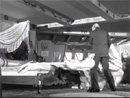
Best Scene:
When things get
too overpowering, Susan leaves the maniacal Kane once and for
all. Kane enters her room and proceeds to smash everything in
sight. After a terrifying rampage, he comes across the snow
globe, introduced at the beginning of the film, and breaks down into
tears.
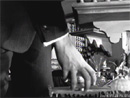
Orson Welles
actually cut his had during the filming of this scene, but tape kept
rolling. While you can't see actual blood, you can see that he is
hiding his left hand after he smashes the mirror.
|
Behind the Scenes:
Leave it to Hedda Hopper and Louella Parsons to get the ball rolling on
this one. The leading gossip columnists of the day, who wielded
considerable control over the careers of many Hollywood actors back then,
used anyone, and anything to one-up each other. Hopper saw a preview
of the film, and immediately called Parsons' boss, William Randolf Hearst,
to tell him that the film was about him. This infuriated Hearst, and
it didn't look too good for Louella either, who was supposed to have an
ear to the ground in Tinseltown. 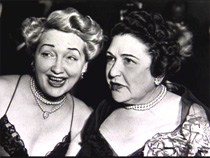 Louella
quickly wrote a scathing editorial about Welles, but that was about
it. Hearst made a bigger move, and forbade any of his newspapers to
write about or advertise the picture. Hearst newspapers were said to
have been read by a quarter of the homes in the United States, and a
common tactic for dealing with his enemies was to simply pretend that they
didn't exist. It was an effective form of censorship. Louella
quickly wrote a scathing editorial about Welles, but that was about
it. Hearst made a bigger move, and forbade any of his newspapers to
write about or advertise the picture. Hearst newspapers were said to
have been read by a quarter of the homes in the United States, and a
common tactic for dealing with his enemies was to simply pretend that they
didn't exist. It was an effective form of censorship.
Orson
Welles was practically given the keys to RKO studios, to write, direct and
star in his first film. Prior to making the film, Welles was best
known for creating the Mercury Theatre in New York, where he staged
outrageous and lavish productions of Shakespeare's, and other great playwright's,
work. He also dabbled in radio, where he produced War of the Worlds,
a shockingly real story about aliens landing in New Jersey and killing the
human race. The story was told as a news broadcast, and used the
same format that would have been used at the time. It created a
shockwave so big, that people actually took their own life while listening
to it. The FCC stepped in later to insist that all fictional works
thereafter, be labeled as such, prior to broadcasting. 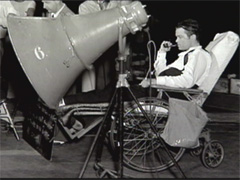 Orson
Welles at first denied that Citizen Kane was based on William Randolf
Hearst, stating that it was actually a combination of several American
tycoons, but Hearst, and anyone that knew anything about him, could not be
convinced. Hearst not only tried to silence the picture, but
he also took legal action, drumming up support from fearful studio bosses
like Louis B. Mayer. While RKO was prepared to backdown, and finally
shelve the picture, Welles threatened to counter sue if the terms of the
original distribution agreement were not met. Orson
Welles at first denied that Citizen Kane was based on William Randolf
Hearst, stating that it was actually a combination of several American
tycoons, but Hearst, and anyone that knew anything about him, could not be
convinced. Hearst not only tried to silence the picture, but
he also took legal action, drumming up support from fearful studio bosses
like Louis B. Mayer. While RKO was prepared to backdown, and finally
shelve the picture, Welles threatened to counter sue if the terms of the
original distribution agreement were not met.
Among
the plot points that were obvious Hearst references was the chosen
profession of the lead character, and his tendency to wield power from
it. The estate which the character lived in was called Xanadu, a
lavish mansion, containing an excess of riches from all over the
world. Hearst's estate, Sam Simeon was the size of Rhode Island, and
written about in gossip columns as a weekend retreat for many Hollywood
elite, including Herman Mankiewicz, who wrote the screenplay with Orson
Welles. Perhaps the most glaring gem from this movie, was the part
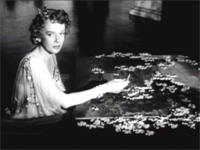
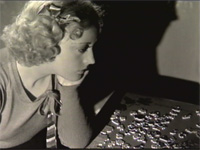
of Susan Alexander, played by Dorothy Comingore. Kane doesn't
divorce his wife, just as Hearst didn't, but takes up with a mistress, and
makes her an opera star, despite her obvious inability.
 |
 |
|
The cheapest shot
from Citizen Kane seemed to be directed at Marion Davies,
portrayed as a dimwitted, no-talent, social climber. Facts
about Davies own life, differ vastly from the character in the
film. |
In actual
fact, Hearst left his wife to take up with established actress, Marion
Davies. It was suggested that the treatment of Davies in this film
was the element that infuriated Hearst the most, and rightfully so.
Davies was an accomplished actress in silent films before she met Hearst,
and unlike the character of Susan Alexander, she was actually pretty
good. Susan Alexander is portrayed as a bit of a dim wit, forced
into a life of solitude within the walls of Xanadu. An inside joke
was the term Rosebud, the opening line from the film and the dying word
uttered by Kane, that became the crux of the story. In the film,
Rosebud referred to his sled from his childhood, but according to Welles,
it was the term Hearst used to describe Marion Davies' private parts. The
scandal surrounding the picture didn't go unnoticed, and defiant theatres
did run it, despite lackluster attendance. The film managed to get
six Oscar nominations, including the Best Actor, Best Director and Best
Screenplay nods for Welles. By this point, however, Welles' own name
was blacklisted, and he was considered to be a trouble making, outsider.
At the ceremony, there were actual 'boos' and 'hisses' when his name was
mentioned by presenters. Welles didn't attend the ceremony that year
as he was scouting locations for a film in South America. The
Academy did honor Welles with the screenwriting credit, although it was
said that the honor was meant for the co-writer, Herman Mankiewicz, who
was already a well known figure in Hollywood circles. The Academy,
too miffed with Welles' ego to recognize the genius behind it, made what
is perhaps their biggest blunder of all time, by presenting the Best
Picture award to the forgettable film, How
Green Was My Valley. Hearst's
tactics of burying the picture, in the end, had an impact on a lot of
people. Hearst, himself, suffered the remainder of his years with
his own bad press, as the incident brought to light, the great power that
the man had been wielding for so many years. It also hurt RKO
studios, which backed the film, and in turn, suffered financially from the backlash of
Hearst's censorship campaign. Even Orson Welles, the boy
genius, didn't escape without injury. His career was never able to
live up to the success of his first picture despite some excellent efforts
(The Magnificent Ambersons, The Third Man) He, himself, said that it
probably would have been best to retire from film making after Citizen
Kane and move on to something completely different.
|
|
 |
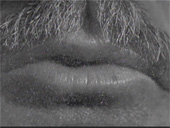
| AFI's
pick for the Best Film of all time! |
 |
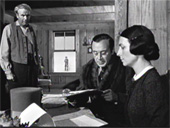
| Uttering
those famous last words, "Rosebud". |
 |
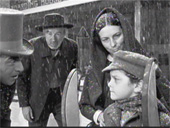
| Agness
Moorehead plays Kane's mother, discussing his promising talents with a man
who would like offer him a private education. |
 |
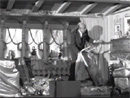
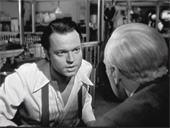
| Young
Kane isn't keen on the idea of leaving his mother, and his precious sled. |
 |
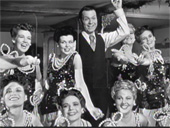
| Orson
Welles plays a young Kane, hungry to make it big in the news buisness. |
 |
| As
Kane's popularity grows, his lifestyle becomes more lavish, and his
politics, more cut throat. |
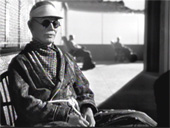 |
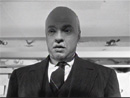
| Joseph
Cotton plays Kane's jaded partner, Jedidiah Leland. He wasn't happy
with the job they did on making him look like an old man. |
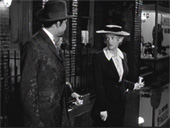 |
| Kane
meets Susan Alexander, by chance, on the street, one rainy evening. |
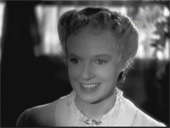 |
| Dorothy
Comingore plays the ditzy Susan, who invites Kane up to show her his
shadow puppet. |
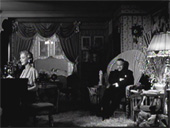 |
|
Kane is so smitten
that he takes her as a mistress, and fosters her burgeoning operatic
abilities. |
 |
|
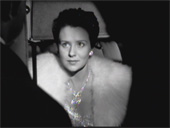
Meanwhile, Kane's own
career is on the rise, with politics as the next likely step! |
 |
|
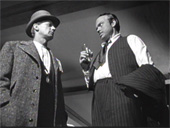
Kane's wife, Emily, played by Ruth
Warrick, is on to her estranged husbands little affair. |
 |
|
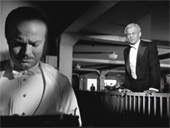
Shots from below, like this one, accentuate
the power of these titans. |
 |
|
Cotton is dismayed at his partner's
abuse of his power. |
 |
|
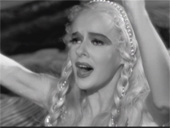
Susan gets her moment on stage, and she
is awful. |
 |
|
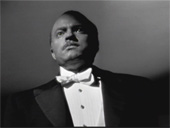
...But Kane doesn't see it that
way! |
 |
|
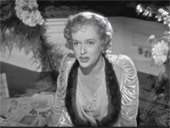
As the Kane empire begins to collapse,
Susan begins to feel trapped. |
Citizen
Kane is available on DVD and VHS. I strongly recommend the DVD, as
it comes with the Oscar nominated documentary, The Battle Over Citizen
Kane, which offers a detailed insight into both Welles and Hearst, and
looks at the successes and failures behind the film. As well, the
film contains audio commentaries by film critic, Roger Ebert and director,
Peter Bogdanovich. You can purchase Citiizen Kane in
most video stores, or through Amazon.com by clicking below!


|
|