|
1970 Best Picture:
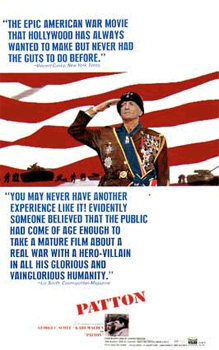
Patton
|
Competition:
Airport, Five Easy Pieces, Love Story, MASH
Other Winners:
Best Actor: George C.
Scott, Patton
Best Actress: Glenda Jackson, Women In Love
Best Supporting Actor: John Mills, Ryan's Daughter
Best Supporting Actress: Helen Hayes, Airport
Best Director: Franklin J. Shaffner, Patton
|
Cast:
George
C. Scott, Karl Mulden, Michael Bates, Ed Binns, Stephen Young
Storyline:
General Patton, the great World War II mastermind, is the subject of this
film that traces his tour of North Africa and Europe, where his own ego is
the key to his brilliance and his ultimate downfall.
Did it
deserve to win:
Goddamned
right, it did! A lot of information fills this epic, but
biographers, take note, as this film focuses on the most important aspect
of the man's career. Geroge C. Scott, some great direction, and a
tight script, give the viewer a first hand view of this man's thinking.
Critique:
Rarely does an epic
film rely so much on the performance on one actor, but if Scott wasn't up
to the challenge of playing this maniac, in an over-the-top, yet very
believable performance, the film might not have worked.
Elaborate
battle scenes aside, the character of Patton is the key to what made this
film an instant classic.
Patton
plays like a well orchestrated chess match, with a view from with the mind
of the champion player. While other biographies tend to be
sprawling, this one is tight and focused, and worthy of a great general
who considered himself to be the great Caesar in another life.
|
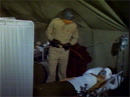
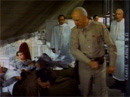
Best Scene: The
slap heard round the world! General Patton learns of the damage that
a little bad PR can do when he slaps a soldier in makeshift
hospital. The soldier is having an emotional breakdown, something
that Patton doesn't have much respect for. After berating the man,
Patton has him sent out to the front, to continue fighting.
|
Behind
the Scenes:
At that
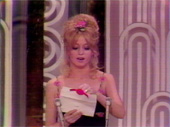
years ceremony, Goldie Hawn, presenting the Best Actor award, uttered the
famous line, "Oh my god, its George C. Scott." It was a
well known fact that Scott would not be attending the ceremony, and that
he would not be accepting the Oscar. He was the first winner in a
major category, to officially boycott the Academy Awards.
Thirty-two
year old, UCLA film school grad, Francis Ford Coppola wrote the screenplay
for the film. He also won his first Oscar.
The role
of Patton was passed on by Rod Steiger, Burt Lancaster, Robert Mitchum,
and Lee Marvin.
Helen
Hayes beats Katherine Hepburn's record, by winning a second Oscar, 39
years after the first.
Best
Actress nominee, Sarah Miles, was candid about her thoughts on the British
Academy Awards. In light of the fact that British actors had
traditionally caused uproar among American patriots who resented them
winning American awards, she stated that "The American Oscar is the
only award that carries any weight. Ours is just a lot of
shit."
|
|
 |
Oscar
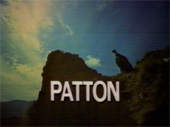
honors a five star general!
|
 |
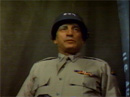
| George
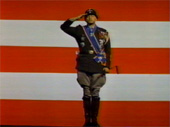
C. Scott in the role of his career, looking ironically like an Oscar
statue in this pose. |
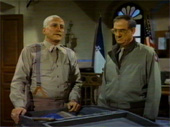 |
Karl
Mulden is General Omar Bradley, in an Oscar nominated performance.
|
 |
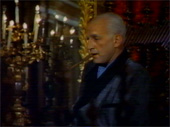
Standing
among the ruins of ancient Rome, Patton states that he was a Roman
warrior.
|
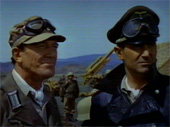 |
| Karl
Michael Vogler plays Field Marshall Erwin Rommell, the enemy to the
great Patton. |
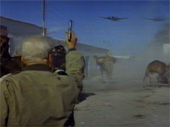 |
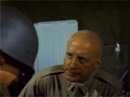
| Patton
faces his attackers head on. |
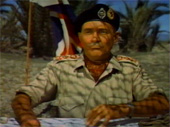 |
British
General Mongomery, played by Michael Bates, plays a game of one-upmanship,
and loses, as he and Patton vie for the taking of Sicily.
|
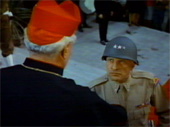 |
| Patton
is given a hero's welcome when he takes Palermo from the Italians. |
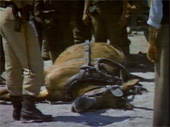 |
Patto's
God-complex starts to get ugly when he shoots a couple of donkeys that
stand in his way.
|
 |
Patton
loses a promotion when the 'slapping' incident outrages the folks back
home.
|
 |
|
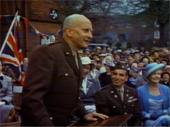
Patton addresses a
Ladies Group in Britain, under orders to watch his language. In
doing so, he inadvertently disses Russia.
|
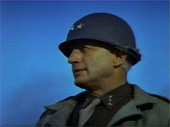 |
Patton
surveys the site of a bloody battle.
|
|