HAMSTER RATING: 3/5 pellets
DIRECTOR: Ernest B. Shoedsack
If you liked "Gladiator," then "The Last Days of Pompeii" is a good choice for an empty
afternoon of no-brainer entertainment.
The story begins in the busy streets of Pompeii where happily impoverished Marcus (Preston
Foster) works as a blacksmith. He wants for nothing, until his wife and young son are
trampled to death under the wheels of a Roman chariot and he cannot afford to pay the doctor.
This leads Marcus into the world of the Arena, where he earns a fortune slaying other men for
the pleasure and riches of the Roman aristocrats. Disillusioned and pained by his actions, he
finds a kind of redemption when he adopts Flavius (David Holt), the son of one of his finished
rivals. But Marcus' heyday in the Arena is ended by an injury, and eager to give Flavius the
kind of charmed, worry-free life only wealth can provide, Marcus reluctantly turns to
gathering slaves and animals to sell for the Arena. Before leaving on a trip to buy horses in
Judea, Marcus is instructed by a prophetic Greek woman to take Flavius along, that he will
meet an important man who will help him.
Believing this man to be Pontius Pilate, the governor of Judea (played by Basil Rathbone,
perhaps most familiar as Sherlock Holmes), Marcus takes Flavius to him. Pilate helps Marcus
profit by a bit of underhanded dealing, but as Marcus returns to collect Flavius and go home,
he finds Flavius near-death after a fall from a horse. On the council of his faithful Greek
slave Leaster (Wyrley Birch), Marcus takes Flavius to "a wandering healer" who restores the
boy. Marcus, Leaster and Flavius get away with Marcus' new treasure just as a riotous crowd
is leading "the healer" to be crucified after a judgement by Pilate. One of the healer's
followers implores Marcus to try and stop the crucifixion, but Marcus cannot entertain the
thought of abandoning his treasure.
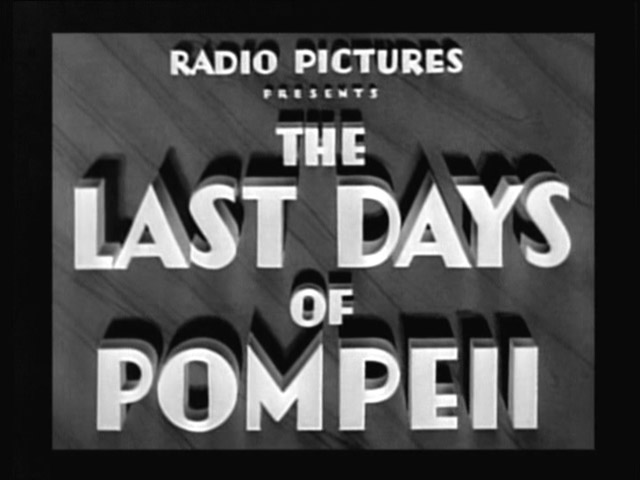
Would you believe, in all the vastness of the internet, that this is the only picture
from this movie I could find? How much does THAT suck? Fast forward 20-odd years, and Marcus has become head of the Arena, one of the richest men
in Pompeii and charged with putting together a top-notch show for the new prefect. Flavius,
however, disapproves of Marcus' dealing in human flesh and secretly attempts to help many of
Marcus' slaves escape. Marcus finally sees to it that they are captured, unaware that Flavius
has been captured along with them. When at last they are sent into the Arena to face their
spectacular deaths, Marcus is horrified to see Flavius in amongst them. Marcus becomes
frantic to stop the games and save his son, but Vesuvius begins its horrific explosion,
complete with earthquakes, lava flows and smoldering ash falling from the sky, and pandemonium
breaks loose in the city. As Marcus' servants begin evacuating his treasure to the boats,
Marcus experiences a change of heart, learning once again to value human lives over material
possessions.
A lovely little parable, the story is spiced up by scenes of Arena carnage (woefully tame
by today's standards, but still fun) and by the movie's considerable scope, complete with
large crowds of extras and huge exterior shots of Roman architecture. The score pounds home
in a way you'd expect from a 1930's action movie, with that nifty big band sound and
absolutely no subtlety. Fairly traditional in this respect, I found Pompeii
entertaining mostly because of the performances by the cast. Recall, this movie was made
before Marlon Brando and other Method actors modernized the industry. Normally I can't stand
classical actors, but the performances in Pompeii are so energetic and heartfelt that
it ends up whisking you right along, kind of in the way a well-acted high school play or
church pageant can. It may not be skilled and professional, but it gets the job done and has
fun doing it.
The moral that "money does not buy happiness" is drilled home bluntly and "spiritualized"
by a couple of appearances by Jesus Christ, complete with awed crowds of followers and the
obligatory boys choir. It must have been written into the Depression-era studio contracts
that every film set in the Roman empire include Jesus Christ (but that you not ever get to
see his face!), but compared with some of the later Jesus epics that Hollywood produced
(King of Kings and The Greatest Story Ever Told), Pompeii handles the
material with considerable flair, without blowing the God thing totally out of proportion.
Still, coupled with the strong theme of the movie, the effect can border on preachiness. Also
interesting to note is the lack of physical buffness displayed by Marcus and the other
gladiators. They're all barrel-chested and somewhat flabby (maybe what inspired Ridley Scott
to cast chubb-alicious Russell Crowe in his gladiator film--sorry, that was mean-spirited).
The only other major nitpick I have with this movie is purely nerdy in nature: Young
Flavius, probably no older than nine when Jesus bites the dust somewhere around 33-35 AD,
can't be older than 30 when it ends with Vesuvius blowing its top, which would put the
eruption in 58-60 AD, max, at least 19 years premature than the historical eruption of 79 AD.
I found that a particularly glaring historical error, but then, when has Hollywood ever
allowed the facts to get in the way of a good story?