
Cs: It's an element!
Cesium (caesium) is the 55th element on the periodic table. It is an Alkali Metal with an atomic mass of 132.90543 and is very reactive. It has 55 protons and 78 neutrons in the nucleus, as well as 55 electrons in "orbit". Cesium is in the 1st column and 6th period on the Periodic Table.
CHECK OUT THE LINKS!
http://tycho.usno.navy.mil/cesium.html
http://www.scescape.net/~woods/elements/cesium.html
http://pearl1.lanl.gov/periodic/elements/55.html
Properties:
Cesium has a melting point of 28.4 degrees Celsius and boils at 669.3 degrees Celsius. Cesium is a very soft, ductile metal, and is actually a liquid at room temperature. Element number 55 is also a silvery/white color. It has a cubic crystal structure and reacts explosively with water.
Discovery:
Robert Bunsen discovered cesium in 1860 in Germany.
He used a spectroscope, one of his own inventions.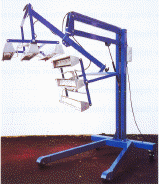 A
spectroscope
contains a diffraction grating that separates electromagnetic radiation
into
its component wavelengths. Bunsen discovered rubidium in 1860, as
well.
A
spectroscope
contains a diffraction grating that separates electromagnetic radiation
into
its component wavelengths. Bunsen discovered rubidium in 1860, as
well.  The name cesium was chosen because in Latin, ceasium means
"sky
blue". The cesium’s salts turn flames blue. Cesium is found in pollucite,
and traces can be found in lepidolite.
The name cesium was chosen because in Latin, ceasium means
"sky
blue". The cesium’s salts turn flames blue. Cesium is found in pollucite,
and traces can be found in lepidolite.
Uses:
Cesium is used in electron tubes, due to
it's great affinity to oxygen. It removes traces of air from within the vacuum
tube. It is also used as a catalyst, and in
photoelectric cells. Because it ionizes readily, it is also used as an ion
rocket motor propellant. Also, cesium is used in atomic watches, and can keep them
accurate to 5 seconds over 300 years. Cesium is also used in infrared lamps, but
other than these, it has few uses.
(left): atomic watches are accurate to 5
seconds over 300 years.
(right): cesium is used in infrared lamps
