This
legend will tell you why this cat is called
"The
Sacred Cat of Burma"
Many
centuries ago by a sparkling lake, in a valley surrounded by majestic
mountains, the temple of Lao-Tsun was guarded by 100 yellow-eyed white
cats with long silken hair. The temple housed a beautiful golden goddess
with sapphire blue eyes who watched over the transmutation of souls. The
head monk, Mun-ha, whose beard had been braided with gold by the enlighten
one, often knelt in meditation before the golden goddess,Tsun-Kyan-Kse.
At his side was his faithful and beloved companion, a beautiful temple
cat named Sinh. Sinh would always shared in his master's meditation. As
the monk meditated, Sinh would gaze steadily at the golden goddess beautiful
sapphire blue eyes.
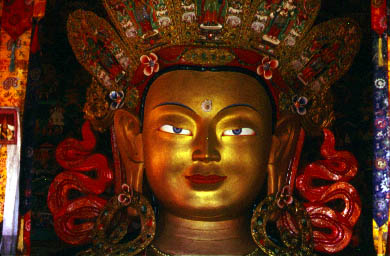
One night as the moon rose, Mun-ha was in communion with the sacred goddess,
Tsun-Kyan-Kse. He was deep in a transcendental state. So deep was his
devotion, that he suffered no pain when the temple was attacked by marauders
and Mun-ha was killed. At the moment of his masters death, Sinh placed
his paws upon the monk's flowing robes and faced the golden goddess. Instantly,
an amazing transformation took place. The hairs of Sinh's white fur were
as though misted with a golden glow which radiated from the beautiful
golden goddess. Her deep sapphire blue eyes became Sinh very own. His
face, ears, legs and tail became the velvety brown color of rich earth,
but his four paws resting gently on his master, remained perfect white,
a symbol of purity. The next morning the temple radiated with the transformation
of the remaining ninety-nine white cats which with Sinh reflected the
golden hue of a hundred brilliant sunrises. Sinh did not move from his
place He stayed on the spot of his masters death, and gazed fervently
into the sapphire eyes of the goddess. Exactly seven days later Sinh died
carrying with him into Nirvana the soul of his beloved master,the monk
Mun-ha.
|
| ! |
The
Birman origin? More legends ... |
|
|
One of the other legend turn around Major Gordon Russell, an
officer in the English army serving in Burma. This british officer
would have come to the aid of the monks. As a gesture of gratitude
the monks sent Auguste Pavie then living in France, a pair of Sacred
Temple Cats wearing "Nine Silver Bells." Unfortunately,
the male did not survive the ocean trip but the female was pregnant
thus, providing the foundation of the Birman Breed. In 1925 the
Birman breed was presented in cat shows in France.
Once more misfortune struck. During World War II the breed was reduced
to only a single pair. Through careful out crossing the Birman once
again came back. In the early 1960s the Birman had made its appearance
in Britain where Mrs. Else Fisher imported the first Birmans. Since
then the breed has been gaining in popularity. In he United States
CFA (the Cat Fanciers Association) accepted the Birman Breed for
championship in 1967.
|
Back to the Laddak
Main Page
|

