
Get free Real Audio player
|
Rimbaud
the African (part 1)
By Heiko P. Wimmen Listen to the original
quotes & sounds by clicking on the links (Needs Rea! Audo Player) About Radio and Sound Files on this Site |
|||
Ambient Sound
Water lapping, motor dinghies, crows, families on
weekend outing
We are in Aden, the main port city of Southern
Yemen, on a springtime weekend. On the quay of Steamer Point, the
landing place for passenger ships visiting this southernmost port of the
Arabian Peninsula, Families squat in the evening sun, chatting and eating
their picknicks. Forty years ago, this pier would have been abuzz with
passengers stopping over on their way to faraway destinations such as London,
Bombay and Singapore, or arriving for business at what was then the humming
hub of trade across the Indian Ocean, and one of the most important naval
bases of the British Empire. Back in the day, Aden used to accommodate up to
500 ships every month. At that time, a volume second only to the port of New
York. |
||||
|
(Photo: Hakem Aziz) |
|||
Aden, 17th August 1880. I looked for work in all ports of the Red Sea –
Jeddah, Souakim, Hodeidah, and so on. I arrived here after trying to find
something in Abyssinia. I was sick upon arrival. Now, I’m employed at a
coffee merchant’s, where I still don’t make more than seven francs. Once I
got a couple of hundreds of francs, I’ll get off to Zanzibar where, as they
say, there are things to be done.
In August 1880, a young Frenchman with no money,
work or education to speak of disembarks at Steamer Point. So far,
young Arthur Rimbaud has acquired a reputation of sorts only as
alcoholic poet, enfant terrible in the art salons of Paris, and
scandalous lover of the renowned poet Paul Verlaine. Already at the
age of fifteen, he runs away to Paris from his hometown of Charlesville
in the French Ardennes. First poems express his yearning for a life off the
beaten tracks of his petty bourgeois surroundings. |
||||
|
 |
|||
|
Et je les
écoutais, assis au bord des routes, Ces bons
soirs de septembre où je sentais des gouttes Où, rimant au milieu des ombres fantastiques, |
||||
|
Rimbaud-building in Aden, birds He wanted to live like a bohemian, and it’s true
that the Bohême refused society – it was a rebellion against traditional
values, against the family. A part of the European youth rejected the world
they were living in, and turned to nature, and some also to the Orient - a
romantic Orient that seemed more appealing than the reality of life in
Europe. Rimbaud's poetry was driven by this urge to transcend reality: the
reality of the village he grew up in, the reality of his life in Paris and
France, and maybe reality as such. Comment Massoud Amshoush, professor
of French literature at the University of Aden. In Crater, the old
downtown district of Aden, Amshoush has discovered the building where,
according to him, Rimbaud lived and worked some 120 years ago as employee of
the French trading company Bardey. A three-story, well-ventilated
edifice in English-Indian colonial architecture, constructed, as most old
houses in downtown Aden, by Yemenite Jews. After a short intermezzo as the
siege of the French cultural center, today a modest hotel, a plain restaurant
and a supermarket try to exploit the name of its famous tenant. However, most
locals still associate the name with the American Vietnam avenger Rambo. I think at a certain point, Rimbaud realized that
poetry was no longer an efficient way to escape from reality, and chose
another way: to leave this reality geographically, first by escaping to Paris
and London, and then by leaving Europe. He is on the quest for a form of
living poetry: Instead of writing poems, he turned his life into a piece of
poetry.
Ambient Sound
Streets of Aden Crater, the old downtown of Aden, takes
its name from its location in the crater of the extinct volcano Shamsan.
Ten out of twelve months, a merciless tropical sun pushes the temperatures in
the crater well beyond 40 degrees with humidity hovering just below 100
percent. At dusk, the city comes back to
life. As the sun sinks below the rugged edge of black basalt, the bazaar streets
repopulate. Peddlers crowd the sidewalks; pushcarts, derelict taxis and
microbuses compete with limousines and 4WDs for what remains of the asphalt,
provided by the English some fifty years ago. Alleyways turn into open-air
restaurants and amusement arcades. In the misty light shed by shops and
erratic street lights, Somalis, Yemenites, Gulf Arabs and Indians rub
shoulders under the crumbling colonial facades. A bearded, emaciated
Yemenite, naked but for a sarong wrapped around his hips, recites
delusional verses to indifferent bypassers.
Street Poet
|
||||
|
Rimbaud – Letter to his
family Aden, 28th September 1885 You can’t imagine the landscape
here. There are no trees at all, not even a dried one, not one blade of
grass, not one piece of soil, not one drop of drinkable water. Aden is the
crater of an extinct volcano, filled up with sand from the sea. You don’t see
anything but lava and sand, entirely dry. And here, the rim of the crater
blocks out the wind and “we are roasting in this hole like in a chalk oven”.
You really have to be forced to work for your bread, to let yourself get
hired in a hellhole like this! There is no
company but the local Bedouins, and so you turn into a complete dolt within a
few years. |
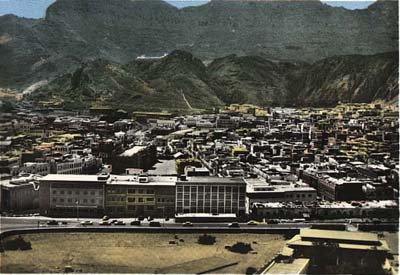 Aden /
Crater, around 1950 (Photo: Hakem Aziz) |
|||
|
Comment Rimbaud deplores his living conditions in ceaseless
lamentations. Unbearable heat, boredom, the high cost of living. After two months,
he persuades his employers to post him to Ethiopia where, according to his
expectations, “the climate is pleasant, the people hospitable and cost of
living next to nothing.” Already a few months after arrival, he plans to
go beyond, “traffiquer dans l’inconnu“, trafficking in the Unknown.
Panama, Zanzibar and Bombay are the destinations he evokes with yearning. The
real life, or so it seems, is always elsewhere. Adeni Youth in a juice shop discuss emigration to
America. The end of the British Empire, the closure of the
Suez Canal after the 1967 Israeli-Arab war, and two decades of Communist rule
destroyed Aden’s role as a commercial center for the region. Today, Aden‘s
youth loaf about in juice bars and teashops, dreaming about a different life
– emigration to Europe or America. The leadership after independence came from the
countryside and ignored the city. The Arab philosopher Ibn Khaldun calls this
the “mental backwardness of the Bedouin“. The Bedouin comes from the
countryside and loathes the city, because the city despises and marginalizes
him. In many Arab countries, the rural areas are still as underdeveloped as
in Ottoman times and the achievements of urban life, such as schooling,
infrastructure and services never reached them. As a result, whenever
countrymen enter the city, they feel hatred, and when they rule it, they turn
it into booty for their tribe. Thus, Aden suffered a great deal
after 1967, and scores of qualified employees and intellectuals left – to
Europe, the US and to the Gulf region. Because at the same time Saudi Arabia,
Kuwait and the Arab Emirates, all of which have marine ports, were the site
of a spectacular boom. And many of the qualified employees who left Aden at
that time, today hold high executive positions in these countries. Dubai – promotion song Gulf Emirates like Bahrain or Dubai have over the past
twenty years, taken over Aden’s former role, establishing lavish tourist
resorts as well as modern infrastructures for communication and trade. Dubai
alone, a tiny sheikdom on the southern entry to the Arab-Persian Gulf,
attracts more than two million visitors to its annual shopping festival.
After the reunification of North and South Yemen in 1990 and the ensuing
civil war in 1994, Aden tries to reclaim its former position. The port is
revamped to accommodate the largest container ships in the world, a free
trade zone aims to attract business, and official lenience towards nightclubs
and other forms of entertainment is geared to visitors from affluent
neighboring countries where more rigid codes of morality are implemented,
such as Saudi-Arabia. Sailor’s Club in Aden The “Sailor‘s Club” in beachside Tawahi, the former
European quarter of Aden, is crammed full on a weekend’s night. Yemenis, Arab
tourists and businessmen, and a few foreigners crowd the tables. Egyptian
dancers heat up the atmosphere, alcohol, a rare item on the Arabian
Peninsula, is served legally and in abundance. The real attraction, however,
are girls from Somalia and Ethiopia. In groups they enter the dancefloor,
single they fan out and join the male guests, preferably the foreigners among
them, for close contact. The ancient trading routes between the African and
the Arabian coasts of the Red Sea, plied by merchants in coffee and arms at
the times of Rimbaud, today sees the trafficking of human merchandise:
prostitutes for the nightclubs of Aden, housemaids for the fat cats of Jeddah
and Riad, menial workers for the fabulously rich and idle petrodollar
societies on the Arabian Gulf. Woman: Hello, my name is Faten. |
||||
|
 |
|||
|
Ambient Sound
Mokha, voices and motocycles
Erosion has also blown away the splendor of Mokha,
described as the most important harbor of Southern Arabia by the German
traveler Carsten Niebuhr in 1770, only 70 years before the British capture of
Aden. Today, it’s a dusty main road lined by miserable sheds. Two sordid
restaurants cater to the workers of a nearby power grid, a cockroach infested
hotel provides shelter for the few travelers to Africa. Even the derelict
taxis and microbuses, ubiquitous in any other Yemeni city are beyond the
purchasing power of the locals: small motorcycles take care of local
transport.
|
||||
|
Read and hear how Rimbaud sails to Africa to become a filibuster
himself, and live his last years in the Ethiopian Mountain city of Harar, intoxicated
with Qat and listening to the laughter of the Hyeana in First broadcast 16/10/2001 in “Politisches
Feature”, Deutschlandfunk Köln Original German version 45:00 minutes. |

