In the early 19th century, the area that is now the UAE was known as the "Pirate Coast" because of the occupation of its inhabitants.
Beginning in 1820, Great Britain entered into treaties with various leaders in the area out of a desire to protect its ships in the Gulf and the Indian Ocean. In addition, Britain was allowed to handle foreign relations for the area known as "Trucial Oman" or "the Trucial States" because of the Perpetual Maritime Truce which the Arab rulers signed with the British in 1853.
The United Arab Emirates became fully independent on 2 December 1971, although Ras al-Khaimah did not join until 1972.
From that time, it has attracted attention -- first because of its oil reserves and its strategic location but now in addition to those, because of its programme of economic and social development. In the last quarter of the twentieth century, the UAE has witnessed the creation of a truly modern welfare state. Education, health care and social services are available to all citizens.
As a result of the oil boom, less than 50% of the inhabitants of the UAE are Arabs. There are large groups of Indians, Pakistanis, Iranians and Southeast Asians. The population is, however, 95% Muslim. The capital is Abu Dhabi and the second most important city is Dubai. In the UAE, six years of primary education is free and compulsory. Because of the income from petroleum, health services and social services are provided virtually free.
The people of the UAE are Arab, descended from the tribal confederations dominating the peninsula since before recorded history. Arabic is of course the official language but English is widely spoken as are Urdu, Malayalam and from the Philippines, Tagalog. All these groups add to the diversity of the UAE's cosmopolitan society.
The state religion is Islam which reached the area during the lifetime of the Prophet Mohammed. The country's laws and practices are founded upon Islam and the Holy Qur'an.
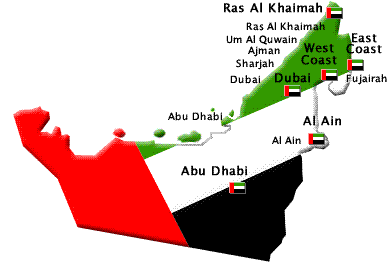
There are no elections or legal political parties in the UAE. Power rests with the seven hereditary sheikhs -- also known as emirs, and hence the area ruled by an emir is known as an emirate -- who control the seven traditional sheikhdoms (Abu Dhabi , Dubai , Sharjah , Ajman, Umm al-Qaiwain, Ras al-Khaimah and Fujairah -- each emirate is named after its principal town) and choose a president from among themselves. Since 1971, the ruler of Abu Dhabi, Sheikh Zaid bin Sultan al-Nahayan, has been president.
He was re-elected to his fourth consecutive term in late 1991 by his colleagues on the Supreme Council of Rulers -- the highest body in the country -- which usually meets informally. The Vice President and Prime Minister is the ruler of Dubai, Sheikh Maktoum bin Rashid al Maktoum. The Deputy Prime Minister is Sheikh Sultan bin Zayed Al Nahyan. There is also a Cabinet, and its posts are distributed among the seven emirates. (The members of the Cabinet are the government ministers, such as Minister of the Interior, etc.)
The Supreme Commander of the Armed Forces is the President while the second in command (Deputy Supreme Commander) is Sheikh Khalifa bin Zayed Al Nahyan, the Crown Prince of Abu Dhabi. The Minister of Defence is Sheikh Mohammed bin Rashid Al Maktoum.
The parliament is known as the Federal National Council (FNC). It was established on 13th February 1972 and is considered a landmark in the country's constitutional and legislative process. The FNC advises the Cabinet and the Supreme Council but cannot overrule them. According to the constitution, the FNC consists of 40 members who are drawn proportionately from each of the seven emirates. Each ruler appoints the members for his emirate.
The social services of the UAE are those of the most advanced and solvent welfare state. Education from kindergarten to university is free. The heavily-subsidized health care sector offers not only preventive medicine but also the very latest in surgical and medical techniques.
The United Arab Emirates has been fortunate in having the wisdom to take great pride in its heritage and to preserve it while at the same time bringing its people the advantages of life in the late twentieth century. The combination of the best of the new and the best of the old makes the country a fascinating and enjoyable place to live in and to visit.
The large number of educated women has had repercussions in the employment market. The most obvious is that more women are demanding and obtaining jobs. The government sector absorbs many of them in education and health but women are spread across the entire civil service and now account for around 40% of the total number of employees.
In some traditional areas women employees are clearly dominant. For example, 100% of nursery school teachers, 55% of primary school teachers and 65% of intermediate and secondary school teachers are women.
Women also play a greater role than men in the health services, accounting for 54.3% of the total number of employees. One out of every three doctors, pharmacists, technicians and administrators is a woman as is 81% of the nursing staff. And it is also true that the Faculty of Medicine and Health Sciences of the Emirates University is attracting more female than male applicants.
In addition to teachers and medical personnel, the university is producing female graduates in the arts, engineering, sciences and communications. The graduates of the Higher Colleges of Technology include specialists in computer technology, office and business administration. Women can also be found in responsible and important jobs in commerce, banking and the oil industry.