
Front SuspensionHere's some pics and details of the front suspension.
|
 Strut
Strut
The front suspension consists of Bilstein "upside down" strut inserts, 60mm diameter springs mounted in adjustable collars, an adjustable sway bar and some other minor mods to correct geometry.
The Bilstein inserts were picked up second hand and were something of an unknown quantity to begin with. Springs were also purchased second hand, although these were from anther IPRA competitor and were of roughtly the right rate. Fortunately this arrangement has worked out very well and the car's handling is neutral/very slight understeer.
The front sway bar is an adjustable aftermarket item. Being it's operation is less than satisfactory (the link system is far from either efficient or rigid), I won't mention the organisation who designed it (no problems with the organistion I bought it from who assisted me in getting it at least closer to right). Safe to say it's replacement is quite high on the list of priorities.
Other modifications to the front suspension include:
In the future, the front springs will be replaced by a larger diameter spring with a shorter coil. This will allow a reduction of the front track, thereby improving turn in. The issue at the moment is that moving the tyre any closer to the strut will result in the tyre rubbing on the spring.
|
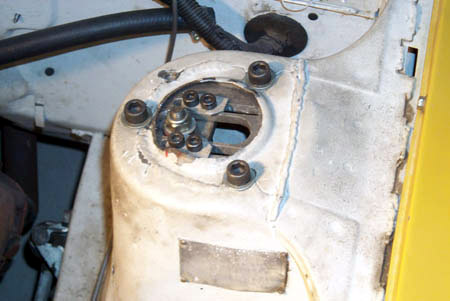 Strut Tops
Originally the car was equiped 260Z strut tops (mounted via a steel plate) and adjustable lower control arms for camber adjustment. This arrangement allowed for a maximum of 3.3 degrees of negetive camber. The downside of this setup was that each time the camber was adjusted, the toe needed adjusting as well - making it hard to adjust camber "on the fly". Therefore a new method of camber adjustment via the strut top needed devising. A good friend of mine had already done this for his rally car, hence I decided to copy his pattern.
The new strut tops were based on 10mm thick alloy plate. They have another plate (made of steel) which mounts the top of the strut insert. Moving the steel plate in relation to the alloy plate allows the angle of the strut to be changed - ie camber.
The strut tops utilise Noelathane bushes in place of spherical bearings. This was done for a number for reasons:
These new tops allow a maximum of 4.1 degrees of negetive camber and can be adjusted with the car on the ground. Toe does not need to be re-adjusted after changes have been made to camber
|
 Lower Control Arm Spacer
This picture gives and excellent view of the lower control arm spacer (the black spacer between the bottom of the strut and the steering arm). The purpose of this spacer is to raise the front roll centre back to where it should be. It does this by putting the lower control arm at roughly the same angel as factory. This is important as when the car is lowered front and back, as the rear roll centre doesn't move a great deal from standard. The front on the other hand does. Putting the front roll centre back where it should be keeps things in balance.
Front Suspension :: Rear Suspension & Brakes :: Head :: Induction :: Quad TB Manifold |
