|
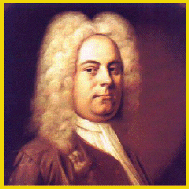
George Handel's 1685-1756 |
|
Music Playing
Hornpipe form Water Music <**Enjoy**> |
G H., born in Germany in 1685, was a man of the world. He moved to Italy at age twenty. When he returned to Germany three years later, he was fluent in Italian musical styles. Handel’s next stop was London. His German patron, the Elector of Hanover, allowed him to leave, if he returned in “a reasonable time”. Handel, 25, arrived in England in 1710. He never returned to Germany. England had recovered from the grim civil wars of the 1600s. London coffee houses were full of literary wits and raconteurs. Alexander Pope and Jonathan Swift wrote scathing satire. Addison and Steele filled their journal, The Spectator, with biting gossip. Italian opera was all the rage. Handel, who wrote opera Italian style, had a hit with his first production. England’s Queen Anne liked the brash young German. She made him a court composer. When she died in 1714, Handel’s old Hanover patron became King George I of England. He forgave his truant musician. On July 17, 1717, the King and his courtiers sailed down the Thames to a supper party in Chelsea. A barge followed with fifty musicians playing Handel’s Water Music. They played it three times, by royal request. The full Water Music Suite has twenty-five movements. Most are based on short dance tunes. This one is the “hornpipe” a popular English sailors’ folk dance. All the pieces feature woodwinds. A comment by the King told all we know of Handels’ love life: “His amours were rather of short duration and always within his profession.” Handel had a voracious appetite for food and drink, and his generosity was as large as his girth. He paid his musicians well and gave freely to charity. His friends remarked on his dry humor that was expressed in a pastiche of English, German, Italian and French. Handel produced Italian opera in London for more than thirty years. He was an honest but autocratic impresario who made and lost fortunes. His quarrels with his opera stars were common gossip in the press. Like many composers of his age, Handel was a skilled musician. He was a virtuoso on organ and harpsichord, and a proficient violinist and singer. Such versatility proved useful when opera went out of style. Oratorios came into fashion in the 1740s. Handel mastered this new form easily. Oratorios have no story line, but consist of biblical texts sung without accompanying action or costumes. Handel’s most famous oratorio is the Messiah. The English monarch leapt to his feet when he first heard the “Hallelujah Chorus.” Audiences have followed this tradition for 250 years. Handel died in 1759 at age 74-a foreigner who for nearly fifty years reigned as England’s national composer. He is buried in the Poet’s Corner of Westminster Abbey, London.
References:
 Richland College-Humanities 1301