

Go To What is it?
Go To How does it work?
Go To Why use RFID
Go To Where is it used?
What is it?
Radio Frequency Identification, uses radio frequency communication to automatically identify, track and manage objects, people and animals.
How does it work?
A low-frequency passive 'magnetically coupled' RF ID system is made up of two parts - a reader and tag.
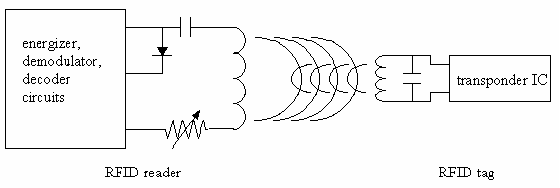
The tags include an electronic circuit (transponder) and tuned antenna-capacitor circuit. The tags are small sophisticated radio transmitters and receivers. They are powered by the RF field generated by the reader. Upon being 'powered-up' the tag will continuously transmit, by damping the incoming RF power field, its data. By 'pulsing' the incoming RF power field some tags can be written to in the field.
The RF/ID reader has three main functions: energizing, demodulating and decoding. The reader, using a tuned antenna-capacitor circuit, emits a low-frequency radio wave field. This is used to power up the tag. The information sent by the tag must be demodulated (like an AM radio). The encoded information is decoded by the reader 's on-board micro-controller. This information can then be used by a controlling computer.
In both the reader and tag, the antenna can be sized and shaped in different ways. Because of the small size of the tag, it can be formed to fit almost any situation. Since there is no contact or 'viewing' required, the RFID system allows great freedom of movement. Placement of the tag and reader are no longer critical.
Why use RFID?
Back toTOP
