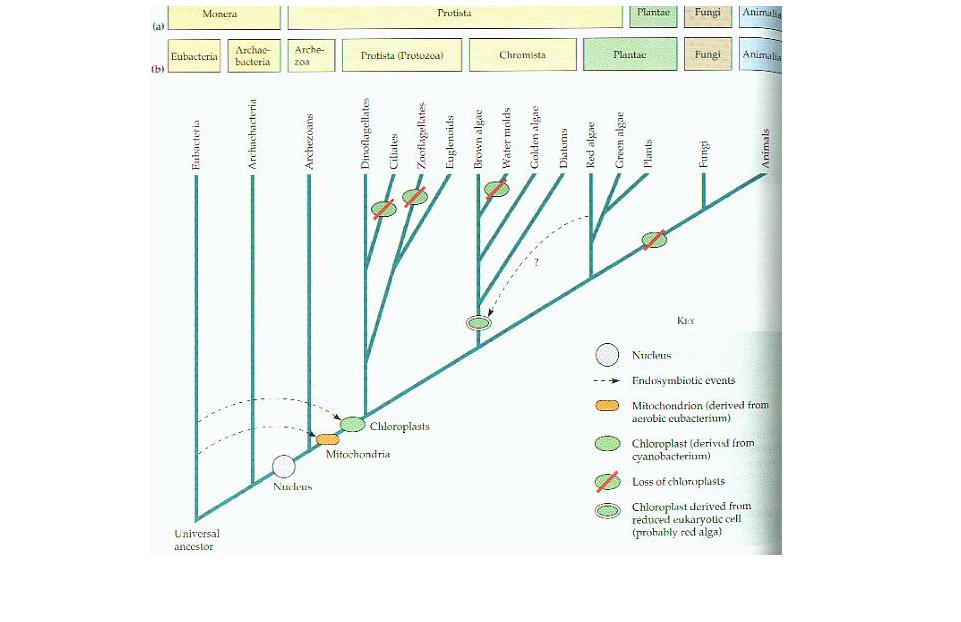
During the genesis of protists the cellular structures and processes of eukaryotes arose: membrane-enclosed nucleuses, chloroplasts, the endomembrane system, the cytoskeleton, 9+2 flagella, multiple chromosomes consisting of linear DNA molecules completely arranged with proteins, diploid stages in life cycles, mitosis, meiosis and sex.
Amoebas: use cellular extensions called pseudopodia to move and feed. Amoebas live mainly in fresh water environments.Ciliophora: live as solitary cells in fresh water. They use their cilia to move and feed.
Zoomastigophora: are heterotrophic, and they absorb organic molecules from the surrounding medium, or engulf prey by phagocytosis. They use a whip like tail to propel themselves.
Forminifera:
are exclusively marine. Forams derive nourishment from the photosynthesis of symbiotic algae that live beneath their shells.
Actinopoda: are components of plankton. These radiozoans live in marine environments.
Chrysophyta (golden algae): golden algae are named for their color, which results from yellow and brown carotenoids and xanthophylls accessory pigments. Golden algae live among freshwater plankton, and they have cells that are biflagellate.
Myxomycota: are plasmodial slime molds. They are heterotrophic. The feeding stage of the life cycle is and amoeboid mass called a plasmodium, which may grow to a diameter of several centimeters.Acrasiomycota: are cellular slime molds. The feeding stage of the life cycle consists of solitary cells that function individually. When there is no food, the cells form an aggregate mass of cells that function as a unit.
Oomycota: are water molds. These organisms consist of coenocytes hyplae, which is an adaptation analogous to the morphology of a true fungus. Most water molds are decomposers that grow as cottony masses on dead algae and animals mainly in fresh water.