

Audio Cables
To send sound from a source to a pre-amp, processor or DAC. Or to send signals from pre-amp/processor to poweramps or subwoofers.
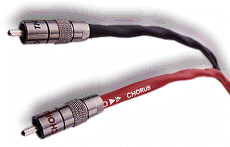 Phono leads- you
can use the included leads you get with the units until you decide on specific
make/models. It is worthwhile buying decent quality phono leads- improvement
in bass response, treble detail & less background noise due to better shielding.
Buy the most expensive one for the source to amp connection, and cheaper ones
for Pre-Power connections
Phono leads- you
can use the included leads you get with the units until you decide on specific
make/models. It is worthwhile buying decent quality phono leads- improvement
in bass response, treble detail & less background noise due to better shielding.
Buy the most expensive one for the source to amp connection, and cheaper ones
for Pre-Power connections
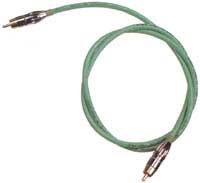 Digital coaxial (75ohm)
leads look identical but have 75Ohm resistance, and you only need one for
a stereo/multi channel signal. Don't go stupid with the amount you spend on
digital cables. £50 maximum each. Also used for composite video.
Digital coaxial (75ohm)
leads look identical but have 75Ohm resistance, and you only need one for
a stereo/multi channel signal. Don't go stupid with the amount you spend on
digital cables. £50 maximum each. Also used for composite video.
 Toslink (Optical)
cable. I would use optical cable for VERY long lengths, if required (for multi-room)
Say 20M or longer. I prefer coaxial cable as it's more durable.
Toslink (Optical)
cable. I would use optical cable for VERY long lengths, if required (for multi-room)
Say 20M or longer. I prefer coaxial cable as it's more durable.
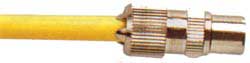 Aerial (75Ohm Co-axial).
Use well-shielded coaxial if possible, as usually you would have quite long
runs from the TV/FM aerial to the wall socket, including other routing throughout
the house for multi-room audio/visual setups. Used for TV aerials. Can also
carry FM from omni-directional FM radio aerial.
Aerial (75Ohm Co-axial).
Use well-shielded coaxial if possible, as usually you would have quite long
runs from the TV/FM aerial to the wall socket, including other routing throughout
the house for multi-room audio/visual setups. Used for TV aerials. Can also
carry FM from omni-directional FM radio aerial.
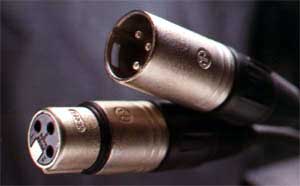 XLR (balanced). Used
for professional equipment. Lower noise floor than standard RCA, and higher
dynamic range. It has a separate ground (compared to RCA's shared ground with
the - wire) XLR's can also lock into place. Ideal for long lengths, ie, rock
venues. Used for analogue & digital connections between high-end CD transports,
DVD transports, processors & poweramps.
XLR (balanced). Used
for professional equipment. Lower noise floor than standard RCA, and higher
dynamic range. It has a separate ground (compared to RCA's shared ground with
the - wire) XLR's can also lock into place. Ideal for long lengths, ie, rock
venues. Used for analogue & digital connections between high-end CD transports,
DVD transports, processors & poweramps.
