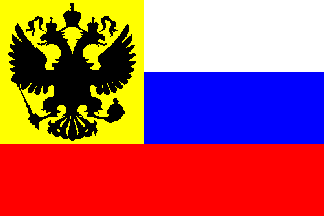
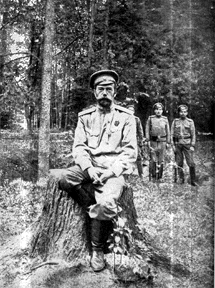
Russia was historically regarded as an Autocracy whilst under the reign of the Romanov Royal family. Nicholas II, the last Tsar was highly regarded by his people despite some key social, economic and political failures;
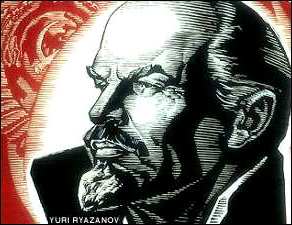
 Peasants, making up 82% of the total population were illiterate, 60% of Russians saw Russian as a foreign language and the poor harvests ultimately led to famines. The census of 1897, showed that for every member of the ruling class there were 164 peasants. As a result, when Lenin set up the Bolshevik Party, he recognised that gaining the support of this proletariat or peasant class would be the key to them gaining power. However the First World War (1914-1918) proved to be the final failure for the Tsar's administration and he was subsequently removed by a peasant uprising.
However some historians have debated on whether the Revolution of 1917 was actually caused by the First World War or by the accumulation of many events spanning the Romanov 300 year dynasty.
Peasants, making up 82% of the total population were illiterate, 60% of Russians saw Russian as a foreign language and the poor harvests ultimately led to famines. The census of 1897, showed that for every member of the ruling class there were 164 peasants. As a result, when Lenin set up the Bolshevik Party, he recognised that gaining the support of this proletariat or peasant class would be the key to them gaining power. However the First World War (1914-1918) proved to be the final failure for the Tsar's administration and he was subsequently removed by a peasant uprising.
However some historians have debated on whether the Revolution of 1917 was actually caused by the First World War or by the accumulation of many events spanning the Romanov 300 year dynasty.
Mainpage [Return]
|
Russia at the start of the twentieth century was a country in turmoil. It was economically and sociably a third world country. The country was ruled as an Autarchy by the Tsar or Tsarina. In reality the they ruled as a dictator, they made the country's decisions and those that opposed him were executed or imprisoned, as a result the people either conformed or became revolutionaries. The Romanov Family had ruled Russia for 300 years dating back to the 1613. Nicholas I, the Tsar of Russia from 1796-1855, said in 1832 "The Emperor of all the Russias is an autocratic and unlimited monarch. God Himself ordains that all must bow to his supreme power, not only out of fear but also out of conscience".It was such remarks that left many Russians feeling frustrated and repressed. The wish for reform was greatly wanted by the people and if the Tsar became too oppressive then they reacted in the only way they knew - Assassination. In 1881, the Tsar at the time, Alexander II was assassinated by a gang of revolutionaries who were unhappy at the repressiveness of the Tsar's rule. His assassination had been in a long line of leaders murdered by the Russian people. Alexander's death was the not the last high profile murder carried out by the wishes of the people. However despite the backwardness of Russia at the turn of the twentieth century, there was a period of rapid industrial growth in the period of 1893-1903. This growth allowed the people to believe that reform was finally occuring and that Russia would become a leading European and World country.
The position of the Tsar meant that all aspects of politics were not allowed. There was no proper parliament, no representatives of the people and ultimatley no opposition to the Tsar. When the Tsar became unpopular - this was the first area that the people wanted reform.
|