
The Great Sphinx
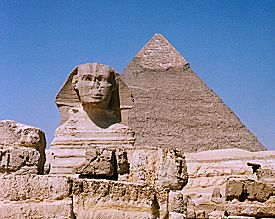
The sphinx is one of the most mysterious and amazing constructions of ancient Egyptian monuments. No one knows who exactly built this massive creature, and theories of alien beings from other planets constructing it cloud the mind. Many clues have been passed through history from many great people to give us an idea of who and when the sphinx was built. Herodutos, the father of history, and Napoleon Bonaparte were some of those.
Egyptians believed one way to reach immortality was through constructions that favored the gods, pharaohs, and future generations aswell. Egyptian builders labored to extraordinary extents, some times even to death. The pyramids of Giza are some of the greatest wonders of the ancient world. They represent 3 thousand years of ancient Egyptian history.
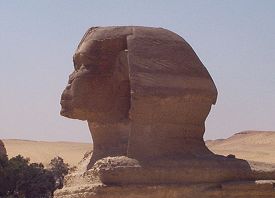
Another magnificant monument at Giza is the Great Sphinx. The Great Sphinx has stirred the immaginations of poets, scholars, adventurers and tourists for centuries. The first colossal statue of pharaonic Egypt, it presides majestically over the Giza necropolis. It has a lion's body and the head of a king, which wears the royal nemes headcloth and false beard. Although badly weathered, the features of King Khafre are similar, although many Egyptologists disagree.
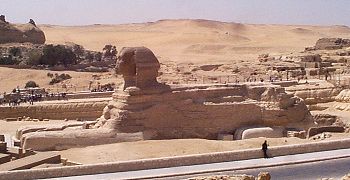
The Greek word "sphinx" derives from the Egyptian shesep-ankh, which means "living image." This magnificant creature is carved from a rock of poor-quality limestone. Some scholars believe that it was a part of the quarry for Khufu's pyramid because of the the poor-quality limestone used. Although others believe the location of the Sphinx in relation to Khafre's mortuary complex were carefully chosen.
The function of the Sphinx is much debated. Lions were guardian figures in ancient Egypt, and there is a theory that the Sphinx was built as the guardian of the Giza Plateau. **According to the German Egyptologist Herbert Ricke, it was associated with the solar cult and was created by its Fourth-Dynasty sculptors as the image of Hor-Em-Akhet, "Horus of the Horizon", an aspect of the sun god and the name given to the Sphinx in New Kingdom times.**
For the Sphinx was standing against the "horizon" formed by the pyramid of Khufu and Khafre. The pyramid of Khufu was called "Horizon of Khufu" in ancient times aswell. For anyone approaching Giza, the head of the Sphinx, framed by the two pyramids behind it might resemble the hieroglyph for "horizon." It represents the sun rising between two mountains. Since the Sphinx does resemble Khafre, and Khafre bore the title Sa-Re, "Son of Re", in ancient times, the Sphinx is probably best understood as a portrait of Khafre as Horus, paying homage to his divine father Khufu, who was identified with Re, the sun.
Since the main body of the Sphinx was carved from weaker rock, it was layered with large blocks of Tura limestone, similar to that which covered Khafre's pyramid. The head and neck, carved from a stronger rock, were left uncovered. The beard, which is now lost, must have been sculpted together with the head. Mainly because it would have been impossible to attach such a heavy piece from under the Sphinx's chin. Giovanni Battista Caviglia found a small part of the beard in 1817. The fragment is now in two piece's that are in the Cairo and British museums.
**...** = From book Ancient Egypt, Oxford.
|
|
Copyright © 2002-2004 Tony E Productions. All Rights Reserved.
