
The Heretic King
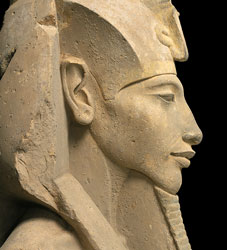
Ancient Egypt was under the rule of Amenhotep III, and a time of peace and prosperity ran through the land. The Nile flourished, and monuments were being built. But one man, a man who would soon claim throne had a vision for Egypt. He had a dream that no one else had dreamt before. This dream was no ordinary dream. He was dreaming of an Egypt with one single god. One single god was being praised and worshiped. He visioned an empire based on monotheism.
Ancient Egypt at the time was polytheist. People praised a god for harvest, and praised a different god for health. It was an independent world for independent offerings and prayers. But one man decided to put all his effort into changing that. Amenhotep IV wanted Egypt to worship the Aten, the sun god. He believed that the Aten deserved its own deity and its own cult to be worshiped. That the Aten created the Earth, created the stars, and the Universe, inside out. He believed the Aten was reborn everyday with the sunrise, and set down to the afterlife with sunset. This gave him the opportunity for daily worship.
Amenhotep IV claimed throne shortly after the death of his father, Amenhotep III (1383-1345 BCE), and began his dream as fast as possible. For a big start, Amenhotep IV changed his name to Akhenaten. This shocked the Egyptian public, because his old name Amenhotep IV contained the name Amen, in favor of Egypt's primary god Amun, Amenhotep. So in this new name of his, Akhenaten, the name Aten was favored, Akhenaten. This was a big step for him. The people of Egypt were already starting to realize Akhenatens motive and did not like it at all.
Akhenaten began setting up temples of worship whereas the general public was allowed entrance, not only the priests. Although there was a problem, the capital of Egypt was Thebes and it was too closely related with the god Amun. Akhenaten wanted to get rid of the god Amun and replace him with the Aten. So he sent his soldiers to Thebes to kill the priests and worshipers, destroy the capital and wipe out all the inscriptions that dare mention anything according to Amun. The name Amun was banned from all Egyptian cities. An amulet was found near Memphis depicting the name Amun etched out of the hymn on the back, the owner did so in fear of being persecuted and murdered for having it there. Even at the very top of gigantic obelisks, the name of Amun was chiseled out.
This was madness. Ancient Egyptians were left with no capital and were in great denial. Akhenaten realized this, so he decided to build his own capital for Egypt. But where? He set out into the desert accompanied by priests to find a location for his new capital. He ended up at Tel-El-Amarna, or simply Amarna. Akhenaten began construction here in the name of the royal Aten. He brought his best builders and architects out in pure desert to build the most luxurious capital Egypt had seen. Akhenaten named his new capital Akhetaten, in favor of the Aten, Akhetaten. As a great accomplishment as it was, this was a city built in a hurry, there was still scaffolding when the royal family moved in.
The reason Akhenaten had chose this spot for his capital was because the surrounding mountains, running smooth in a straight line, had a sudden break in the cliffs. It was a perfect slot in which when viewed at an angle, the sun came up and down perfectly in its setting. It was a dream come true, what better idea for the birthplace of the Aten. Akhenaten thought this was a gift from god, to witness first hand the rebirth of the Aten and its descent into the afterlife. With Akhenatens new capital, he built the most luxurious temple he could and aligned it towards the break in the cliffs. This temple is known as the Window of Appearances. Reason being, when the sun would rise, sunrays would hit directly through the main window of the temple.
Akhenaten had a short-lived reign, with rebellions sprouting all over Egypt, he died shortly after celebrating his seed-festival early. He died of natural cause at the age of 31. Afterwards Smenkhkare assumed throne. Many believe that Smenkhkare was a name Nefertiti overtook so she can rule Egypt after Akhenaten's death. Many others believe Smenkhkare was a later son of Akhenaten. Although Nefertiti mysteriously disappeared after the death of Akhenaten, she might of had disappeared with the name of Nefertiti and ruled as Smenkhkare. Soon after the end of Smenkhkare's reign, a young boy; son of Akhenaten claimed the throne and named himself pharaoh. This was the boy king, Tutankhaten, aka Tutankhamun.
Akhenaten introduced many forms of culture never before seen in Egyptian civilization. He introduced an erratic form of art. Loose and sloppy yet elegant and stylish. It was the way he was depicted in his reliefs and statues. He was depicted with apple knees, and slouching backs, tall knecks, long arms and legs, and sagging bellies. Perhaps it wasn't on purpose that he was depicted in this manner. Maybe he suffered from a disease of some sort. Egyptologists have related many diseases and only one has seemed to match. It is called Marfan Syndrome. Perhaps Akhenaten suffered from marfan syndrome, or perhaps it was a new style Akhenaten briefly brought to the Egyptian Culture.
Akhenaten's Tomb was found but there was no coffin holding his remains. What could of had happened to Akhenaten's corps? In 1907, Edward R. Ayrton stumbled upon what is now known as KV55. Ayrton, a young English Egyptologist who had been appointed a year previously as chief excavator for Theodore M. Davis. In Tomb 55, which is located in the Valley of the Kings, Ayrton found a abandoned coffin of an unknown man hidden under rubble of rocks and sand. The coffin's face was chiseled out and its labeled cartouche as well. It was done so that no one would know who it was. Egyptologists debate on whether it is Akhenaten or not, and science is taking its role with cat scans and skeletal reconstruction for identification.
Overall, Akhenaten has contributed an enormous amount of culture as well as monotheistic views. He was the first in recorded history to practice monotheism. His heretic actions immortalized his image in history. He earned himself a title as the heretic Pharaoh.

Copyright © 2002-2004 Tony E Productions. All Rights Reserved.
