| Home - Discussion
Forum & Chat - Articles Forum FAQ - Species Profiles - DIY Projects - Books - Photo Gallery - Free Email - Annotated Links |
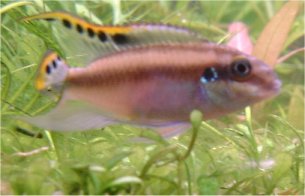
The ubiquitous Kribensis (Pelvicachromis pulcher) can be found commonly in most pet stores in Australia. Its name is derived from Latin, Pelva meaning "belly" chromis "colourful" and pulcher "beautiful," thus the name beautiful belly. In most stores, the juvenile krib sports dull or pale colours and only in maturity do the females show a dark purple/red spot on its belly. The males tend to be larger (up to 10cm), slimmer and with tapering dorsal and anal fins. The females are rather smaller, rounder and generally more colourful. Sexual maturity is usually reached in 5 to 7 months.
These dwarf cichlids originate from Southern Nigeria, and can be found in the brackish deltas. With this in mind they tolerate most water conditions and will breed readily in soft, slightly acid and well planted tanks. Partial to most foods (omnivorous), they will readily accept prepared foods. To improve colouration, a diet supplemented with live foods such as black worm or brine shrimp is recommended. Caves should be provided and a tank larger 50 litres should be provided to prevent injuries stemming from the krib's propensity to defend its territory with gusto.
Pelvicachromis pulcher is to be heartily recommended as a beginner fish to introduce breeders to the world of dwarf cichlids. They will spawn in most water conditions, and generally in caves. With no caves to spawn in, they will resort to flat smooth rocks, or the under sides of driftwood. The fish do not seem particularly fussy about pairing, and a male and a female may be introduced to each other without too many hassles. Hiding areas must be provided, as initial contact may prove injurious to the male. Prior to spawning, the female's belly turns black and the purple/red spot becomes intense. She will be found shuddering to the male, attempting to entice him to the spawning ground, the male may reciprocally nudge the female on the belly. A spawn is characterised by the disappearance of the pair for several days. The eggs are roughly 1-2mm and an orange to red colouring, hatching will take roughly 2 to 3 days. Wrigglers can be brought up on a diet of baby brine shrimp, microworms and even crushed flake food and should be left with the attentive female until the next spawn. The male usually does not require removal, as they guard the territory from intruders. pH supposedly has an affect on the gender of the young, acidic leading to females, and alkaline to males. As a side note, I have found java moss to be highly useful in providing hiding areas for the fry as well as a food source of algae and micro-organisms.
Aside from their slight aggression, kribs are inquisitive and intelligent fish that should be respected. With their undemanding conditions and ease of breeding, these fish are a great primer to dwarf cichlid reproduction. So the next time you visit the pet store, why not give these charming little fish a go?