To successfully build a complex and interesting aquascape,
there are several simple rules that can be followed. Please note, that
you should already have the knowledge of how to grow plants successfully
before attempting to create more complex aquascapes.
There must be an aim in all things, and in Aquascaping,
my personal aim is to create an aesthetic piece of art, something the
eye will find complex, interesting and most of all, beautiful. To accomplish
this goal, there are some basic concepts. Complements, contrasts and
tension.
Triangles
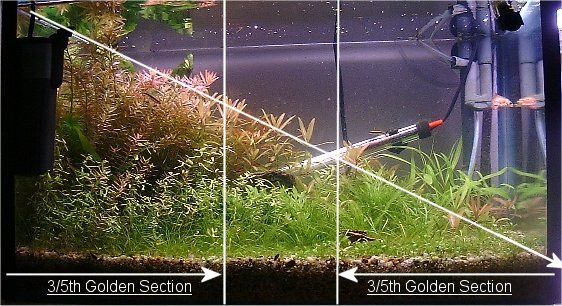
Triangles provide visual climaxes. The eye generally follows
straight lines along an image. In a tank the diagonals allow the eye
to follow the plants on a "path". In my 29 gallon, There are
several diagonals/triangles. The main one begins from the far left with
the Rotala rotundifola. This is the climax, or centre point of my tank.
The slope descends into some Hygrophila polysperma which provide a similar
colour but different leave shape. Surrounding this triangle is a "band"
of green. This contrast creates a complexity that I believe is useful
in creating an aesthetic picture. Triangles are created by varying levels
of height. This is created naturally within my tank, the Rotala shoots
for the surface and the Hygrophila grows at a slower rate. to the sides
of the Hygrophila are some H. difformis and H. sp. (unknown), these
both grow quite low and provide contrastst in colour and leaf shape.
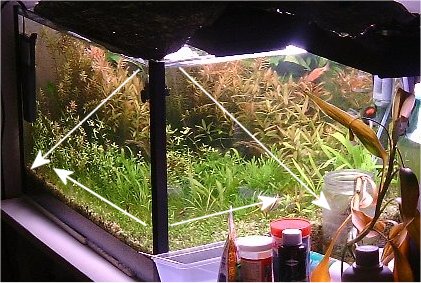
As you can see, there is another triangle in use here.
As the tank is viewable from two sides, it is important for me not to
clutter the open spaces. The furthest left of this picture shows the
small leafed plant playing a role in complementing the Rotala rotundifola.
Flats
Open spaces are very important in building planted space.
They allow a space for fish to swim in, and a space to plant high light
and 'special' plants. I think a flat area provides alot of space for
experimentation, particularly in creating complex floors. Hair grass,
Glossotigma and Echinodorus tenellus form my carpet, and the leaf shapes
perfectly blend with each other. Hygrophila difformis makes an interesting
foreground plant, and will throw out runners in good conditions.
Terracing
To create a sense of depth, most aquarists have a shallower
gravel bed in the front, and a deeper one in the back, (e.g 5cm ->
13cm). This can be taken one step further, by building areas of deeper
gravel. This was done in my tank by placing the length of rock along
the back, and damming up gravel behind it. This allowed me to plant
the Rotala at the back as though it was a very "tall plant".
By building these terraces, it creates steps and aids in triangle building.
Misc Techniques
I'm sure this has been done to death, but to attach java
moss to rocks or driftwood, wrap black cotton thread around it, and
leave it for a couple of weeks. To attach anubias or java fern, twist-ties
are more suitable.
It is not advisable to plant centrepieces, directly in
the centre. If you see the first picture, there is the two lines down
the centre cut at around 3/5th of the tank. This is known as the Golden
section, It is where things seem "paradoxically more balanced,
more appealing to our esthetic sensibility." (Amano, NAW). when
placing rocks it is good to remember this.
Also (unlike what I've done), it is a good idea to keep
heaters out of the way, it is unsightly. This can be done by either
buying a Lifegard heater module or placing it behind plants/rocks. The
same goes for output of filters and powerheads. The reason for my placing
is out of practicality.
Conclusion
These are only suggestions, in the end Aquasculpture is
a highly personal thing, every person should design their tanks to their
own tastes. Allow your own creative juices to run wild and enjoy creating.
If you do not enjoy it, take a break and try again later. Aquasculpture
must come from both the heart and the mind.
Next Section : Plant Choice
MAIN PAGE


