| October 2001 Issue |

 '''''''''''

|
 main
timeline
newsflash
projects
lab at home
funfacts
links
main
timeline
newsflash
projects
lab at home
funfacts
links
|
|
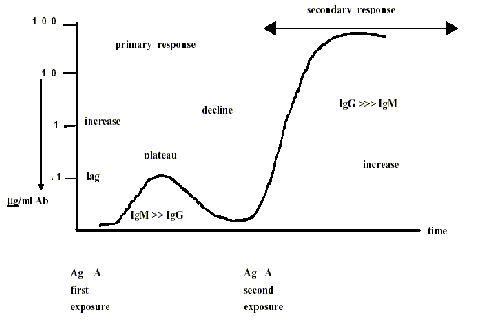
Do you remember the first time that you receive your first injections, either at school or the clinics? Do you know what they are for? They are given to children and adults as a series of immunizations, as protection against serious diseases. Some diseases, such as Hepatitis B are one of the most serious types of viral hepatitis. It can cause acute disease resulting in jaundice (yellowing of the skin and eyes), dark urine, nausea, vomiting and extreme fatigue for several weeks. Some individuals may have an acute infection with no symptoms. However, do you know what takes place when you receive the injections? Let’s take a look at what takes place when we immunize a rabbit, to demonstrate how antibodies help in protecting the host. The rabbit is first injected with the first dose of bovine serum albumin (BSA). This acts foreign particles to the rabbit, as the rabbit do not have this protein.
 Once the antigens are circulating around the body system, the rabbit’s immune system detects the presence of such particles and sends its first set of antibodies, IgM (Antibodies are formed from our bodies B cells). IgM attaches themselves to the antigen receptors and bring them towards the lymph nodes for processing. Once the antigens are circulating around the body system, the rabbit’s immune system detects the presence of such particles and sends its first set of antibodies, IgM (Antibodies are formed from our bodies B cells). IgM attaches themselves to the antigen receptors and bring them towards the lymph nodes for processing.IgM is the major component in the primary response followed by IgG antibodies. This first response declines soon after the first antigen challenge. The second dose of antigen is then introduced 1 month later, into the rabbit; this time the dose is reduced in amount. The second response to the antigens is more swift and efficient as IgG as higher affinity to the antigens. Also, there are more memory cells that can recognize this specific antigen, so more IgG are produced to target it and bring it away from the system. We are immunized against Hepatitis B in a similar way, so that our immune system can recognize the Hepatitis B antigens and produce efficient “killer” bodies, the antibodies, to prevent us from being susceptible to the disease.
|