SPY PROFILEs: Edward Snowden's intelligence
operative father Lonnie & granddad ‘Admiral Joe’
Follow the breadcrumbs also on his
grandfather...... "Rear Admiral Edward Joseph Barrett (born August
14, 1943) is a flag officer in the United States Coast Guard serving as chief of systems of the United States Coast
Guard, serving from 1966 to 1999. He is the grandfather of whistleblower
and former NSA contractor Edward Snowden. Lonnie Snowden, Edward's father,
was also an officer in the Coast Guard who has worked on national security
issues in his career."
https://www.intelligence.gov/how-the-ic-works#our-organizations
Edward Snowden's father
Lonnie is an executive spy with the Coast Guard Intelligence Agency – Snowden’s
grandfather was an Admiral in the Coast Guard national security department
lonnie g. snowden coast guard intel covert manager—aka “Lon”, Ed
Snowden’s influential dad.
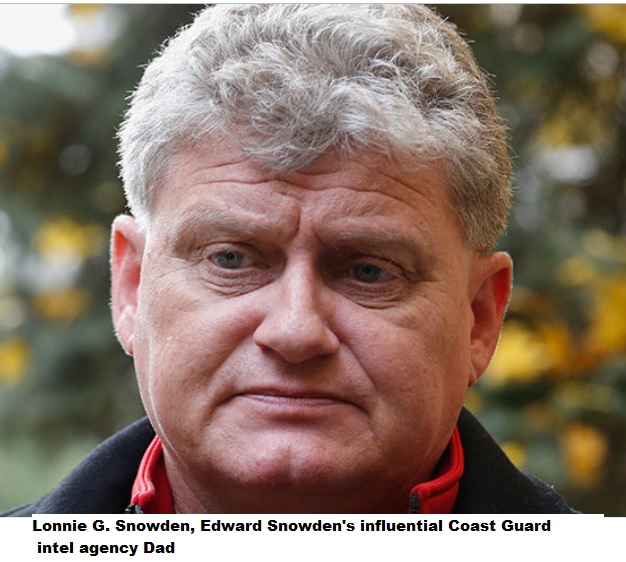
Edward Snowden's father Lonnie (aka “Lon”) is an executive officer spy with the
Coast Guard Intelligence Agency – Snowden’s grandfather was an Admiral in the
Coast Guard national security department
U.S. Coast Guard Intelligence spy agency has been working in Dulles
Airport and along the Texas border to assist in ICE "operations"
along with Homeland Security undercover & unformed personnel for two
decades already….
Although the United States Coast Guard has utilized intelligence capabilities since the service’s inception in 1790, the Coast Guard was not included as a formal member of the Intelligence Community until December 2002. From the days of Revenue Cutter Captains walking the docks, to its pioneering use of signals intelligence during prohibition, and with today’s use of national technical means, many Coast Guard successes rely on intelligence. As a regulatory entity, a law enforcement agency, a military service, and as the premier domestic maritime agency, every day the Coast Guard executes a very broad area of mission responsibility. Prior to 2002, the Coast Guard contributed to and benefited from Intelligence Community analysis as a customer. However, increasing transnational threats such as drug smuggling, weapons proliferation, and illegal migration, some involving or supporting international terrorist organizations, accentuated the need for and the benefit of Coast Guard membership within the CIA-FBI-NSA-NRO Intelligence Communities.
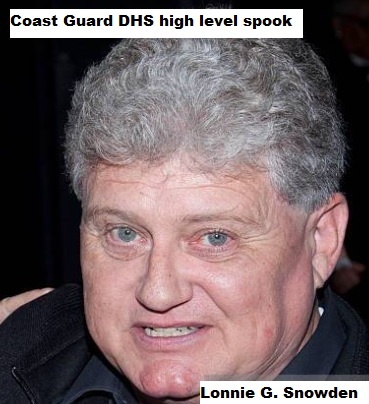
more on!: SPY PROFILE: Edward Snowden's father Lonnie & Admiral
Grand pappy
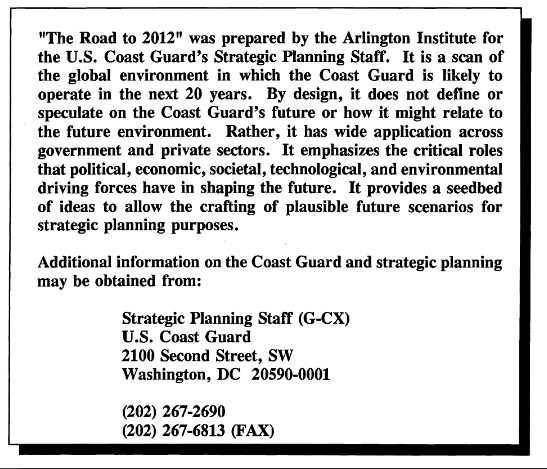
https://www.uscg.mil/Portals/0/Strategy/Article%20Road%20to%202012%20Mar%201993.pdf
This spooky "wet"
human brain internet interface & biogenetic/viral nano engineering goes way
back to 2002 and even in US Coast
Guard Intelligence Spy Agency research
and publications (Arlington Institute)-- NOTE: Edward Snowden's father has/had a very high position
in this Coast Guard spy agency
http://web.archive.org/web/20060825130716/http://arlingtoninstitute.org/library/Small%20Security.pdf
(2002) Similarly, computing will not be the
same after nanodevices become a reality. Nanoelectronics advances have recently resulted in nanotransistors, diodes, relays, and logic gates, all of
which are computer components. Nanotech researcher Ralph Merkle
writes that in the coming decades nanotechnology could
yield a supercomputer so small that it could barely be seen in a light
microscope. Nanotechnology is developing very quickly. In 2001, the RAND National Defense Research Institute
published a report, The Global Technology Revolution, that
identified technology wildcards and stated that “Another approach known as
molecular electronics would use chemically assembled logic switches organized
in large numbers to form a computer. These concepts are attractive because of
the huge number of parallel, low-power devices that could be developed, but
they are not anticipated to have significant effects by 2015.” But on October 18, 2001, The
Washington Post reported the success of Lucent Technology Bell Laboratories in creating the first such
device through “chemical self-assembly.” If this new device is viable, at the
rate of present technological change, it is unlikely that it will take 13 years
to convert this breakthrough into practical use. Nanoelectronics
researchers also are working on DNA computing, which could produce very
large-scale parallel processing and ultrasensitive detectors for gas molecules
and biological compounds. Nanodetectors of this kind
could theoretically sense single atoms or molecules of selected substances.
Also, the Defense Advanced Research Projects Agency DARPA has a nanoelectronics
program that is exploring and developing material processing technologies,
quantum and conventional devices, and device architectures for a next
generation of information processing systems and subsystems.
trSeeponsJaulolya oc7sr, s20eel1d3c ·
According to one Federal Security Services (FSB)
bulletin on their continued debriefing of Snowden, and analysis of the information
he has provided Russian intelligence officers, his father, Lonnie Snowden,
was an officer in the US Coast Guard during the 11 September 2001 attacks on
the United States who had “direct knowledge” of the true events that occurred
and whom the real perpetrators were.
Being directly affected by the events of 9/11, this
FSB bulletin says, Snowden “self initiated” a multi-year
effort to gain access to America’s top secrets, a mission which when recently
completed led him to contact various international reporters, including Hastings,
whom he believed could be trusted with disseminating the information he had
obtained.
Though known to us directly from our Kremlin sources
as to the exact connections Snowden’s information proves regarding 9/11 and
both the Bush and Obama regimes, and the even more horrific event soon to come,
a June 2013 Defence Advisory Notice (DA-Notice) prevents our being able to…at
this time.
Likewise, and as the assassination of Hastings clearly
shows, the Obama regime claims a legal right to kill anyone it so chooses
without charges or trial they believe may threaten US national security, and
what Snowden’s information reveals definitely falls into that category.
What can be said though, there is a critical reason billionaires all over the world have been dumping
their stocks, and fast; and those who are not able to read between the lines
will soon find themselves in the most dangerous situation they’ve ever encountered.
-----
itOgShcitofber p3Sico0nnnlts,o gren20ui1nd9 ·
Here’s
what the Corporatocracy is up to today, OCTOBER 30, 2019
It’s
#WhistleblowerWednesday today, where,
each Wednesday, we focus on the whistleblowers – the brave activists who work
to expose the corporate takeover of our democracy, what we call the US Corporatocracy...
Some
of the most important patriots in US history were Whistleblowers. In fact, the US
was practically founded by Whistleblowers. For a brief history, you can check
out the first edition of #WhistleblowerWednesday in
our October 2nd podcast.
Today,
we’ll focus on whistleblower Edward (Ed) Snowden, who released the largest trove
of classified government intelligence documents in U.S. history. We’ll get into
the substance of his leaks in a moment, but first, here’s a quick bio—
Ed was
born on June 21, 1983, in Elizabeth City, North Carolina. His father was an officer
in the Coast Guard, and his mother, a clerk at the U.S. District Court. In high
school, Ed got sick and missed almost a whole year of school, so he just
dropped out and got his GED and began taking college courses. Ed has scored
above 145 on two separate IQ tests (for us mortals, that means
he’s got a “Genius” IQ…).
Ed says
he always expected to work for the federal government, like the rest of his
family. In 2004, he enlisted in the United States Army Reserve. And a few years
later, in 2006, he got a job with the CIA.
Over
the next 7 years, Ed would distinguish himself as a “computer wizard”, quickly rising
in the ranks of the CIA, and then later as a contractor on CIA and NSA projects.
By 2012, Ed says, “I had practically unlimited access to the communications of
nearly every man woman and child on Earth who’d ever dialed a phone or touched
a computer...From my terminal at the NSA, [I] could watch entire villages and
see what everyone was doing. I watched the NSA tracking people's Internet
activities as they typed... I became aware of just how invasive U.S.
surveillance capabilities had become. I realized the true breadth of their.....
www.WAKINGJUSTICE.org
Snowden
is instinctively careful about entering anything about himself into the
permanent record of “Permanent Record.” The man who emerges from such “personal
disclosures” seems consequently guarded and meticulous — ideal traits for a spy
or a whistle-blower.
Born
in 1983 in North Carolina, Snowden comes from a family whose service
includes the F.B.I. (his grandfather), the Coast Guard (his father), the N.S.A.
(his mother) and the Army (himself). He remembers the first thing he ever hacked was
bedtime, changing all the clocks in the house so that he could stay up later on
his sixth birthday. As a teenager, Snowden learned how to hack school,
examining the class syllabus to figure out how he could exploit its weaknesses;
the goal was to do the least amount of work without flunking out.
School
was at best a distraction, he says....the internet of the 1990s was a
liberating space, he says, where adopting and discarding different avatars
could open up possibilities for more authentic expression and connection.
“This
ability to reinvent ourselves meant that we never had to close our minds by
picking sides,” he recalls, “or close ranks out of fear of doing irreparable harm
to our reputations.” (In the 2014 book “The Snowden Files,” the British
journalist Luke Harding describes online posts made in the early 2000s under
the handle TheTrueHOOHA — identified by Harding as
Snowden — that extolled “sink-or-swim views on Social Security” and “the joys
of gun ownership.”)
Galvanized
by 9/11, Snowden eventually turned his technical know-how into a career
in intelligence, obtaining a top-secret classification at the age of 22 and
bouncing around between different contractors before becoming
disillusioned at some point during the Obama presidency. “I fully supported
defensive and targeted surveillance,” Snowden writes, but as a young systems
administrator he was learning that the government was pursuing “bulk
collection” — indiscriminately vacuuming up data from Americans’ internet
communications and storing it for possible later use.
---
The
second half of “Permanent Record” reads like a literary thriller, as Snowden
breaks down how he ended up in a Hong Kong hotel room in the summer of 2013,
turning over a trove of classified documents to Glenn Greenwald and Ewen MacAskill of The Guardian,
Barton Gellman of The Washington Post and the filmmaker Laura Poitras.
Julian
Assange wanted Snowden to release the information through WikiLeaks, but the
site’s “total transparency,” Snowden says, wouldn’t allow for proper
authentication and curation of such incendiary
material. Snowden emphasizes that the distinction was important to him — not
that the government would see it that way. “Whereas other spies have committed
espionage, sedition and treason,” he writes, “ I would
be aiding and abetting an act of journalism.”
In
his acknowledgments, Snowden thanks the novelist Joshua Cohen for “helping to
transform my rambling reminiscences and capsule manifestoes into a book.”
---
Snowden did not finish high school so he has no
high school diploma or even any college degrees, yet he is a great critical thinker
and he achieved the highest level top secret clearance in the entire gov”t.
most of what he learned was thru the internet due to his own curiosity.
He was raised by a conservative multi-generational
military family.
father, commander in coast guard; grandfather, admiral in navy.
he enlisted in the army due to “911”, and later became a fed agent
in NSA or CIA, he had to swear allegiance to the US Constitution.
CIA/NSA... ultimately he worked in both and helped
develop cloud storage and associated algorithms/programs for spies.
------
Edward Snowden
Interview (2017) - My Analysis
This is interesting.
Snowden appears, to me, to be a very naïve, but very idealistic, eloquent, and
intelligent person. Naïve in the intel sense of naïve.
As astute as he is about public matters, he apparently has a remarkably shallow
knowledge and understanding of covert methods. That implies to me that his role
involved more specific technical training, and duties, but within very limited
confines as to "need to know". An avid student of published
histories, he lacks deeper insights as to anything "off the public
record" and outside of easily accessible public speculation.
Oddly, I sense that Snowden has a deep
admiration for journalism and perhaps even some desire to become or be a
journalist. Not sure if he sees himself as one, but there are suggestions in
that direction, that he identifies with journalists or with working with
journalists far more than he identified with working for and with the
government. He does express some indications as to deeper conflicts existing
between intelligence community values and its morality versus the law and its
relation to public morality. Something that would have stood in his way as to
advancement in intelligence work, but not in public journalism
---
https://www.phillymag.com/news/2015/01/11/edward-snowdens-father-speaks/
In the course of reporting on John and Bonnie Raines for
our January issue, writer-at-large Steve Volk spoke with a source who had a
uniquely personal take on the plight of whistle-blowers — Edward Snowden’s
father, retired U.S. Coast Guard intelligence officer Lon
Snowden. Lon appreciated how John and Bonnie’s story
parallels his son’s, and agreed to share his perspective with Philadelphia magazine.
With his permission, published for the first time here is Lon Snowden’s essay —
a father speaking in his own words about the controversial and historic actions
of his son; fellow activists
(editor's note: please be aware that
within the labyrinthine U.S. intel spy agencies there is much competition and interdepartment turf wars, and that Democrats and
"progressives" abound in these covert agencies, feeling heads above
their Republican fellow operatives, thus leading to "fifth columns"
in many intel agencies which are allegedly non-partisan.
Here it is shown, clearly, the Snowdens have been competing for glory for some time with Republican agents in the agencies, if given the chance. They are all still masters of often illegal covert operations, equally guilty (as Democrats) of any transgressions of the ideals of our Constitution (not only Republican intel agents do this!) and more likely than not, puppets of mega-corporations and Pentagon billionaire business generals).
“My
son collaborated with carefully selected journalists who possessed the
integrity and ability to protect his identity, but all concerned — including my
son — agreed that it was critical to expedite the reporting on the disclosures.
The actual discussions that took place in a Hong Kong hotel room regarding my
son’s decision to reveal his identity have been captured in Laura Poitras’s award-winning documentary film Citizenfour. Beyond information that is a matter of
public record, I have no unique insight regarding the decisions made by my son
or the collaborating journalists and publishers. But considering the
ever-increasing evidence of insidious constitutional and human rights abuses
committed during the Bush and Obama administrations, I’m now convinced they
made the correct decision. The underlying logic of my son’s decision not to
remain anonymous is best explained in his own words as shared during a video
interview on the Guardian website on
June 9th, 2013.
Hoover
and Nixon would have surely leapt at the opportunity to conceal their abuses of
power under the cover of a heavily redacted executive summary, but that didn’t
happen thanks to the actions of brave citizens like Daniel Ellsberg and the
Media Eight and bold journalists like Betty Medsger.
They delivered the truth, the whole truth and nothing but the truth to the
public. As a result, the American citizenry is better informed and knows it is
dangerous to assume that our representatives are beyond reproach — including
those at the highest levels of government. We owe that awareness to lessons
learned in the 1970s, and those lessons have been underscored again and again
since 2001 thanks to courageous journalists like the Intercept’s
Glenn Greenwald and Laura Poitras, James Risen of
the New York Times, the Guardian’s Ewan MacAskill and others. The government tried to spin the
Media break-in as a threat to the public, when in fact the FBI did not fear a
foreign power in 1971 — it feared an informed citizenry.