
|
|
|
ETHIOPIA TIMES Issue #17 March 15th 2008.
REMEMBER ADWA, MARCH 1896
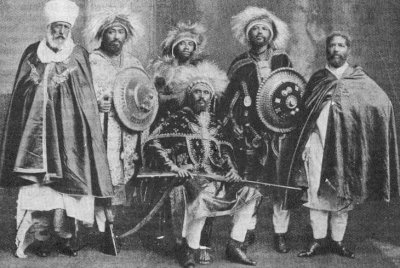 Photo L: Ras Makonnen, father of Emperor Haile Selassie I, seated with other captains of Menelik's Imperial Court who fought valiantly at Adwa.
March 2nd 1896, on this day Ethiopia defeated the Italian colonial army in the Battle of Adwa. This victory signaled the decline of European colonialism in Black Africa. When Menelik II, one of the greatest rulers of the Negro race, came to the Ethiopian throne in 1889 the Italians thought that he would surrender power to them because they had been supplying him with arms. In May of that year Menelik signed the Treaty of Wichale giving the Italians some land in the Ethiopian northern province of Tigrai and the adjacent highlands. The Italians tried to swindle him by having two different versions of the treaty-an Amharic, and Italian one, with Article 17 reading differently in each version. The Italian version said, “The Emperor consents to use the Italian government for all the business he does with all the other Powers or Governments.” The Amharic version said, “The Emperor has the option to communicate with the help of the Italian government for all matters that he wants with the kings of Europe.” When Menelik realized that he had been cheated he rejected the treaty and ceased all gratuities from the Italians. In Europe all countries except Turkey, Russia, and France chose to support the Italian version of the story. Menelik confronted the Italians, angering Rome, who ordered the Italian governor of Eritrea, General Oreste Baratieri to retaliate. He captured the cities of Adigrat, Adwa, and Makalle from the Ethiopians and was noted as a hero in Italy. The Italians fatally underestimated the Ethiopians, thinking that they were barbarians who needed Roman civilization. Bartieri returned to Eritrea boasting that he would bring Menelik back in a cage, not knowing Menelik had assembled 196,000 men in Addis Ababa. Over 50% of these were armed with modern rifles. General Bartieri could only muster 25,000 men and when he realized that he was outnumbered he retreated to Adigrat where Menelik overwhelmed him for 45 days. Menelik’s gift of safe passage to the Italian garrison and offer to negotiate only infuriated the Romans who sent reinforcements and more funds to continue the war. Instead of attacking, as Baratieri hoped he would, Menelik concentrated his forces at Adwa and waited. While both sides waited for the other to attack throughout February 1896, supplies started to run out for both. Menelik had set up depots to store food for his army but soon even these began to empty and the Army considered retreat. The Italians’ supplies would only last until March 2nd (on half rations). On February 29th, angered by a telegram from Rome calling him incompetent and cowardly, Baratieri prepared to advance. He planned to send his troops along different routes to meet on the high ground overlooking Adwa by dawn on March 1st. However, the country was so difficult to cross that his forces became lost and confused. The confusion expanded great holes in the Italian lines and the Ethiopians took advantage. The Ethiopain Imperial army surged forward led by Ras Makonnen, Menelik's Governor General of the South Western province Harar. He with some 15,000 warriors engaged in battle joined by the masses of the Empire's other Generals with their warriors. Emperor Menelik II advanced from the rear with 35,000 of his personal guard while his consort Empress Taytu travelled with an entourage of over 10,000 including foot soldiers, calvalry and women to nurse the wounded. In the battle that ensued, wave upon wave of Ethiopian soldiers attacked the Italians, causing them to run off in total confusion. At the end of the battle 289 Italian officers, 2,918 European soldiers, and about 2,000 Eritreans, fighting for the Italians, were dead. More were wounded, missing or captured. Menelik stopped the torture of prisoners and forced the rest of the captured troops to march to Addis Ababa where they were held until the Italian government paid 10 million lire in reparation. At the news of the victory at Adwa, Black people all over the world rejoiced. Ethiopia became a symbol of the struggle for freedom and Black intellectuals and religious leaders made pilgrimages to the country. The battle of Adwa not only saved Ethiopia from colonization by Rome but also raised the status of an African country to an equal partner in the world community. When the Italians under Mussolini again invaded the country 40 years later, Black people worldwide supported Haile Selassie’ efforts to regain freedom for Ethiopia and celebrated on May 5, 1941 when the Emperor returned in triumph to Addis Ababa.
Excerpt taken from The African American Registry®,
a resource on African American History.
ETHIOPIA TIMES Vol.1  
|