EMPRESS INK: "Our Women & What They Think"
Issue #8
December 20th 2003
European Imperialism: A Teenager's Perspective
by Brandie
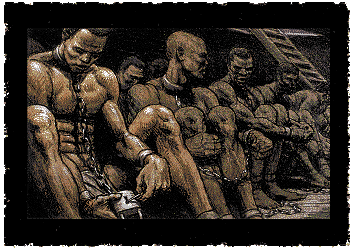 There were three main forces that drove European imperialism: economic, political and social. These three combined forces ensured European and European-American domination over the less technologically developed nations of Africa, Asia, the South Pacific Islands and the Americas. European imperialism revolved around the physical (advanced weapons—guns and cannons) and mental control (the manipulation of the teachings of Christianity and European culture) the Europeans used against the people of those lands. With the Industrial Revolution, their factories made more than enough products for sale, and the raw materials from those lands were needed to run the factories. Also, European and European-Americans needed those lands for trading posts to sell their products worldwide.
The first force, the economic, consisted of the need to exploit the food, material for clothing, mineral wealth and raw materials of the conquered lands. The Europeans controlled the materials of the lands they conquered to further their own wealth and development. For example, in 1900, when Hawaii became a territory of the U.S., it allowed James Dole, owner of the Dole Pineapple Company, to be known worldwide as the “Pineapple King.” At the same time, in the Caribbean, the United Fruit Company (now Chiquita Brands) produced and sold the majority of the bananas throughout the world. Clothing material was also exploited and taken from these lands. Silk was a major material taken from India by the British to sell silk clothing. The raw materials, however, were the most profitable for the Europeans. The gold, diamonds, coal, and oil made their nations rich. That is why the Europeans dominated the richest material place in the world, Africa. The materials in Africa can’t be found in abundance anywhere else. Africa is home of the world’s largest gold and diamond mines. Gold and diamonds are used for making jewelry like necklaces, rings and bracelets. Minerals, like coal and oil, kept their machines running to produce the products that made them rich. The Europeans’ advanced technology in warfare (guns and cannons) allowed them to easily conquer. In America, factories produced products that were more than the Americans needed. One solution, advocated by U.S. Senator, Albert J. Beveridge in 1891, was that America should control trade all over the world. In 1912, President Woodrow Wilson stated that, “The next frontier to be conquered consisted of the fertile export market of Asia.” European and European-American nations looked to Africa, Asia, the South Pacific Islands, and the Americas to increase their wealth.
The second force, the political, dealt with European and European-American’s reasons for instigating wars against those continents. They preyed on these less technologically developed nations to control their economic wealth, but with the political issue, the European and European-American nations had to solidify their stronghold by having political control. Military outposts were created so that the European and European-American armies could defend their economic policies against the native populations and rival nations. Some political people wanted their nation to go to war because war meant that they would be able to make more profits for companies that would help their economies. The makers of cotton and iron goods were needed for war because they made the uniforms and weapons needed for soldiers. That made it easy for them to get the materials they wanted without much of a fight. The gun and the cannon accomplished this physical control of Africa, Asia, the Pacific Islands and Americas—weapons the natives did not possess. Fueling stations were set up around the colonized lands for commercial and military ships to refuel. Producers of the telegraph and railway materials were needed to build communication systems and railways so the military could communicate and travel more efficiently. The last, and most important political backers were the bankers. The colonized nations, and European governments all looked to bankers for loans to build roads, buildings, and factories. A good example of Europe’s political driving force was the Berlin Conference. The Berlin Conference, held in Berlin, Germany in 1885, and attended by the major European colonial powers, discussed and divided up Africa to be further politically and economically exploited.
Finally, the social force, used Christianity and the European culture to control the will of the people of the conquered lands. Physical force was used to bring the Christian religion to the people of the conquered nations, but the manipulation of its teachings was used as a tool to control them mentally. By teaching the conquered people Christianity, they were telling them that their own religions were not good. Also, the European and European-Americans felt that white people were superior to the people they conquered. They even called them savages and heathens. The Europeans felt that it was their duty to teach them to be civilized (“the White Mans Burden”). Cecil Rhodes, a colonizer who exploited South African gold and diamonds mines, believed that the British were the finest race. He felt that they should inhabit more land and by doing so it would be better for all of human kind. Not only did the Europeans feel that the white race was superior, but European-Americans felt the same. William L. Langer, U.S. Senator from North Dakota, believed in the “survival of the fittest”—the fittest being the white race. President McKinley said that the Philippines should be taken over by the U.S. because they were unfit to handle themselves, and that the U.S. takeover would bring education to Christianize and civilize them. A reminder of England’s religious imperialism still stands in a well-known square in England. It is a statue of David Livingstone, a well-known Christian missionary who spent many years in Africa preaching Christianity. The statue shows Livingstone with a gun in one hand and a Bible in the other. Livingstone always advocated spreading what he called the three C’s—commerce, Christianity, and civilization.
The economic, political and social forces were indeed the main factors in driving European imperialism. European and European-American reasons for imperialism were not to civilize the people of the conquered lands; it was to gain the material wealth of the conquered lands. It was all about what the Europeans wanted. The Europeans really thought that they were superior, however, in reality, they were no better than anyone else from a different government or race. If the Europeans and European-Americans were so superior—they wouldn’t need to steal from and dominate other nations. They would have thought of better ways of getting the resources they wanted and needed in a more peaceful way. Just because one nation has high-tech weapons and the other nation does not, is no reason to use those weapons to dominate economically, politically, and socially. Being civilized is not about fighting; it is about spreading peace. And being greedy is not being civilized. They had the nerve to judge others, people that they knew nothing about because they looked different, spoke a different language, and had a different culture, and used it as a justification to exploit is not Christian or civilized behavior (after death, only your God can judge). To put money and political aspirations over the life and culture of the exploited is just selfish and wrong. Today, Europeans and European-Americans can be the heroes of the world by using some of the wealth that they illegally got from the conquered nations to ensure that everyone in the world has food, clothing, medical care and shelter. The people of the world need to work together, regardless of race, religion or creed so that imperialism will never happen again.
*Brandie is a 15-year-old writer. She is a sophomore at James Madison High School in Brooklyn, New York.
EMPRESS INK Vol.1

