


Two significant economic market failures are leading to the under preservation of land in Vermont unless effective policy action is taken.
The first economic inefficiency originates from property rights themselves.
With property rights structured as they are, all the costs and benefits accrued as a result
of owning and using environmental resources do not simply accrue to the owner. An externality exists
where landowners share the consequences of their actions with the community.
This economic reality is common among a category of resources called common property resources.
For example, open space and natural resources (like air and water) are not exclusively controlled
by a single agent or source and can therefore be considered common property resources. As such,
if use of these resources is not restricted, they can be overexploited on a first come first serve basis.
Why? Because landowners have less incentive to restrict land use since the costs of lost open space and
natural resources are spread across the community. At the same time, the benefits of restraining
development can be capitalized upon by landowners who develop open space first. Therefore, open
space and natural resources will be overexploited unless the scarcity of these resources is added
to the cost-benefit analysis of development decisions.
->
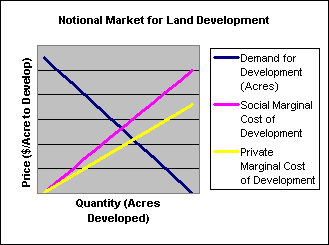
If only private or individual costs are used to make development decisions, too much land will be developed and the price to develop will be too low.
The tragedy of the common develops in this way. Picture a pasture open to all. As a rational being, each farmer seeks to maximize his gain. At some point one asks, "What is the benefit to me of adding one more animal to my herd?" The action has a benefit and a cost. The benefit is the income from the sale of the additional animal. The cost is a function of the additional overgrazing created by one more animal. Since the individual farmer doesn’t bear all the costs of overgrazing, which are shared by all the farmers, the farmer decides to add another animal to his herd. And another.... But this is the conclusion reached by each and every farmer sharing the pasture. Therein lies the tragedy. All the farmers are locked into a system that compels them to increase their herd for their own advantage, but this ultimately destroys the pasture.
The Classic Example:
The Tragedy of the Common->
The second economic inefficiency is from what is commonly called the “free rider” problem,
in which individuals may not feel compelled to contribute to conservation if they believe another is
providing it. Many land uses or conservation values, such as recreation, scenic views,
clean air, clean water, and biological diversity, are public goods. This means that these goods are
accessible to all, and one’s consumption of the “good” does not diminish the amount available for others.
Due to these characteristics, public goods are under valued in economic markets.
For example, take two people who value an open space for scenic purposes and recreational trails. One person
is willing to pay $50 and the other $100 for the conservation of that open space. Economically speaking,
the proper amount of money that should be applied to this conservation effort would be $150. However, if
the town announced it would contribute $100 dollars to the effort, neither person, trying to maximize their net
benefits, would feel an incentive to make an additional donation. Therefore, money available for conservation
will be less than the true demand for conservation in Vermont.


