|
|
|
|
|
|
Workshop on |
|
|
NEW TRENDS IN CHEMISTRY CURRICULA |
||
|
|
Budapest, Hungary |
|
By
|
Prof. Dr. A. F. M. Fahmy Chemistry Dept. Faculty of Science Director of Science Education Center Ain Shams University,Cairo, Egypt. e-mail: fahmy@online-com-eg |
August
2000
Systemic Approach in Teaching and Learning
Chemistry (SATLC) as a New Trend
Chemistry is the branch of science that studies matter, energy and their interaction. The most interesting aspects of chemistry often apply to our daily lives. Teaching Chemistry have been attempting reform in Chemical Education. The interest in the Chemical Education reform (
CER) has gained great importance internationally.SATL
vision in the (CER) (1-3) was dictated by the globalization of most human activities, thus the future of Science Education must reflects a flexibility to adapt to rapidly changing world needs.Through the use of
SATL we believe it is possible to teach students in all areas of human activities, economic, Architecture, Scientific.... to exhibit a more global view of the core science relationships.We Suggest the development of an educational process based on Systemics, which we believe will affect both teaching and learning chemistry. The uses of
SATLC will help students to understand the interrelationships between concepts in a greater context, a point of view that finally, should be beneficial to the citizens living in a global age.By systemics we mean an arrangement of concepts through interacting systems in which all relationships between concepts are made clear.
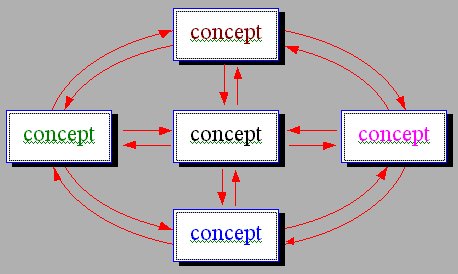
In contrast with usual strategy
concept mapping (4,5), and ordered tree technique(6) which involves establishing a hierarchy of concepts , our approach creates closed-cluster of concepts maps which stress inter-relationships, and helping students to engage in meaningful learning and provides them with a global view of the subject.To illustrate
(SATLC) we have produced the following:1
A module in organic chemistry (7) which was used for the pre- university students.2
An organic Chemistry course (8) for pre-pharmacy and second year, Faculty of science, students.The above materials were experimented, and revealed the efficiency of our approach.
The statistical analysis of achievement results shows that students engaged with SATL materials, and taught by teachers trained systemically, have achieved at significantly higher levels than those taught by using standard linear methods.
Note
More (SATLC) Courses were produced by (SEC) but still under experimentation [e.g: Aromatic Chemistry, Systemic Green experiments in chemistry]How can teachers of chemistry in different countries be informed of the new trends?
This can be verified via the following:
1
Published Journals and books.2
International conferences on Chemical Education (ICCE).3 Satellite Centers of Science Education (SCSE) around the world:
These centers may be chosen by IUPAC and / or UNESCO from the active national centers around the world. The chosen centers will be connected with each other, and with international bodies
(IUPAC UNESCO...), to establish a global network for improvement of Chemical Education
The proposed tasks of this global Network of Centers are:
1)
Viable vehicle for production, testing, and dissimination of (NTCT) materials on the national and the international scale.2)
Organization of electronic seminars, workshops, and conferences on the new trends in chemistry teaching (NTCT).Actually
SCSE stress the global perspective of IUPAC to contribute toward enhancement of Chemical Education.e.g.:
Science Education Center (SEC) of Ain Shams university promote these tasks in Egypt and Arab World.
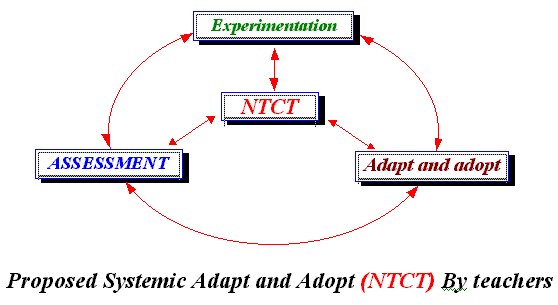
How can teachers of chemistry from different countries be enabled to adapt and adopt (NTCT), if they are appropriate?
This can be done via the following systemic process which involves experimentation Assessment, Adapt and Adopt
NTCT materials