
| Northern Territory |
ANOTHER GREAT AUSSIE STATE
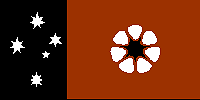
Northern Territory: (Area = 1,346,200 kmē) (Population = 168,000) I
myself did not see much of the N.T. But I do love what I did see. The Kakadu
national park, Mataranka springs, Darwin city, the crocodilia, and the desert.
The desert may be boring and dangerous but when you look at it right it can look
so nice. I loved the Katherine gorges. Very Nice state. I travelled most of it
on bus.
The Northern Territory is a huge area that is very sparsely populated. It lies in the tropical to arid climatic zones. The northern coast is fringed with tropical rain forest, but the state becomes increasingly arid as you head south. The majority of this territory is wilderness areas or Stations which are huge farms or ranches, some of these stations are bigger in area than some countries.
The northern part of this state is known as the Top End to the locals. There are only 2 seasons here, the Wet season and the Dry season. Darwin (pop 80,000) is located here and is the capital city of the Northern Territory. Darwin is a true tropical city and is the last Australian city before heading across the Arafura sea into Asia. The city is pleasant and has a laid back feel to it.
To the west of Darwin lies a huge World Heritage Area called Kakadu National Park. The park is renown for its unique Bird life and rugged tropical beauty. It also has cultural importance to the Aborigine People and there are many Aboriginal Paintings found on rocks and cave walls.
As you head down the main highway commonly known as "The Track" you will start to notice the landscape becoming increasingly arid. Mataranka Springs however are the exception and are definitely worth a visit. Mataranka is an oasis which is surrounded by the parched Australian Outback and is the result of an abundance of underground water which surfaces here through huge vents. The springs themselves are refreshing to swim in and are warm enough to stay in for hours.
The Australian desert has a surprising amount of Flora and fauna. You won't find Cactus in Australia as it is not native, but you will find many Eucalyptus trees and many other bush and flower species. Like the rest of Australia there is also an abundance of birds such as Parrots, Cockatoos and canaries to add colour. The deserts are also heavily populated by kangaroos, emus, snakes and giant lizards.
Ayers Rock is located in the south of the state and almost the centre of Australia. The Rock as it is affectionately known is probably the country's most famous geographical landmark and is about a half day drive from Alice Springs. Further to the west of Ayers Rock are a group of 27 Domes called the Olgas which are even more spectacular and definately worth seeing.
If you continue south along the main highway you eventually cross the border into South Australia. To the west is Western Australia and to the east is Queensland. To the north is the Arafura Sea and the nearest land, the Indonesian islands.
But this city hasn't always been so peaceful. The city has been destroyed and rebuilt twice . In 1945 the Japanese bombed Darwin making this city the only Australian city to ever be attacked. The second time was Christmas Day 1974. While the rest of the world were opening up their Christmas presents, residents of Darwin were under seige from the most powerful cyclone they have ever experienced. This cyclone like any other passed through and took roofs of houses blew down trees, then it was gone. But no one expected what was to happen next. The cyclone turned around and came back with twice the fury and completely flattened the city centre.
Today it is hard to imagine that such an event took place as the city has been completely rebuilt, making it the most modern city in Australia.
Kakadu National Park is Crocodile country in fact parts of the movie "Crocodile Dundee" were filmed here and it is the crocodiles that are the most popular tourist attraction. There are also many spectacular waterfalls in the park and they are best viewed during the wet season. Kakadu is a huge 1.3 million hectares (3.2 million acres) in size and extends from the wild, sandstone escarpments of Arnhem Land to the east, to the mangrove-rich, tidal fiats of Van Dieman Gulf in the north, and south almost to Katherine Gorge.
 Katherine
Gorge another scenic area, is the result of the Katherine River winding its
way through some very rugged Australian landscape. One of the best ways to see
the gorge is to hire a canoe and just take your time exploring the cliffs and
when it gets to hot you can jump in and enjoy a swim.
Katherine
Gorge another scenic area, is the result of the Katherine River winding its
way through some very rugged Australian landscape. One of the best ways to see
the gorge is to hire a canoe and just take your time exploring the cliffs and
when it gets to hot you can jump in and enjoy a swim.
 If
you continue to head south you will eventually come to Alice Springs the second
biggest city in the Northern Territory. Alice Springs is a modern outback city
with plenty of air conditioned shopping malls to please some tourists, but the
city still has its pioneering charm. The city is surrounded by the Mac Donnell
Ranges and endless desert. This area of Australia is called the Red Centre,
due to the colour of the sand. Occasionally this sea of red sand dunes is broken
by white salt from dried out salt lakes.
If
you continue to head south you will eventually come to Alice Springs the second
biggest city in the Northern Territory. Alice Springs is a modern outback city
with plenty of air conditioned shopping malls to please some tourists, but the
city still has its pioneering charm. The city is surrounded by the Mac Donnell
Ranges and endless desert. This area of Australia is called the Red Centre,
due to the colour of the sand. Occasionally this sea of red sand dunes is broken
by white salt from dried out salt lakes.
