
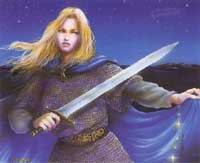
 'All your words are but to say: you are a woman, and your part is in the house. But when the men have died in battle and honour, you have leave to be burned in the house, for the men will need it no more. But I am of the House of Eorl and not a serving-woman. I can ride and wield a blade, and I do not fear either pain or death.'
'What do you fear, my lady?' Aragorn asked. 'A cage,' Eowyn said. 'To stay behind bars, until use and old age accept them, and all chance of doing great deeds is gone beyond recall or desire.' 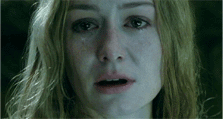 'My friend,' said Gandalf to Eomer, 'you had horses, and deeds of arms, and the free fields; but she, born in the body of a maid, had a spirit and courage at least the match of yours. Yet she was doomed to wait upon an old man, whom she loved as a father, and watch him falling into a mean dishonoured dotage; and her part seemed to her more ignoble than that of the staff he leaned on.
But who knows what she spoke to the darkness, alone, in the bitter watches of the night, when all her life seemed shrinking, and the walls of her bower closing in about her, a hutch to trammel some wild thing in?' But Theoden was not utterly forsaken. The knights of his house lay slain about him, or else mastered by the madness of their steeds were borne far away. Yet one stood there still: Dernhelm the young, faithful beyond fear; and he wept for he had loved his lord as a father. 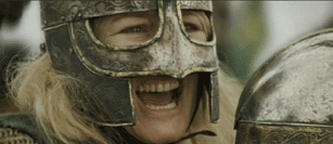 Then out of the darkness in his mind [Merry] thought that he heard Dernhelm speaking; yet now the voice seemed strange, recalling some other voice that he had known. Then out of the darkness in his mind [Merry] thought that he heard Dernhelm speaking; yet now the voice seemed strange, recalling some other voice that he had known.
‘Begone, foul dwimmerlaik, lord of carrion! Leave the dead in peace!’ A cold voice answered: ‘Come not between the Nazgul and his prey! Or he will not slay thee in thy turn. He will bear thee away to the houses of lamentation, beyond all darkness, where thy flesh shall be devoured, and they shriveled mind be left naked to the Lidless Eye.’ 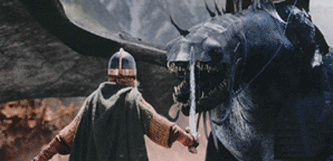 A sword rang as it was drawn. ‘Do what you will; but I will hinder it, if I may.’ A sword rang as it was drawn. ‘Do what you will; but I will hinder it, if I may.’
‘Hinder me? Thou fool. No living man may hinder me!’ Then Merry heard of all sounds in that hour the strangest. It seemed that Dernhelm laughed, and the clear voice was like the ring of steel. ‘But no living man am I! You look up on a woman. Eowyn I am, Eomund’s daughter. You stand between me and my lord and kin. Begone, if you be not deathless! For living or dark undead, I will smite you, if you touch him.’ 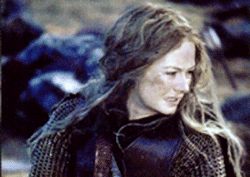 A little to the left facing them stood she whom he had called Dernhelm. But the helm of her secrecy had fallen from her, and her bright hair, released from its bonds, gleamed with pale gold upon her shoulders. Her eyes grey as the sea were hard and fell, and yet tears were on her cheek. A sword was in her hand, and she raised her shield against the horror of her enemy’s eyes. A little to the left facing them stood she whom he had called Dernhelm. But the helm of her secrecy had fallen from her, and her bright hair, released from its bonds, gleamed with pale gold upon her shoulders. Her eyes grey as the sea were hard and fell, and yet tears were on her cheek. A sword was in her hand, and she raised her shield against the horror of her enemy’s eyes.
Eowyn it was, and Dernhelm also. For into Merry’s mind flashed the memory of the face that he saw at the riding from Dunharrow: the face of one that goes seeking death, having no hope. 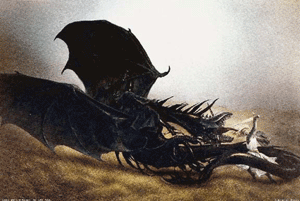 Suddenly the great beast beat its hideous wings, and the wind of them was foul. Again it leaped into the air, and then swiftly fell down upon Eowyn, shrieking, striking with beak and claw. Suddenly the great beast beat its hideous wings, and the wind of them was foul. Again it leaped into the air, and then swiftly fell down upon Eowyn, shrieking, striking with beak and claw.
Still she did not blench: maiden of the Rohirrim, child of kings, slender but as a steel-blade, fair yet terrible. A swift stroke she dealt, skilled and deadly. The outstretched neck she clove asunder, and the hewn head fell like a stone. Backward she sprang as the huge shape crashed to ruin, vast wings outspread, crumpled on the earth; and with its fall the shadow passed away. A light fell about her, and her hair shone in the sunrise. |
