
Zvezda is a Russian company that makes space suits, flight suits, and ejection seats. They have been heavily involved in the Russian space program since the Russians first started putting animals in space. They are also providing the "Orlan" space suits for the Mir and ISS programs. They have a museum located in an underground chamber, and these pictures come from there. There were also some military-related items there, but I was not allowed to photograph them.
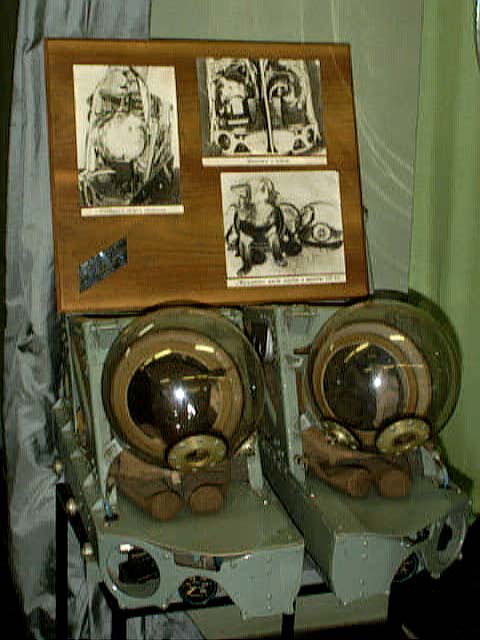 This is a sort of space suit for two small dogs.
Note the cute little jammies for the front paws.
There is a dummy dog's head in the left one.
This is a sort of space suit for two small dogs.
Note the cute little jammies for the front paws.
There is a dummy dog's head in the left one.
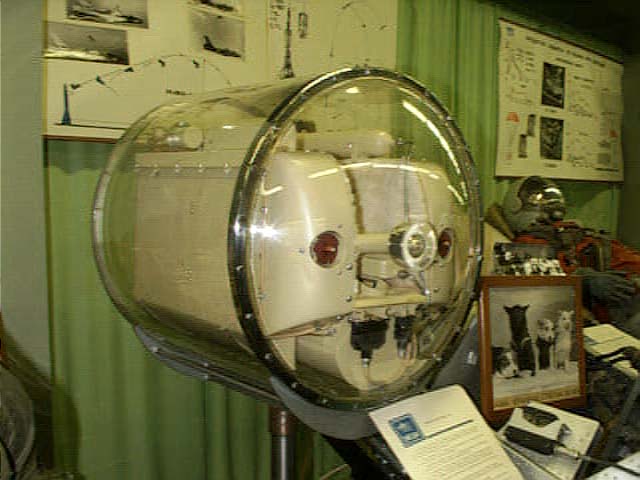 Another early space suit for dogs.
The dog goes in the big notch in the middle.
Another early space suit for dogs.
The dog goes in the big notch in the middle.
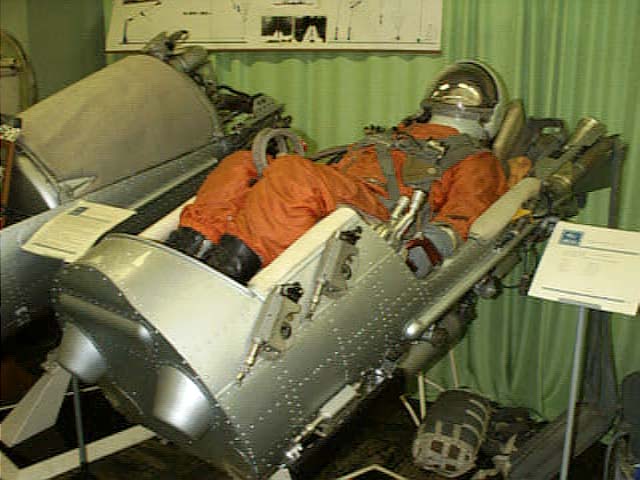 This is supposed to be the ejection seat from Yuri Gagarin's
historic first flight into space.
The suit isn't the original one; see below for that.
The early Russian spacecraft came down over land.
The cosmonauts rode in ejection seats that were ejected
during descent.
The seats were then discarded as the cosmonauts rode down on
parachutes.
The craft to the left is a spacecraft for a dog, similar to the
one that Laika rode in.
This is supposed to be the ejection seat from Yuri Gagarin's
historic first flight into space.
The suit isn't the original one; see below for that.
The early Russian spacecraft came down over land.
The cosmonauts rode in ejection seats that were ejected
during descent.
The seats were then discarded as the cosmonauts rode down on
parachutes.
The craft to the left is a spacecraft for a dog, similar to the
one that Laika rode in.
 The suit from Yuri Gagarin's historic first flight into space.
Note that this exact suit is sold by Moscow street vendors to unwary
visitors at a fraction of the price of the original.
The suit from Yuri Gagarin's historic first flight into space.
Note that this exact suit is sold by Moscow street vendors to unwary
visitors at a fraction of the price of the original.
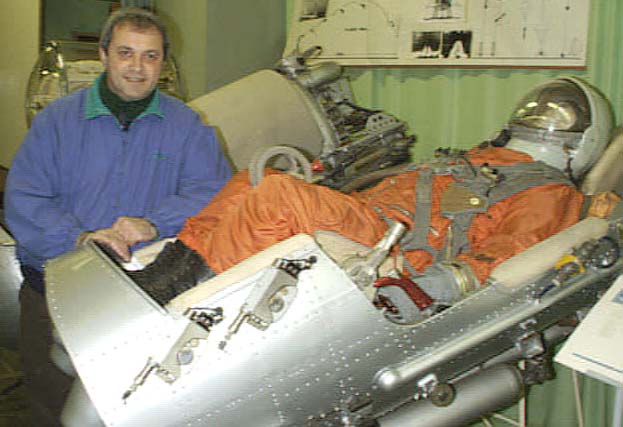 Ilia Rosenberg standing behind Gagarin's ejection seat.
 We couldn't resist.
From left to right: Todd May, Ross Drake, me, Yuri (seated),
and Scott Dubach.
We couldn't resist.
From left to right: Todd May, Ross Drake, me, Yuri (seated),
and Scott Dubach.
 A survival kit provided to early cosmonauts in the event of landing in
inhospitable territory.
Items shown include a gun (see below), medical supplies, something
to make clean drinking water out of really bad water, a
parachute flare, a canteen, and bullets.
The large white sphere is a water supply for some spacecraft and is not
a part of the survival kit.
A survival kit provided to early cosmonauts in the event of landing in
inhospitable territory.
Items shown include a gun (see below), medical supplies, something
to make clean drinking water out of really bad water, a
parachute flare, a canteen, and bullets.
The large white sphere is a water supply for some spacecraft and is not
a part of the survival kit.
 This is another view of the gun provided to some of the early
cosmonauts for survival purposes.
It is being held by our tour guide.
The gun is basically a sawed-off shotgun with two side-by-side
barrels on top and a smaller-gauge barrel under it.
The Russians wanted the gun to be powerful enough to kill a bear.
The rifle stock is a sort of trapezoidal machete that can be detached
from the gun.
This is another view of the gun provided to some of the early
cosmonauts for survival purposes.
It is being held by our tour guide.
The gun is basically a sawed-off shotgun with two side-by-side
barrels on top and a smaller-gauge barrel under it.
The Russians wanted the gun to be powerful enough to kill a bear.
The rifle stock is a sort of trapezoidal machete that can be detached
from the gun.
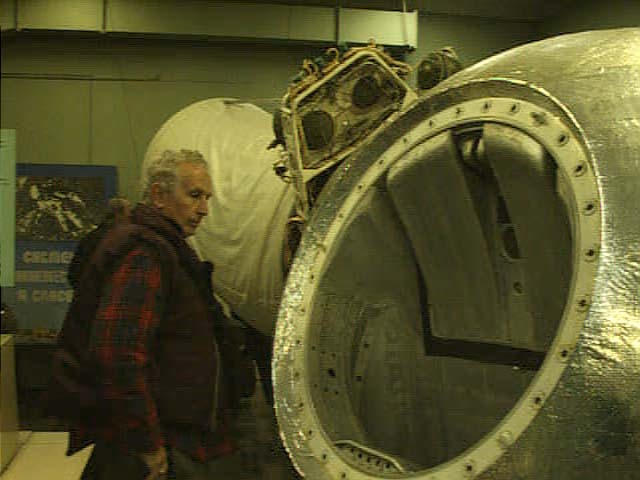 The first spacewalk took place from a "soft airlock" which inflated from
the side of a two-person spacecraft.
This design was never used again because of various problems.
The spacecraft shown here was donated by Energia and has simulated
innards.
Ross Drake surveys the spacecraft.
The first spacewalk took place from a "soft airlock" which inflated from
the side of a two-person spacecraft.
This design was never used again because of various problems.
The spacecraft shown here was donated by Energia and has simulated
innards.
Ross Drake surveys the spacecraft.
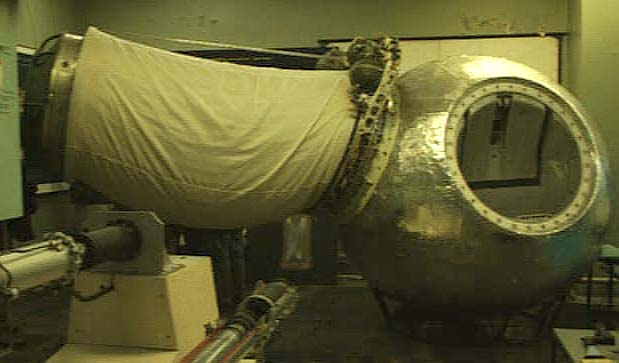 Another view of the "soft airlock" used by Leonov.
The exterior hatch on the inside of the leftmost part of the airlock
was made out of metal.
Another view of the "soft airlock" used by Leonov.
The exterior hatch on the inside of the leftmost part of the airlock
was made out of metal.
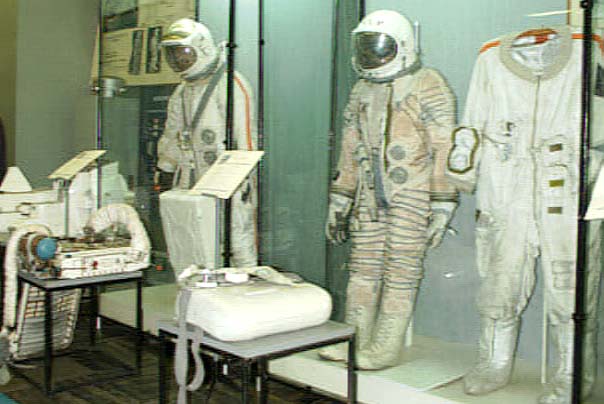 The suit in the middle is
the actual suit that was used by Leonov during
the historic first spacewalk.
The suit was very risky because it had no active cooling system.
The suit has a large number of small external pulleys and cables to
keep the suit from expanding too much.
The suit on the right was the suit worn by Leonov during the descent
from orbit.
When the two-man crew from this flight returned to earth,
they landed far off
course in a snow-covered part of the Ural Mountains, where they stayed
for 3 days until they could be rescued by helicopters, which could not
land in the inhospitable terrain.
To keep warm, they started a fire, and there is a burn mark on the
suit as a result.
I've often thought that Leonov's adventures during this mission would
make a really great movie.
The suit on the left is one of the first Orlan suits.
It does not have a backpack; the corresponding equipment is instead
located in the big white box in front of the legs.
This was done to make it easier for the cosmonaut to pass through a
hatch.
There is an open "legpack" on a table on the left.
The blue object is one end of a cylindrical oxygen tank.
There is another oxygen tank on the table in the middle.
The suit in the middle is
the actual suit that was used by Leonov during
the historic first spacewalk.
The suit was very risky because it had no active cooling system.
The suit has a large number of small external pulleys and cables to
keep the suit from expanding too much.
The suit on the right was the suit worn by Leonov during the descent
from orbit.
When the two-man crew from this flight returned to earth,
they landed far off
course in a snow-covered part of the Ural Mountains, where they stayed
for 3 days until they could be rescued by helicopters, which could not
land in the inhospitable terrain.
To keep warm, they started a fire, and there is a burn mark on the
suit as a result.
I've often thought that Leonov's adventures during this mission would
make a really great movie.
The suit on the left is one of the first Orlan suits.
It does not have a backpack; the corresponding equipment is instead
located in the big white box in front of the legs.
This was done to make it easier for the cosmonaut to pass through a
hatch.
There is an open "legpack" on a table on the left.
The blue object is one end of a cylindrical oxygen tank.
There is another oxygen tank on the table in the middle.
 Zvezda makes some other specialized garments.
The yellow inflatable garment in the foreground is a shock suit.
It is used for accident victims.
The suit is inflated and becomes rigid, compressing the body.
It is designed to keep the body stiff and to keep the victim from
passing out.
The suits worn by the mannequins are for victims of cerebral palsy.
There is also an inflatable bed cushion (blue object at right) that
has some therapeutic nature that I can't recall.
Zvezda makes some other specialized garments.
The yellow inflatable garment in the foreground is a shock suit.
It is used for accident victims.
The suit is inflated and becomes rigid, compressing the body.
It is designed to keep the body stiff and to keep the victim from
passing out.
The suits worn by the mannequins are for victims of cerebral palsy.
There is also an inflatable bed cushion (blue object at right) that
has some therapeutic nature that I can't recall.
 This is a rigid suit that was intended for use by lunar cosmonauts.
Obviously, it was never put to use.
The back has been opened up so that you can see the inner workings
of the suit.
This is a rigid suit that was intended for use by lunar cosmonauts.
Obviously, it was never put to use.
The back has been opened up so that you can see the inner workings
of the suit.
 This is the so-called "penguin suit" used by Mir occupants.
 I had a clear shot of this until Ilia got in the way.
Oh, well.
This is the Russian equivalent of a Manned Maneuvering Unit.
The wall chart visible in the background was a comparison of the
performance of the U.S. and Russian MMUs.
In general, the Russian unit beat out the U.S. one, at least
according to this Russian-provided chart.
I had a clear shot of this until Ilia got in the way.
Oh, well.
This is the Russian equivalent of a Manned Maneuvering Unit.
The wall chart visible in the background was a comparison of the
performance of the U.S. and Russian MMUs.
In general, the Russian unit beat out the U.S. one, at least
according to this Russian-provided chart.
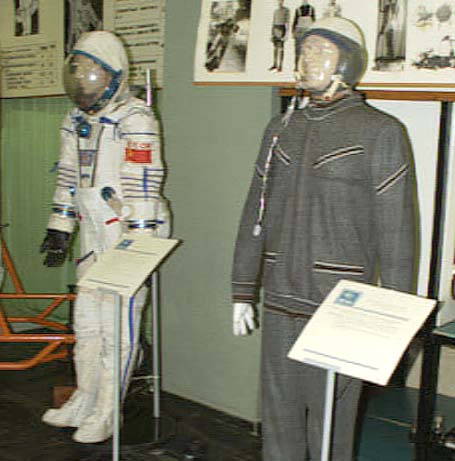 These two suits were used in the era of the Apollo-Soyuz Test
Project.
The one on the right has something of a Star Trek cut to it.
It was made completely with noninflammable materials because of
the U.S. concern about flammability after the Apollo fire.
These two suits were used in the era of the Apollo-Soyuz Test
Project.
The one on the right has something of a Star Trek cut to it.
It was made completely with noninflammable materials because of
the U.S. concern about flammability after the Apollo fire.
 The original space suits worn by Valentina Tereshkova, the first
woman in space.
I forget why there are two of them.
The original space suits worn by Valentina Tereshkova, the first
woman in space.
I forget why there are two of them.
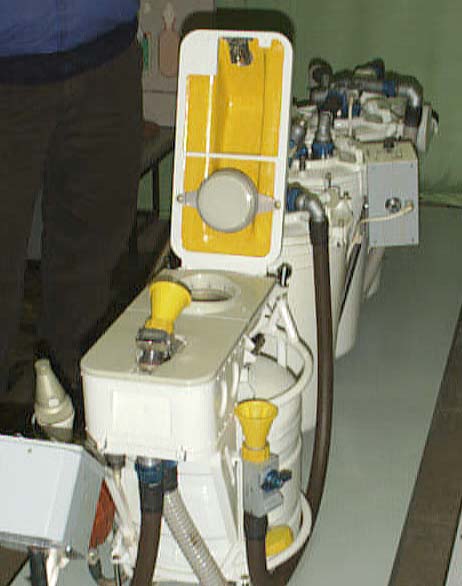 You can't have a museum of space relics without having a space
toilet.
This one is just like the Mir toilet.
It does not use centrifugal force for, uh, separation purposes,
but it does use a vacuum somehow.
I didn't ask a lot of questions here.
This toilet is said to be preferable to the one in the Shuttle by
nine out of ten astronauts.
There will be one similar to it on ISS.
You can't have a museum of space relics without having a space
toilet.
This one is just like the Mir toilet.
It does not use centrifugal force for, uh, separation purposes,
but it does use a vacuum somehow.
I didn't ask a lot of questions here.
This toilet is said to be preferable to the one in the Shuttle by
nine out of ten astronauts.
There will be one similar to it on ISS.
Author: Porter Clark <jpc@suespammers.org>
The suespammers.org mail server is located in California.
Do not send unsolicited bulk or commercial email to my suespammers.org
address.
Last update: December 31, 2001
