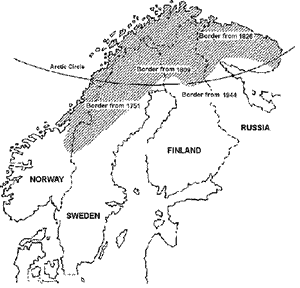
About the Lapps or SamiThe short, nimble, dark-skinned people of Lapland, with triangular faces, flat noses, and high cheekbones, call themselves the Sameh or Samelats. We call them Lapps, which means wanderer or nomad. The Lapps, in race, are like some Arctic Tribes of Asia. Their language is something like Finnish. In the dim past, the Lapps probably wandered from Asia into Northern Europe. Over the vast area of Lapland, are scattered about 30,000 Lapps. Some live by fishing in the Arctic Sea and Lapland's rivers; they are called Coast Lapps, and dwell in villages or in lonely shack. Others who live by reindeer herding, must follow the reindeer herds from grazing ground to grazing ground, and move their tents and goods along with them. These tent-dwelling nomads are called Mountain Lapps, for some of the best pasturage lies in the mountain valleys. Many Finnish Lapps are farmers, dwelling in little farm-houses.
The Lapp loves bright colors, and his reindeer skin clothes are gaily embroidered. He hangs little tinkling bells on the shaft of his sledge, and drives his reindeer furiously over the snowy tundra, while the bells jingle merrily. He likes weird stories, and is easily frightened and becomes angry over very little. Though a Christian, he still believes in strange heathen things, like Magic Spells. But he is kindly, and hospitable.
~ ~ ~
Lapp Seide or Place of Worship
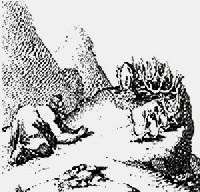
The Lapps worshipped at a sacrificial site (seide). Such sites are usually distinguished by a curious, or awe-inspiring feature. A small idol, whether a stone or for the higher gods, a platform, would, like the typical pole-store, be placed on or surrounded by a bed of twigs. A semi-circle of antlers, occasionally of birch-branches, enclosed the “altar”, which the worshipper approached bareheaded, on his knees with his hands palm uppermost in supplication.
Lapp life and customs; a survey by Ornulv Vorren and Ernst Manker.
~ ~ ~
Lapp Creation Story
When the Creator created the earth, the bear was made the master of all the beasts. The wolf, the fox, and the wolverene paid homage to him. But the wild reindeer refused to obey him, and ran about free, as before. One day the Forest-Owner was hunting five reindeer-does; and one doe, in running, brought forth a fawn. The Forest-Owner caught it and wanted to devour it. The Fawn said, "Please give me a respite. My flesh is too lean. Let me grow up to be a one-year-old."--"All right," said the Forest-Owner, and he let him go.
After a year the Forest-Owner found the fawn, and wanted to devour it; but the fawn said once more, "Do not eat me now! Let me rather grow a little and be a two-year-old."--"All right," said the Forest-Owner, and he let him go. Another year passed, and the reindeer fawn had new antlers, as hard as iron and as sharp as spears. Then the Forest-Owner found the fawn and wanted to devour it. He said, "This time I am going to eat you up."--"Do!" said the fawn. The Forest-Owner drew his knife and wanted to stab the fawn. "No," said the fawn, "such a death is too cruel and too hard. Please grasp my antlers and wrench off my head." The Forest-Owner assented, and grasped the fawn's antlers. Then the fawn gored him and pierced his belly through, so that the intestines fell out and the Forest-Owner died. The fawn sought his mother. "Oh, you are still alive! I thought you were dead."--"No," said the fawn, "I killed the Forest-Owner, and I am the chief of the reindeer." Then the bear sent a fox to the fawn. The fox said, "All the beasts pay homage to the bear, and he wants you to do the same."--"No," said the fawn, "I killed the Forest-Owner, I also am a chief."
After that they prepared for war. The bear called together all those with claws and teeth,--the fox, the wolverene, the wolf, the ermine. The reindeer-fawn called together all those with hoofs and antlers,--the reindeer, the elk, the mountain-sheep. Then they fought. The bear and the reindeer-fawn had a single fight. The fawn pierced the bear through with its antlers of iron. Then it stood still and felt elated. But its mother said, "'There is no reason to feel elated. Your death is at hand." Just as she said this, a wolf sprang up from behind, caught the fawn by the throat and killed it.
Because the reindeer-fawn gored the Forest-Owner to death, no reindeer dies a natural death. It lives on until a wolf, creeping up from behind opens its throat and kills it.
Told by Innocent Karyakin, a Tundra Yukaghir man, on the western tundra of the Kolyma country, winter of 1895.
 Return to Main Deer page