
Viking Longships
Introduction
The Vikings lived in Scandinavia between AD 800-1100 The word ‘Viking’ came from a language called ‘Old Norse’ and means ‘the pirate raid’.
They were pirates and sailed to coastal villages and monasteries, bringing complete destruction and death to the inhabitants and returning home with rich treasures. They also conquered many new countries, such as Iceland.

viship.jpg
The Structure of the Longship
Their ships were a very important mode of transport to them, they were most commonly known as ‘Viking Longships’. The sometimes 30
metre-long ships could have up to 32 oars and could travel up to 32km per hour.
Most ships were given Scandinavian names, which reflected the shape of their bow, such as ‘Snake of the Sea’ or ‘Horse of the Home of Ice’. They would carve such animals and sometimes paint it with a layer of gold, which was called gilding. They did this so that when they met other ships out at sea, it was supposed to scare them and especially when the gold paint would shine in the moonlight. When arriving home from a long journey, they would put on the carved animal as a sign of victory, but lower it if they had lost (which was not very often!).
The planks were ‘clinker’ (overlapped) and the small gaps were covered with sheep wool dipped in tar. At the right of the stern of the ship was a sort of rudder called a steering oar, which started way back with the Egyptian boats. The sail of a Viking Longship could be to 10 metres long. It could be lowered and risen at any time. It would be made from lightweight cloth with leather strips.
Can you still visit Viking Lonships?
There are a group of Viking Longships in Oseberg, Oslo, Norway. It is made of oak and is believed to have benn built around AD 800. It was discovered in 1904 and is 70 feet long, 16 feet wide but only 5 feet deep.
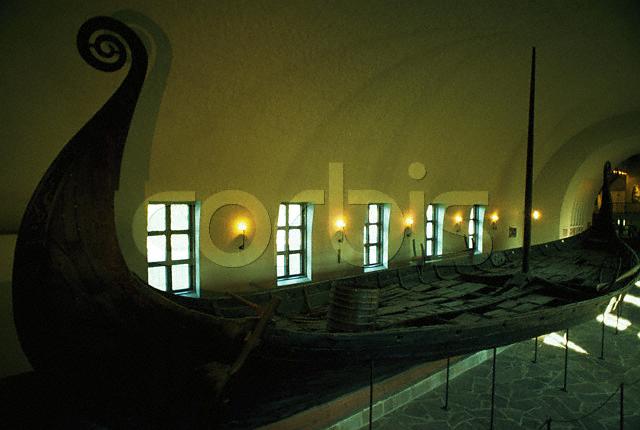
osepic.jpg
Above: The Oseberg Ship
