Preliminary notes: The following are selected pieces from an essay written for a college class. I have left out the parts dealing with the novel the essay analyzed, and have only included the examples of multireligious depictions of a specific duality. The essay aimed to prove that two characters in the novel Jane Eyre were representative of dual aspects within the human being. The characters were sisters, and were opposites like the yin and the yang. The ultimate goal of the attractive, immature, yet selfish one was to find happiness through a good husband. The ultimate goal of the unattractive, serious, but also coldly selfish one was to grow in wisdom, which ultimately led to her being mother superior at a convent, where she inspired and led many younger seekers. The religious sister was the ego (reason), and the ego is the superficial consciousness that works at whatever it thinks is right. The sexual sister was the subconscious (feeling), which is the essential, chaotic consciousness and drives that are often suppressed or overindulged.
Essay proper:The struggle of reason and feeling within oneself can be wonderfully obvious in religious depictions. The first example of humans being split as such is found in Sri Yukteswar’s interpretation of the story of Adam and Eve in Sri Paramahansa Yogananda’s Autobiography of a Yogi:
In Adam or man, reason predominated; in Eve or woman, feeling was ascendant. Thus was expressed the duality or polarity that underlies the phenomenal worlds. Reason and feeling remain in a cooperative state of joy so long as the human mind is not tricked by the serpentine energy of animal propensities (Yogananda, 197).*
Another explanation of the dual nature of humanity is subtly suggested in the famous Light Verse of the Qur’an:
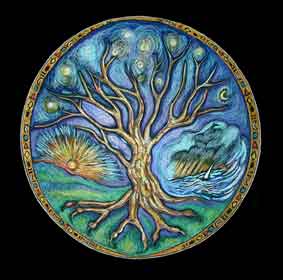
God is the light of the Heavens and the earth. The likeness of His light is as a niche in which is a lamp. The lamp is in a glass. The glass is as it were a shining star, kindled from a blessed tree, An olive that is neither of the East nor the West, Whose oil almost glows with no fire touching it. It is light upon light (Ernst, 210).
The writings of Sufi masters translated in Carl Ernst’s book Teachings of Sufism intimate the meaning of this verse. ‘Isa Jund Allah says: “The meaning of the ‘Heavens’ is the spirit, and the meaning of ‘earth’ is the body (Ernst, 63).” Here we have reason, “the light of the Heavens” and the lamp connected to the tree, referred to as spirit and as something divine which is also separate from the feeling nature, or tree. Shaykh Farid al-Din ‘Attar says “He created the body from earth and water, He blew air and fire into the spirit (Ernst, 64).” ‘Ala al-Dawla Simnani says that “the Heavenly light is active and the earthly light is passive (Ernst, 163).” So it seems possible to say that the tree is feeling, and the lamp is reason.
Christian saints, perhaps displaying the role of mature reason, are often portrayed holding the divine Christ child- feeling and the essential self- in their arms. This is probably based on the image of Mary holding the Christ child, which is itself probably based on images of Isis holding Horus in her arms.
Hebrew, Taoist, Christian, Greek, and Hindu religious art and legends depict the dual nature of man through characters that are closely associated with animal mounts. In the Book of Numbers is the fable of Balaam and his donkey. Balaam, or the divine faculties of reason, was the seer who was called on to curse the Israelites. Along his journey, he came into conflict with his feeling donkey, which he had “ridden all (his) life,” and who had wishes -interpreted probably as more noble than Balaam’s in this case- contrary to his (HCSB, 245). The Taoist sage Lao Tzu is similarly portrayed as a wise old man riding a large ox. A large number of Hindu deities are often portrayed mounted on particular animals. Indra rides the mighty elephant Airavata, Sarasvati a beautiful peacock, and Agni a hairy old goat! The warrior goddess Durga rode a ferocious tiger in her battle with the buffalo demon Mahisha. The Greek hero Bellerophon rode the winged Pegasus in his battle with the Chimaera. The Christian Saint George is depicted as riding a horse in his battle with the dragon (Cotterell and Storm, others). That all these images are of reason mounted above feeling is an interesting idea. As to the nature of the monsters they fight, strangely akin to the mounts of the heroes and from the same earthly source, one can only leave to future speculation. Even if the perception of the dual nature of man as shown through the use of all the aforementioned religious interpretations is true, it still does not delve into what seem like deeper religious connotations within each of those stories.
*Additional notes: Looking at the story of Adam and Eve that way, the story of Babel becomes the same tale. The tower, like the serpent, becomes a phallic symbol of restlesness that leads one to separation from God (or communication/communion with other people).
A banner in a Buddhist monastery had some of that strange Oriental writing. The translation, as I later found out? Transcend the duality!
Bronte, Charlotte, Jane Eyre, Penguin Books, England, 1847.
Cotterell, Arthur, and Rachel Storm, The Ultimate Encyclopedia of Mythology, Lorenz Books, New York NY: 1999.
Ernst, Carl W., Teachings of Sufism, Shambhala Publications, Inc., Boston, Massachussetts: 1999, 63, 64, 163.
The HarperCollins Study Bible, HarperCollins Publishers, New York, NY: 1993, 245.
Yogananda, Paramahansa, Autobiography of a Yogi, Self-Realization Fellowship, Los Angeles, California: 1998, 197.