more Muybridge!

Eadweard Muybridge, born April 9, 1830 as Edward James Muggeridge, grew up in England as a common corn farmer. In 1851 he emigrated to America in search of a better job and a better pay. He remained in America working in a Publishing Firm until some time in 1852 when he found himself, unintentionally, a participant in a stage coach accident. He returned to England and took up photography as a hobby.
By 1867 he found himself back in America, taking pictures as Eadweard Muybridge, using the pen-name of Helios, and taking pictures of the Yosemite Valley. A man named Leland Stanford challenged him to take a picture of a horse while trotting, with all four feet off the ground. The particular horse was a famous horse named Occident (meaning “the west”). This was how Muybridge became seriously known. The challenge was in 1872. By 1873 he knew the picture could be taken but his work was interrupted by the trial of his wife’s lover’s murder. He disappeared into central America for some years, wishing to withdraw from society. Four years later, using 12 cameras and sensors, he had the picture of Occident with all four feet off the ground.
To get the desired picture, Eadweard actually had to invent numerous things. The Sky Shade and Dry Print were some important ones along with a shutter several magnitudes faster. He published the book “the Horse in Motion” which lead him to fame.
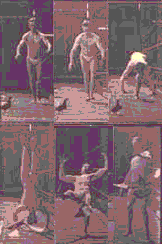 After his success with Occident, Muybridge set to work refining his instantaneous pictures and animations. He headed off to the University of Pennsylvania and with the help of the head of “the Academy of the Fine Arts” and student volunteers, he managed to create hundreds of thousands of pictures making animations of 12 frames each. He compiled them in the scientific book known as “Animal Locomotion.”
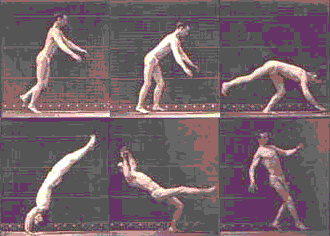 Stanford became jealous.
He felt that his part was downplayed and Muybridge’s was over exaggerated. Stanford published a rewritten version of “The Horse in Motion” with Stanford as the main chief and Muybridge as a photographer who might have helped in the making of some of the photos. Muybridge found himself discredited and his plea disbelieved. He set back to work on “Animal Locomotion.” “Animal Locomotion,” though well known and well made, was a very large book. People bought packets of 100 plates of animations each and in the end only 27 full books were sold and Muybridge’s publishing company went bankrupt. Muybridge returned to England and remained there until his death.
back
 onwards!

