
Murad’s Divisibility Test
Murad
A. AlDamen
https://www.angelfire.com/de2/abbas
Abstract
A general divisibility test for
integers is given and proven.
ملخص
يقدم
هذا البحث طريقة جديدة بسيطة و عامة لاختبار قابلية قسمة عدد على آخر مع برهان لهذه
الطريقة.
INTRODUCTION
Divisibility for integers and it
tests are important in number theory and cryptography.
There are many tests of
divisibility, different for different integers no general test for divisibility
of any integer N by any integer M
 .
Below is a list of famous divisibility tests for the given
integers.
.
Below is a list of famous divisibility tests for the given
integers.
|
A prime |
Divisibility
test of N by the
prime |
|
2 |
If N is an even (that is the say
if rightmost digit of N is Zero or an even digit)
then 2 divides N. |
|
3 |
If the sum of the digits of
N is divided by 3 then
N is divided by 3.
|
|
5 |
If the rightmost digit of
N is 0 or 5 then 5 divides
N.
|
|
7 |
Double the units and
substract from the tens; it the chain ends in zero or a multiple of 7 then
the original number is divisible by 7;e.g.: 1365 |
|
11 |
Let N =
a1a2a3…ak then if
(a1a2+a3a4+…) is divided by 11
then N is divided by
11. Substract the units from the
terms, if the chain ends in zero then the original number is divisible by
11. |
|
13 |
Add the terms to 4 times the
units; if the chain ends in a multiple of 13 then the original number is
divisible by 13. |
|
17 |
Substract the last two digits
from twice the hundreds, and so on, if it ends with a multiple of 17, then
it is divisible by 17. |
|
19 |
Add the hundreds less to 4
times the rest, if the chain ends in a multiple of 19, then the original
number is divisible by 19. |
|
|
… |
This paper is concerned with giving
a general test. We shall find conditions that make the integer N divide by the number M.
Symbol
List:
M, N are positive integers,
M ≤
L is a positive integer that
satisfies LM =N
n1 the units of N
n2 the tens of N ,
n1+10n2=N
m1 the units of M
m2 the tens of M, m1+10m2=M
Test 1:
M|N  n2m1
n2m1 m2n1 (mod M); where m2
 m1 & m2
 0
0
Proof:
Assume M|N 
 L integer, L
M.L=N
 L (m1+10m2)=(n1+10n2)
where M= m1+10m2, N=
n1+10n2
L (m1+10m2)=(n1+10n2)
where M= m1+10m2, N=
n1+10n2
 Lm1-n1=10(n2-Lm2)=10a
…(1)
Lm1-n1=10(n2-Lm2)=10a
…(1)
Also n2-Lm2=a
…(2)
n2-Lm2=a
…(2)
Add (1) to
(2)
|
Lm1-n1=10a n2-Lm2=
a (n2-n1)-L(m2-m1)=11a |
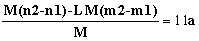
But ML=N
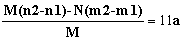

(m1+10m2)(n2-n1)-(n1+10n2)(m2-m1)=
n2m1-m1n1+10m2n2-10m2n1-n1m2+n1m1-10n2m2+10n2m1
 11m1n2-11n1m2=M
(11a)
11m1n2-11n1m2=M
(11a)
 m1n2-m2n1=M.a
or by congruence
language
m1n2-m2n1=M.a
or by congruence
language
M|N  n2m1
n2m1 m2n1 (mod M)
Assume n2m1 m2n1 (mod M)
n2m1 m2n1+kM, k
integer
….1
m2n1+kM, k
integer
….1
 n2m1-m1n1+10m2n2-10m2n1-n1m2+n1m1-10n2m2+10n2m1=kM
Or (m1+10m2)(n2-n1)-(n1+10n2)(m2-m1)=kM
M (n2-n1)-N
(m1-m2)=kM
 (n2-n1)+
 (m1-m2)=kM
…2
(m1-m2)=kM
…2
So (1) to be
integral formula the N/M =integer say L i.e. M|N
q.e.d.
Test
2:
Let x be an integer
if:
1) 
2) m2 0 and m1
 m2
m2
Then M|N
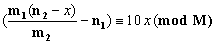
Proof:
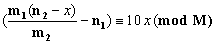 , m2
, m2 0
0
(m1(n2-x)-n1m2) 10xm2+Mkm2, k integer
m1n2-n1m2 10xm2+m1x+Mkm2 but
M=m1+10m2
10xm2+m1x+Mkm2 but
M=m1+10m2
m1n2-n1m2 xM+Mkm2
 0
(mod M)
0
(mod M)
q.e.d.
Example
1:
N=3598207
M=61
N is divided by M because 3598207/61=58987
n1=7,
n2=359820
m1=1, m2=6
Murad’s
Divisibility Test or (MDT): m1n2 n1m2
(mod M)
n1m2
(mod M)
359820*1 6*7=359778
359778=N, 61=M
n1=8, n2=35977 35977*1
 6*8=35929 …and so on and so for
  …30*1
…30*1 6*5=0;
the zero is divided by 61 then M|N.
Example
2:
M=7: m2=0 3*7=21
to avoid m2=0
3*7=21
to avoid m2=0
m2=2;
m1=1 n2-2n1
 0
(mod 7)
0
(mod 7)
Example
3:
M=11;
m2=m1 but Murad’s
divisibility is right for 11 m2=1, m1=1
n2-n1 0 (mod
11)
0 (mod
11)
In this paper I’ve presented a new general method to test any integer if is divisible by any integer else.
Divisibility tests are important in number theory and
cryptography.
Until
now there is no general divisibility test for any prime number or also I’ve
presented a complete proof for this test.
[1] "Divisibility
Tests" by A. Khare, Furman University Electronic Journal of
Undergraduate
Mathematics,
Volume 3, 1997, pp 1-5.
[2] "Tests for divisibility by 19" by
M. Humphreys and N. Macharia, The Mathematical Gazette, Vol
82, No. 495, November 1998, pp 475-477.
[3] Burton, D. M. "Special Divisibility
Tests." §4.3 in Elementary
Number Theory, 4th ed. Boston,
MA: Allyn and
Bacon, pp. 89-96, 1989.
[4] Dickson, L. E. History
of the Theory of Numbers, Vol. 1: Divisibility and Primality. New
York:
Chelsea,
pp. 337-346, 1952.
[5] Gardner, M. "Tests of Divisibility."
Ch. 14 in
The
Unexpected Hanging and Other Mathematical Diversions. Chicago, IL:
Chicago University
Press,
pp. 160-169, 1991.
[6] Wells, D. The
Penguin Dictionary of Curious and Interesting Numbers. Middlesex,
England:
Penguin
Books, p. 48, 1986.
[7] Carlos Rivera Website http://www.primepuzzles.net/

 136-2*5
 12-2*6=0.