


 Foaming
churning whitewater, placid mirror-calm canyons, and gently rippling runs
are features of Tasmania's most popular rafting destinations which include
the mighty Franklin, the Huon and Picton rivers. There are guided tours
available on all three. And, there are scores of gentler rivers,
less demanding, each beautiful in itself. The Franklin has combined
reputation for danger and beauty.
Foaming
churning whitewater, placid mirror-calm canyons, and gently rippling runs
are features of Tasmania's most popular rafting destinations which include
the mighty Franklin, the Huon and Picton rivers. There are guided tours
available on all three. And, there are scores of gentler rivers,
less demanding, each beautiful in itself. The Franklin has combined
reputation for danger and beauty.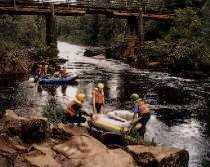 It was first canoed in 1958 by John Hawkins and John Dean. Even though
they approached the river cautiously, that first complete trip - their
third attempt - was difficult and dramatic. Caught in the torrent of the
Franklin Upper Gorge, they were swept backwards, virtually powerless.
Through the work of the pioneer enthusiasts there are now detailed maps
of the Franklin, and ratings of the troublesome stretches. Colourful
and evocative names like Irenbyss, The Churn, Corruscades, Thunderush and
the Cauldron speak for themselves. It's not all wild and hellish!
The lower Franklin is a relaxed drift. Guided raft trips of the lower
Franklin are probably the best introduction to the river. One five-day
camping adventure has often carried 65 year olds.
It was first canoed in 1958 by John Hawkins and John Dean. Even though
they approached the river cautiously, that first complete trip - their
third attempt - was difficult and dramatic. Caught in the torrent of the
Franklin Upper Gorge, they were swept backwards, virtually powerless.
Through the work of the pioneer enthusiasts there are now detailed maps
of the Franklin, and ratings of the troublesome stretches. Colourful
and evocative names like Irenbyss, The Churn, Corruscades, Thunderush and
the Cauldron speak for themselves. It's not all wild and hellish!
The lower Franklin is a relaxed drift. Guided raft trips of the lower
Franklin are probably the best introduction to the river. One five-day
camping adventure has often carried 65 year olds.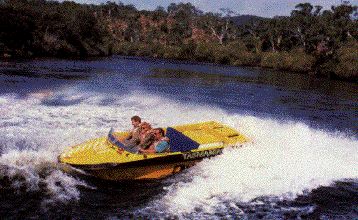
At New Norfolk, a jet boat can whisk you along the willow-lined river to the Plenty Bridge at speeds up to 70km/h! A sister speedster operates on the Huon River from Huonville in the heart of the apple producing region. Further afield, a jet boat operates out of Strahan up the King River. Top
What about a relaxing glide down a wide, willow-lined river? The
good news is Tasmania has plenty of these, suitable for beginners with
a good command of the basic strokes. They include 50km of the lower
Derwent River, the picturesque South Esk, the Meander, and a 128km venture
along the Arthur River in the North-West.
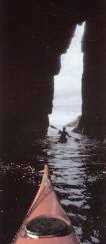
Correct equipment and thorough planning are a must. Proper precautions
must also be taken with the weather. Hydro-Electric Commission waters
are subject to rapid rise and fall and there may be dangerous weirs and
gates. Always get local information before attempting a run.
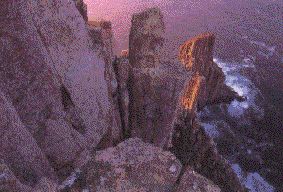
Being an island, Tasmania offers a fascinating diversity of coastal
terrain to explore. The
East Coast, the Derwent Estuary and the moderately protected D’Entrecasteaux
Channel offer much to explore in the way of coves and beaches. For the
more adventurous there is the cliff-scalloped coastline of the Tasman Peninsula
and the grandeur, further afield, of the West Coast which bears the brunt
of the Roaring Forties. Top
