


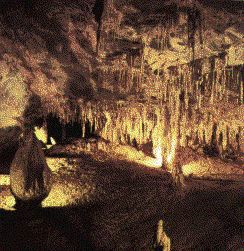
 Tasmania's
natural underground marvels have a grand reputation for huge cathedral
spaces and wondrous fantasy formations. The better-known caves have
professional guides and easy access. Others are challenging chambers
of adventure requiring a proficient escort and safety gear. At Hastings,
125km south of Hobart, is Tasmania's most accessible dolomite (rather than
limestone) cave. The popular Newdegate Cave is renowned for its beautiful
crystallization - visitors, especially children, are always enchanted by
the brilliant splendour of “Titania’s Palace”. Well-lit, spacious,
with steps provided between the chambers and regular guided tours, the
cave offers little difficulty for visitors of all ages. A few kilometres
away, and part of the same State Reserve and geography is a thermal swimming
pool set in attractive picnic grounds with a delightful fern-glade walk.
Only half an hours drive away is Mystery Creek, one of the remarkable caves
to be found in the 19km length of the Exit Cave system - Australia's longest
cave. Excellent glow worm displays, stalactites, stalagmites, columns
and “moonmilk” a fragile amalgam of calcium carbonate and other minerals
probably produced by bacterial action, can all be seen here. A guide
is recommended - lives have been lost in sudden wet weather. Near
Mole Creek in the north of the State are two more popular limestone caves.
King Solomons Cave is a delight with its fascinating light-reflecting crystals
- perhaps recalling the mythical jewels of King Solomons Mines. This
is a dry cave with impressive shawls, pillars, cathedral chambers and other
fine formations which are still growing. There are few steps and
the track slopes gently. Nearby is Marakoopa Cave, larger than King
Solomons, and with more climbing. It contains an underground river,
massive underground chambers and a magnificent glow worm display
can be seen above the stream. Both caves have guided tours.
More than 200 caves are known to exist in the Mole Creek district and tours
can be organized to enable enthusiasts to visit a selection. Gunns
Plains Caves, inland from Ulverstone, were formed by an underground river
that still flows through some sections and contains freshwater crayfish,
eels and fish. Lofty chambers contain many well-illuminated and imposing
formations.
Tasmania's
natural underground marvels have a grand reputation for huge cathedral
spaces and wondrous fantasy formations. The better-known caves have
professional guides and easy access. Others are challenging chambers
of adventure requiring a proficient escort and safety gear. At Hastings,
125km south of Hobart, is Tasmania's most accessible dolomite (rather than
limestone) cave. The popular Newdegate Cave is renowned for its beautiful
crystallization - visitors, especially children, are always enchanted by
the brilliant splendour of “Titania’s Palace”. Well-lit, spacious,
with steps provided between the chambers and regular guided tours, the
cave offers little difficulty for visitors of all ages. A few kilometres
away, and part of the same State Reserve and geography is a thermal swimming
pool set in attractive picnic grounds with a delightful fern-glade walk.
Only half an hours drive away is Mystery Creek, one of the remarkable caves
to be found in the 19km length of the Exit Cave system - Australia's longest
cave. Excellent glow worm displays, stalactites, stalagmites, columns
and “moonmilk” a fragile amalgam of calcium carbonate and other minerals
probably produced by bacterial action, can all be seen here. A guide
is recommended - lives have been lost in sudden wet weather. Near
Mole Creek in the north of the State are two more popular limestone caves.
King Solomons Cave is a delight with its fascinating light-reflecting crystals
- perhaps recalling the mythical jewels of King Solomons Mines. This
is a dry cave with impressive shawls, pillars, cathedral chambers and other
fine formations which are still growing. There are few steps and
the track slopes gently. Nearby is Marakoopa Cave, larger than King
Solomons, and with more climbing. It contains an underground river,
massive underground chambers and a magnificent glow worm display
can be seen above the stream. Both caves have guided tours.
More than 200 caves are known to exist in the Mole Creek district and tours
can be organized to enable enthusiasts to visit a selection. Gunns
Plains Caves, inland from Ulverstone, were formed by an underground river
that still flows through some sections and contains freshwater crayfish,
eels and fish. Lofty chambers contain many well-illuminated and imposing
formations.
