|


| |
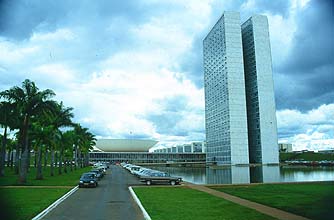 Located
near the geographical center of the country, Brasilia, the nation's capital
(pop. 1,598,000), was
constructed at the end of the 1950s. It replaced Rio as the capital in 1960.
Built in only three years under the direction of Brazil's leading architects,
Oscar Niemeyer and Lucio Costa, and landscaper Burle Marx, Brasilia was intended
to draw development to the country's interior. Although, it appeared to be a
well-planned city on paper, in reality it falls short of its promise. The city
was laid out in the shape of an airplane (a modernist metaphor): Government and
administrative buildings form the cockpit and fuselage, and residential and
shopping areas fill in the wings. The city was planned for a maximum population
of 500,000, with space set aside in every residential block for apartments,
restaurants, shops and services. No provisions were made, however, for the great
mass of nongovernmental workers (more than 1 million in number) who provide
services to the city and who live in several "satellite communities" (more
commonly referred to as slums). Located
near the geographical center of the country, Brasilia, the nation's capital
(pop. 1,598,000), was
constructed at the end of the 1950s. It replaced Rio as the capital in 1960.
Built in only three years under the direction of Brazil's leading architects,
Oscar Niemeyer and Lucio Costa, and landscaper Burle Marx, Brasilia was intended
to draw development to the country's interior. Although, it appeared to be a
well-planned city on paper, in reality it falls short of its promise. The city
was laid out in the shape of an airplane (a modernist metaphor): Government and
administrative buildings form the cockpit and fuselage, and residential and
shopping areas fill in the wings. The city was planned for a maximum population
of 500,000, with space set aside in every residential block for apartments,
restaurants, shops and services. No provisions were made, however, for the great
mass of nongovernmental workers (more than 1 million in number) who provide
services to the city and who live in several "satellite communities" (more
commonly referred to as slums).
There are a details that city planners did not plan for very well. Even though
the temperature is always blazing hot, there's little shade, and every building
must be air conditioned - a tall order for an energy-poor country. It's also a
city that's convenient only if you have a car: Even short distances on a map
make miserable walks. What's more, its location in the middle of nowhere has not
endeared it to the politicians who live and work there (those who can afford it
get away every weekend to enjoy the cultural attractions of Brazil's larger and
more cosmopolitan cities).
Unless you're particularly interested in modern architecture, don't go out of
your way to visit Brasilia - especially at the expense of some of the country's
other attractions. If you do go, one or two days will be ample time to see some
of the more impressive buildings (that have earned it a place on UNESCO's list
of World Heritage Sites): the Palacio do Congresso (National Congress Building),
Palacio do Planalto (presidential mansion and offices), Palacio da Justica
(Supreme Court, with its artificial waterfall) and the Palacio de Itamaraty
(Foreign Ministry). For a nice view of the main buildings, go to the Praca dos
Tres Poderes (Square of the Three Powers - referring to the legislative,
executive and judicial branches). Afterward, see the impressive National
Cathedral, built in the shape of a crown with angels suspended within.
You'll find a good view of the city atop the main television tower (you'll be
able to see from there that the city is indeed shaped like an airplane). If you
have more time, visit the national museum (historical displays and a
comprehensive modern firearms collection). The embassy sector, where each
country has taken pains to represent its national contemporary architecture, is
worth seeing only if you're stumped for something to do - the area is relatively
isolated, and all you can do is look over the compound walls at embassies.
575 mi/925 km northwest of Rio de Janeiro.
|


