|
return to computer science and java
Section 1: Declarations and Access Control
Section 2: Flow Control, Assertions, and Exception Handling
Section 3: Garbage Collection
Section 4: Language Fundamentals
Section 5: Operators and Assignments
Section 6: Overloading, Overriding, Runtime Type and Object Orientation
Section 7: Threads
Section 8: Fundamental Classes in the JAVA.LANG Package
Section 9: The Collections Framework
|
|
- Write code to define, instantiate and start new threads using both java.lang.Thread and java.lang.Runnable.
- Recognise conditions that might prevent a thread from executing.
- Write code using synchronised wait, notify and notifyAll to protect against concurrent access problems and to communicate between threads.
- Define the interaction among threads and object locks when executing synchronised wait, notify or notifyAll.
Threads
- Creating a Thread
- If want it to execute it's own run() method:
MyThread extends Thread
- write the
public void run() method
- any other thread/class can make this one eligible for running as a separate thread by calling
instanceOfMyThread.start() (calling instanceOfMyThread.run() makes it's run method execute inside the current thread).
- If you want it to execute the run() method of another object:
public void MyClass implements Runnable
- Write the
public void run() method (note: run() takes no arguments).
- Pass an instance of MyClass to a Thread object:
	    MyClass myClass = new MyClass();

												    Thread t = new Thread(MyClass);

												    t.start();
- When Execution Ends
- when
run() returns
- thread considered dead
- can't restart - need to create a new instance of the thread
- can call other methods/variables though
- Thread Priorities
- (low)1-10(high). Default is 5, or that of creating thread.
Thread.MAX_PRIORITY, Thread.MIN_PRIORITY, aThread.setPriority(intPriority), aThread.setPriority()
- execution is platform-dependent
- Control of Threads
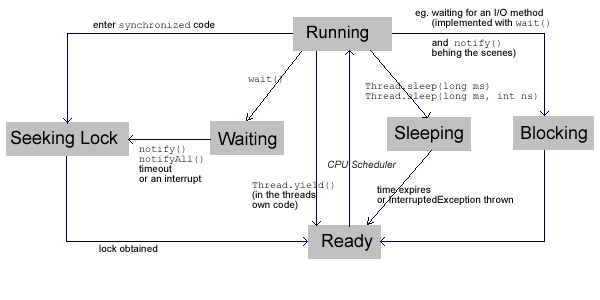
- Scheduling Implementations
- Preemptive, Round-Robin, Priority Queueing etc.
- Platform dependant
- Monitors,
wait(), notify() and Object Locks
- Monitors
A monitor is any object that can block and revive threads (any object that has
synchronized code is a monitor)
- Object Locks
- Every object has a lock
- When a thread tries to enter some
synchronized code it puts in a request for that objects lock, then can either:
- acquire the lock and move to the ready state
- someone else has the lock so thread moves into the objects wait set, in a 'waiting for lock' state.
- When a thread leaves synchronized code, it automatically releases the lock for that object
- The Class Lock controls access to all
synchronized static code
synchronized
- Modifier for an entire method or...
- within a method, can synchronize a block of code
	    synchronized (someObject) {

											        //synchronized code

											    }
someObject is the object we wish to obtain the lock for, usually this
wait(), notify() and notifyAll() must be called from within synchronized code (else get a runtime exception: IllegalMonitorStateException)
wait()
- Can throw an
InterruptedException (a checked exception)
- Causes the thread calling the (non-static) method to lose the lock on the object, giving up the CPU, and moving to wait on the objects waiting pool of threads (it's wait set)
- Good to have in a while loop, where the condition checks if it wants a thread to have the lock, so when the thead returns here, the condition is rechecked
notify()
- Arbitrarily picks a thread from the objects wait set to resume where it left off, moving it into the 'seaking lock' state
- Better to use
notifyAll() so if CPU scheduler is using priority queueing, the threads priorities may count
- Other ways of moving from 'waiting' to 'seeking lock' state:
- if had moved there from a call to
wait(timeInMillis) and that time had elapsed
- if a thread receives an
.interrupt() call
yield()
static void Thread.yield()
- causes whatever thread is currently in the CPU to temporarily leave, giving other threads a chance
|


