Part
Five:
Losar
and Monlam:
Religious Festivals
Losar, the Tibetan New Year, and the period that follows called Monlam, is an extremely jovial time for the Tibetan community in Dharamsala. During these holidays, which, according to the Western calendar was from February twenty-fourth to March ninth, I was able to view and be involved in these special Tibetan festivals. I would like to describe my personal experience of these festivals, displaying the practices of Tibetans in Dharamsala and illustrating the important role holidays play in refugee culture.
In Dharamsala, as in every community throughout the world, holidays are times of collective celebration. While the Tibetans of Dharamsala are a diverse group of individuals, the entire community was unified in their observance of that specific span of time. The activities surrounding Losar and Monlam distinguished Tibetans from their Indian and Western neighbors, allowing them to assert their unique Tibetan identity. These two festivals connected Tibetans within the community and also allowed the people of Dharamsala to savor their connections with their native land and the families that have not followed them into exile.
During Losar I spoke with a wide variety of Tibetans in Dharamsala, in both informal conversation and formal interview. A common topic of conversation among all was the differences between Losar in India and Losar in Tibet. Some individuals were spending there first New Year season in India and spoke of the family that they missed while expressing their joy in being close to His Holiness the Dalai Lama. Others hadn’t been in Tibet for fifty years and related to me their nostalgic memories of jovial festivities and ornate ceremonies. Regardless of individual situations, the Tibetans of Dharamsala were proud of their cultural and spiritual history particular to Losar and Monlam.
Losar is translated as ‘New Years’ in English because it is typically celebrated on the first days of the first month of the Tibetan lunar calendar. Originally, it was most likely a winter ceremony during which farmers made offerings to the pre-Buddhist local deities. As the Buddhist faith was transmitted throughout the cultural area the festival acquired Buddhist overtones. Losar has occurred at different times of year, depending on the various traditions and regions of Tibet but in India it is always held at the beginning of the Tibetan calendar year.
The celebrations of Losar and Monlam blend into each other and to my eyes were usually indistinguishable. In Tibet, the Losar celebrations continued for several weeks and then continued with Monlam, both were national holidays during which people did not usually work. This is not possible in India, Tibetan businesses could only close for two to four days. This did not greatly hamper the secular and religious aspects of the holidays.
The Monlam festival commemorates one of the great acts of Shakyamuni Buddha. During this time, Buddha is said to have entered a contest with a group of six heretics which he won by displaying a miracle a day for fifteen days. These miracles were produced in order to increase the merit and aid the devotion of future disciples, as well as to overcome the evil forces of the heretics. Unlike Losar, this festival has purely Buddhist roots and was not celebrated until later in Tibetan history.
The great Je Tsong Khapa instituted the Monlam festival in 1409, the Earth-Female Ox Year of the Tibetan calendar. Tsong Khapa believed a sacred festival was necessary in the present era, a time that the dharma is degenerating until the arrival of the future Buddha, Maitreya. The first Monlam festival in Lhasa is a glorious story that is known by all Tibetans. People from all over cultural Tibet gathered in Lhasa and for the lavish ceremonious with grand offerings. During the celebration, Tsong Khapa received several visions of Buddhas and goddesses, once seeing a beautiful woman holding an entire temple in her arms for protection. An abbot also saw the three Buddhas and retinue hovering over Tsong Khapa. These famous visions prove the sanctity of the great Monlam festival.
At first glance it seemed that most secular activities could be attributed to Losar and religious acts to Monlam. While both festivals do have these particular inclinations, neither are one-dimensional events. Both festivals are inherently related, revolving around the New Year, driving out the negative and propitiating the positive. In entirety, it is difficult to consider Losar a religious festival because it is no more religious than everyday is a religious event to Tibetans. Conversely, it is difficult to see the effect Monlam has on the lay community, since most activities are carried out by monastics. By studying the exact activities of the lay community during this period I was able to understand the relevance of both these festivals for the entire community of Dharamsala.
An indispensable aspect of the festivals is the preparation. Many people in Dharamsala began preparing for the New Year weeks before the actual event. The month before the holidays was a major business season for the entire community. Families were particularly busy making purchases and preparing the home for the social events. The main object of preparation was food, not surprising since dining and snacking are the focal point of most Tibetan recreation.
The first item my household sought to purchase was the all important drink of celebration, beer. The beer market in Dharamsala was not facilitating to our economic situation, but we were lucky to be in India, a land in which anything is possible. A friend bought us two cases of beer and a week before Losar we traveled to Norbulingka to obtain it. Immediately we ran into a stumbling block. The taxi driver would not drive us home, it was equivalent to smuggling beer. A question mark went off in my brain, was I breaking the law? I’ll never know the precise weight of my illegal activity, but I do know that I paid a taxi-driver twice the normal amount to take us half-way up the mountain. We walked the remaining hike carrying heavy boxes of cheap beer. I am grateful that this was the most complicated item on our list.
Another necessity that required preparation was a major offering as well as edible treat. Khabse are deep-fried biscuits, the traditional snack of Losar. My friends and I had the opportunity to take control of a restaurant’s kitchen for our khabse making. The simple process consisted of kneading the dough, rolling it out and cutting it, twisting it into shapes, and deep-fat-frying it until it puffs to a golden brown. We competed in our designs, the winner making a perfect Knot of Life (palgyi behu), one of the Eight Auspicious Symbols (krashi tag gyad) which is common in Dharamsala.
The objects remaining on our shopping list were of a more simple nature. First we needed to bolster the basic supplies of the household, we purchased larger than ordinary portions of rice, flour, butter, milk, tea and incense. I thought of how providential it was that the weather was still chilly enough to not worry about preservation. We also took a special trip to the Kangra valley to search for cheap sweets, nuts, and fruit. I became childishly excited to have mass amounts of delicious walnuts, pistachios, coconut, and candy. Then, a day or two before the holiday, we purchased large amounts of fresh fruit, vegetables, and meat. I was startled to see an entire side of a goat walking towards my doorway. These were all rare treats that intensified the anticipation for the holidays.
Other preparatory
activities involved cleanliness and purity. Losar is a general
period of spring cleaning for Tibetan households. This is due to
the obvious reason of allowing families to begin the New Year in
a pure state but also draws its origins from a Monlam tradition.
During the festivals in Lhasa the city was administered by
Drepung monastery. The monastery had there own staff and police
force that imposed strict rules and regulations during the
festivals, one of them being cleanliness. In my household we
removed everything from our rooms so as to perfectly cleanse the
entire environment. We then completely reorganized the rooms,
designating one room as the cooking room and the other as the
party room.

The Tibetans of Dharamsala also took great care of their physical appearance during the festivals. Many people, especially the young bought new clothes for the event. I had the chance to have a new chupa and blouse made in early February. After the purchase I had to wait two weeks to wear them, as it would have been bad luck and I’m assuming bad taste, to wear them before the appointed time.
While I was bustling around with my household the entire village was doing the same. The atmosphere of Dharamsala held that special jovial holiday air of expectancy and positive thoughts. People purchased fireworks of the bright and noisy variety and children could be heard lighting them off days before the festival. The bustle of the village was increased by the mass amounts of monks, nuns, and pilgrims streaming in from all over Asia.
The population of Dharamsala quadrupled during February and March. Almost immediately after the holidays, His Holiness the Dalai Lama gave a public teaching for fifteen days. Right before Losar people began to arrive from all over India, Tibet, and Western countries. The refugee reception centers guest houses, and hotels quickly filled and most homes were hosting guests. This caused problems in the community, although it did not damper the high spirits.
One major problem was a water-shortage due to sparse winter snows combined with the population explosion of the small area. This was especially problematic for the monasteries and poorer Tibetans, all of whom found themselves waiting in line for one bucket of water. My household lived without a toilet for two months.
Another difficulty was regarding rented rooms. Three days before Losar our Indian landlord told us to be out of our rooms in two days. This was equivalent to being evicted three days before Christmas. The rising prices of rent had obviously made our eight hundred rupee (about twenty American dollars) monthly rent seem insubstantial to the landlord. We were able to convince him to allow us to stay but other Tibetans in similar circumstances were not as lucky.
Although there was much discomfort caused by the festivals the Tibetans in Dharamsala considered themselves extremely fortunate. To be in the proximity of His Holiness the Dalai Lama is a desire of all Tibetans. To be near His Holiness during one of the most sacred times of the year is particularly momentous. Just to be in the same location as the Monlam ceremonies conducted by His Holiness allows Tibetans to gain a great deal of positive merit and increases their receptive ability to positivity. Some people traveled for months across the Himalayas, risking their freedom and survival, only for this reason. There were no regrets regarding the festivals, especially after the fun began.
The celebration of Losar is typically broken into days on which certain traditions are followed. One peculiarity I experienced was a traditional superstition. The night before Losar I decided to go to a movie, a common diversion for Westerners in Dharamsala. As I prepared to leave, my Tibetan friends persistently objected, stating that one should not go out that night after sunset because of there were dangerous spirits roaming free. Coming from the mouths of my very modern-minded Tibetan friends, this statement slightly surprised me. When asked if they really believed this, they merely laughed and mentioned their mothers’ warnings. I must admit that I looked over my shoulder more than usual that night as I walked the dark path homeward.
The first day of Losar was a very happy and comforting affair. On this day Tibetans do not rove far from home and spend most of their time with their families. We awoke at five AM to set up offerings on the altar and begin cooking. The offerings consisted of the best of our food (including an entire bottle of beer), incense and thorma.
The rest of the day involved general inactivity. We ate, drank beer, played the guitar, sang Tibetan songs, and enjoyed our own company. At one point I wanted to go buy cigarettes but was told that spending money on the first day of Losar would cause me poverty in the coming year. My friend’s brother, a monk visiting from South India, was at the temple for most of the day, engaged in special Losar ceremonies. He joined us in the late afternoon and we all chatted drowsily into the night.
The next day we all became more social and went up to McLeod Ganj. The streets of McLeod Ganj, (there are two) were full of young people parading up and down. Many people were more intoxicated then we were, children were letting off fire-crackers, and everyone was thoroughly relaxed and joyous. After socializing on the street we followed the crowds of people heading toward Namgyal Temple. The temple was also busy, full of monks, nuns and lay-people joined in worship. In one of the main worship halls there were monks chanting special prayers and people standing by listening.
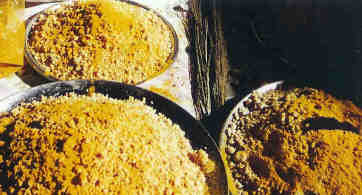
During Losar special offerings are made to His Holiness the Dalai Lama. The main offerings are long life pills, called tseril, made out of barley and other herbs. At the entrance of the inner temple there was a huge bowl of tsampa (barley flour). Upon entering people would grab a bit of the flour and throw it into the air three times in offering to the Three Jewels. The decoration of offerings inside the temple were quite impressive. Before the statues of Maitreya and Avalokiteshvara there was a large wall of stacked khabse and an even larger thorma, or butter sculpture. The making of butter sculptures is a tradition particular to Losar and Monlam. Large and intricate thorma are displayed in temples and many homes have small ones as an offering.
After circuambulating the temple, spinning the prayer wheels and stopping to pray, we continued to walk around the residence of His Holiness. This popular route of Dharamsala was exceptionally busy during Losar and Monlam. Entire families were having picnics along the sacred path and large groups were congregated at the top point, praying, socializing, and resting. I remember the day was especially beautiful and the valley below could be seen clearly, accentuating the convivial atmosphere.
Later on the second day of Losar we had several visitors to our humble home. My fondest memory of Losar is waking from a late afternoon nap to a room full of content Tibetans. The room was candlelit because there was no electricity and a monk friend of ours was playing the guitar and quietly singing a beautiful Tibetan song. People wandered in and out, eating and drinking and always bearing gifts of more food. While I could not follow the Tibetan conversation, there was usually someone in the room with enough English skills to keep me informed of the topic of conversation.
The major subject of the conversations was friends and family in Tibet. They often reminisced about what their families were doing back home, what food they were eating and the temples they were visiting. All of my friends had arrived in India within the last five years and their homeland was never far from their minds on these special festival days. I looked around the room and felt like I was surrounded by orphans. They did not pity themselves, they simply wanted to make sure that they would not forget.
If they were not being nostalgic my Tibetan friends were usually telling jokes and laughing. Their store of jokes and funny stories seemed inexhaustible. Often they became excited and would talk over each other, none seemed to mind if no one could hear them as long as everyone laughed in the end. If someone translated the joke for me I frequently couldn’t see the humor in it but would laugh because their laughter was so infectious.
Another activity common to all Tibetan parties was singing. Sometimes an individual would burst in to song and everyone would either listen or continue their conversation. Other times they would have big singing sessions. They wrapped a khata (silk scarf for offerings) around a bottle and passed it around the room. Tibetan singing is impossible to describe but its an aspect of Tibetan culture I find impressive. If I close my eyes during a song the images that immediately jump in my mind are pristine mountain landscapes and nomadic homes full of simple pleasures. Perhaps I have romanticized this a bit, but I won’t apologize.
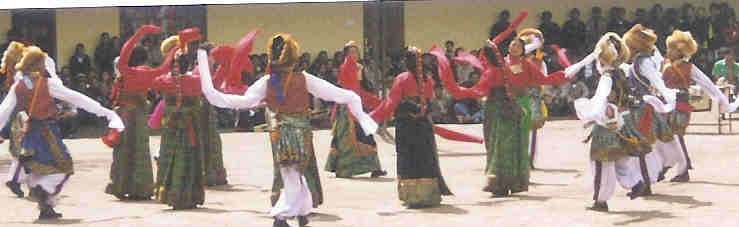
On the third day there
was an event at the Tibetan school in Norbulingka. Hundreds of
people gathered to see the dancing, singing, and comedic sketches
performed by students of the Tibetan School.

I always enjoy the
traditional Tibetan dancing and was particularly impressed by
their dress. It always makes me happy to see young Tibetan
refugees wearing traditional clothing, even if they only wear
them for special occasions. The bright colors and long sleeves
were well-suited for the whirling Tibetan dances.
During intermission we went to our friends’ dormitory room at the school. This room housed twenty-four young men and was decorated in typical Losar fashion. The long table in front of the altar was full of all kinds of food and as we sat they brought us large bowls of butter tea. I always become slightly distressed when offered butter tea, the one beverage in the world I find so completely unpalatable. However, it wasn’t difficult to convince a friend to drink my tea for me and the khabse that were strewn across the table were very delicious. After a full day of festivities and socializing we returned home to continue our private celebration.
By the fourth day I felt that Losar would never end, celebration had practically become a part of my Dharamsala lifestyle. We still had a great deal of food and several friends came to visit, usually coerced to remain with us for their meals. The atmosphere of our room was of endless party and it was difficult to keep the empty beer bottles and other rubbish in check. This was the period during which I began to find it difficult to distinguish Losar and Monlam practices.
As I explained previously, most of the formal events of Monlam were in the monastic community. Everyday the monasteries had long prayer sessions, teachings and rituals. One occurrence that interested me was the guarding of monastic discipline. During the festivals there were thousands of monks visiting from the different monasteries in India. As they were not staying in monasteries it was impossible to monitor the actions of the monks and nuns. Therefore, certain groups of monks became vigilantes and roved around the village searching for dissidents. This displays the importance of monastic discipline, especially during holy festivals such as Monlam, when impurity can negatively affect the entire community.
Losar and Monlam were followed by Lhasa Uprising Day on the sixteenth and the beginning of His Holiness’ Teachings on the seventeenth. These two events consummated the spirit of community achieved during the festivals of Losar and Monlam. While the two festivals were dual occasions of secular and religious activity, Uprising Day and the Teachings were mainly singular in nature. Lhasa Uprising Day commemorates the uprising in 1956 during which His Holiness escaped from Tibet, hence is the marker of the beginning of Tibetan refugees in India. During the sixteenth the community of refugees were a force of political solidarity and retrospection. The sixteenth was a day devoted to political thought while the next day and following fortnight was devoted to religious thought.
The religious and secular
events surrounding the Tibetan New Year brought the refugee
community of Dharamsala (as well as the world community of
Tibetans) together as only festivals can. Religion and tradition
cannot be contrived or forced onto individuals or collectives,
these can only survive if people value them and carry them out
naturally. After Losar, Monlam, and the Teachings of His Holiness
there was no doubt in my mind that the Tibetan refugees of India
value their culture and traditions in entirety.
 |  |