
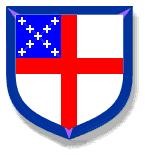
The Episcopal Church is the name of the Anglican Church in the United States. It had to change its name from The Church of England after the Revolution and make certain changes in its Prayer Book, for instance to substitute prayers for the President for that of the King. Our Anglican heritage provides much of our theology and world view, so here are a few paragraphs which might help.
Christianity as a system of expression of the faith existed in England in an organized manner well before the beginning of the 4th century when bishops from that church attended a conference of their peers in France. When St. Augustine arrived from Rome in the 597, he found that the church had preceded him by centuries. There ensued centuries of flux, with allegiance to what we now call the Roman Catholic Church and the Bishop of Rome (the Pope) changing off and on depending on whether a Roman Monarch or an independent (nationalist) church monarch reigned at the time. In the 16th Century things came to a head when the Archbishop of Canterbury, The Rt. Rev. Thomas Cranmer created the first Book of Common Prayer designed to be used by the people and in the common language of the people. Until that time the liturgy was done in Latin, which few in worship understood, and only clergy were allowed to read the scriptures. At this time the Bible was translated into English as well and made available to all people. A copy was placed for use in every church in England. It was so popular that they often disappeared, so the copies thereafter were chained to a podium.
Many people believe the story that the Church of England had its beginning in the lust of King Henry VIII. Give him a break! Henry was desperate to provide a male heir to the throne; indeed, every monarch of that day considered such a sacred duty. As a typical male of the day, he assumed that his failure to produce a male child was his wives' fault and not his. This is the reason for his perceived need for new wives. He did disobey the Pope in so doing, and did produce several children.
The male heir was the sickly Edward, who reigned for a short time in the tradition of a national church rather than a Roman one. When he died, Mary came to power. Mary was a Roman Catholic and tried to purge the church of its independence by burning priests. In a blazing example of an ex-post-facto law, she declared that priests who were married (most were) were to be burned at the stake. Archbishop Cranmer was one to so die. After an exceptionally bloody reign, Mary was deposed and Henry's daughter Elizabeth came to power. Elizabeth engineered what is known as the Elizabethan Settlement which defined the Church of England as an independent national church. That settlement holds to this day in England.
During the Reformation, the Church of England was in a unique situation. The northern European church was carried away in a frenzy of anti Roman Catholic feeling and reformed itself in such ways as to discard the ancient liturgies of the church, which were in use from the second century. To compensate, these reformed churches developed a heavy emphasis on and expertise with the teaching and preaching of the Word of God. Worship became rather cerebral and non participatory, but the body of theology and study of the bible greatly expanded. In the southern part of Europe, the Catholic tradition held on, with its near absence of preaching and teaching other than of doctrine, but with the preservation of its magnificent liturgies, the high, holy drama that involves the heart in the activity of God in the world.
The Church of England sat off shore half way between these two poles and was able to incorporate the best of both traditions. We became a church, founded on the sacred stories of the Bible, with a strong sense of teaching and preaching and yet we are a church with its ancient and powerful liturgies intact.
During the expansionist period of the English colonies, ships went from England regularly with four purposes. They were to settle new lands, develop commerce, build towns, and carry the faith to the natives. The first English speaking colony was established by such a mission of the London Company in 1607, when the Jamestown Colony was established. With this colony came the Church of England and its first priest in the new world, the Rev. Robert Hunt, who celebrated the first Holy Eucharist on a board under a sail on dry land on the Day of Pentecost of that year. So it is that there are Anglican churches all over the world which are bound (in communion with) the See of Canterbury. It is the loose confederation which keeps us focused on the world-wide nature of the church.
Episcopal lay persons and clergy led the way in the Revolution of 1776. George Washington was a vestry person of Pohick Church south of D.C. Most of the chaplains of the Continental Army were C of E. When the war was over, however, there was a great backlash against the Church because of the fact that it had been the established church of the land (as it still is in England), so punitive laws were passed, especially in the mid-Atlantic states, and the property of the church was confiscated. Hundreds of fine colonial buildings were turned into barns and lost.
The church slowly began to pull itself together, however, and by the beginning of the 19th century had formed itself into a nation-wide church with a revised Prayer Book, which called itself Episcopal, meaning led by shepherds, or bishops, and with a loose connection to the mother church in England. Since then, it has continued to struggle to be faithful to our Lord and to provide a balanced representation of liturgy and word, faith and works, piety and activism.
Saint James Church was founded prior to the American Revolution as this area became populated with farmers who brought their grain to Monkton Mill. Clergy from the congregation of St. John of Joppatown began holding worship nearby in the 1740's and this treasure of a building was constructed on this hill around 1750. This road was at that time the main north-south road in this part of the world, so we were on the main drag. By 1795 the parish numbered about 1,600 baptized members. With the opening of York Road in about 1803, this road became the long way around, and things became quiet until the growth in population of recent years. All through these years, however, the prayers and hymns of the faithful have risen from and consecrated this place in which we worship today.
We still preserve our ancient roots as we interpret the actions of the Holy Spirit to a new age. There is much to love in this church, most of all the people who are continually drawn to its majesty and its openness.
Last Update September 3, 2001
Copyright © Christ Episcopal Church, 2001

