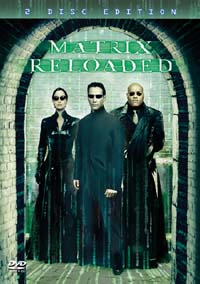
Cast
The Final Flight Of The Osiris
Main article: Final Flight of the Osiris Six months after the events of the first film, Captain Niobe (Jada Pinkett Smith) of the Logos calls an emergency meeting of all Zion's Hovercraft Ship Fleet. She has successfully recovered the information left by Captain Thadeus (in the Animatrix short film "Final Flight of the Osiris"): 250,000 sentinels are tunneling towards the underground city of Zion and will reach it in 72 hours (thus making Zion at a depth of at least 21 km). Commander Lock, the ranking military officer of Zion, orders all ships and their crews, including Neo, Trinity, and Morpheus, to return to Zion to prepare for the onslaught of the machines. Morpheus defies Lock's directive and asks one ship to remain at broadcast depth to await word from the Oracle. Morpheus believes that when she contacts Neo, she will tell Neo how to fulfill the Prophecy. Captain Ballard, captain of the Caduceus, accepts the challenge.
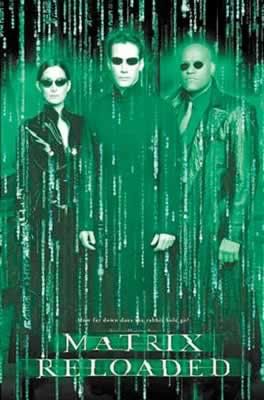
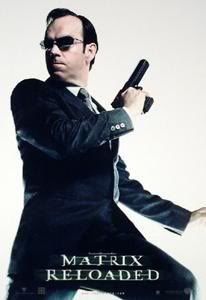
The Caduceus receives a message from the Oracle, and the Nebuchadnezzar ventures out to allow Neo to contact her directly. Meanwhile, one of the Caduceus' crew members, Bane, encounters Agent Smith while receiving the Oracle's message, who then copies himself onto Bane. Bane/Smith then leaves the Matrix.
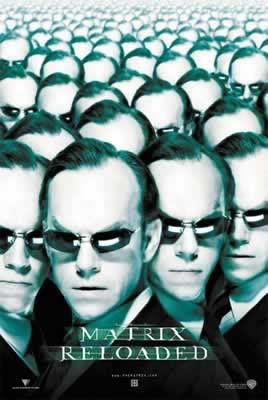
The Smith copies
Cause & Effect
Before the meeting, Neo is having trouble sleeping and has recurring dreams about the death of Trinity. During their relief in Zion, Trinity and Neo make love while the rest of Zion's inhabitants attend a celebration (similar to a rave) in Zion's great temple. The celebration begins with an inspiring speech by Morpheus, who rallies the cause of the humans fight for their survival in this latest machine attack. After the meeting and after the Nebuchadnezzar is charged in Zion, Neo enters the Matrix to meet with the Oracle. Upon reaching the designated meeting area, he encounters Seraph, the Oracle's bodyguard (he is effectively a firewall, or more accurately, a CHAP, who restricts access to the Oracle program via a method of validation). Once Seraph determines that Neo is who he claims to be, he leads him into a hallway which appears to be filled with nothing but doors.
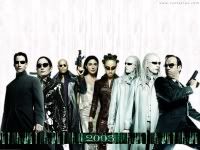
The Burly BrawlThrough conversation with his guide, Neo determines that the passageway and doors represent backdoor access to various locations in the Matrix. Seraph leads Neo to an isolated courtyard, where he meets with the Oracle again, and they have a conversation which in some respects parallels their conversation of the first film. She is aware of Neo's sleeplessness. Neo then asks her if she is human or not, and she confirms that she isn't. Neo then says she must be a program of the Machine World, and the Oracle confirms that as well. Neo says if she is a program, then she could be another system of control involved with the Matrix; he is not sure if he can trust her or not. The Oracle then agrees and confronts Neo with a choice: he must either trust her or not, by saying "You'll just have to make up your own damn mind, to either accept what I've got to tell you or reject it."
The Oracle explains other self-aware programs exist beside the Agents, who have various roles in running the Matrix. Sometimes these programs go awry, and, somewhat analogous to free humans, they voluntarily disconnect themselves from the Source, the machine mainframe, and exist in exile in the Matrix. The implication is that she and Seraph are two such rogue programs. The Oracle then says in order to fulfill the prophecy, Neo must reach the Source.
To reach the Source, Neo must first seek the Keymaker, another rogue program. His keys give access to all Matrix "back doors." The Keymaker is held captive by the Merovingian, a dangerous power-hungry program, among the eldest in the Matrix.
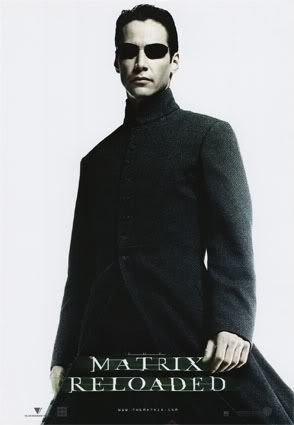
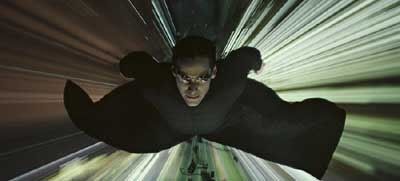
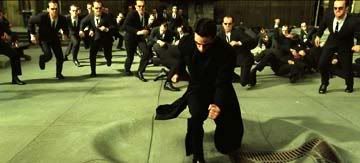
Upgraded Agents and The Twins chase Morpheus, Trinity and the Keymaker through the freewayThe Oracle wishes Neo good luck and exits the courtyard just before Agent Smith arrives. While it appeared that he was destroyed at the end of The Matrix by Neo, Smith explains that he and Neo are now somehow connected. Disobeying deletion, Smith is no longer an Agent of the system, he, like Neo, is free. He has gained the ability to convert anyone he touches into a duplicate of himself (which implies he has become a virus program), and recruits an ever-increasing gang of self-copies to attack Neo (a scene known as "The Burly Brawl"). Eventually understanding that he will be overrun, Neo overpowers a mountain of Smiths and flies to an exit, leaving the Smith clones to silently ponder their next move.
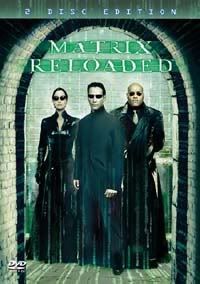
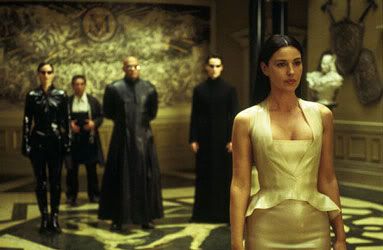
Neo battling the Merovingian's minions.Neo, Trinity, and Morpheus leave to visit the Merovingian, an aesthete who exists in the Matrix mainly for his own enjoyment. He is accompanied by his wife Persephone and The Twins, two albino bodyguards. When the protagonist trio request the Keymaker, the Merovingian instead responds with his own line of questions. The Keymaker "...is not a reason," according to the Merovingian. "This is not a why. The Keymaker himself—his very nature—is a means. It is not an end. And so to look for him is to be looking for a means to do ... what?" Not receiving an answer to his satisfaction, the Merovingian makes some oblique remarks about cause and effect before refusing them access to the Keymaker. Denied, the trio leave, only to be unexpectedly led to the Keymaker by Persephone, who has grown tired of her husband's emphasis on decadence. Neo stays behind to fight a half dozen of the Merovingian's followers, earlier versions of Agents who are described by the Oracle as being similar to "vampires, ghosts and werewolves". Trinity and Morpheus briefly escape the Twins with the Keymaker, stealing a nearby car and are chased onto a freeway by the Twins, who are later joined by two Agents. A lengthy car chase follows where Morpheus and Trinity continuously dodge traffic, attempting to keep the Keymaker alive.
Meanwhile, in the real world, we learn the machine army will reach Zion in just over nine hours. In response, the entire hovercraft fleet is strategically placed for a surprise counter-attack before the army reaches Zion.
Inside the Matrix, having survived the freeway chase, the Keymaker explains how to reach the Source: "There is a building. Inside this building there is a level where no elevator can go and no stair can reach. This level is filled with doors. These doors lead to many places. Hidden places. But one door is special. One door leads to the Source." To access the building, its alarm must be disabled and to do that the electricity must be cut. In addition, the core network of the electricity grid must be accessed and the emergency fail-safes deactivated. For 314 seconds, the mainframe can be entered, but the Keymaker warns, "Only the One can open the door, and only during that window can the door be opened."
Meeting The Architect
Realizing that the power grid may not be down in time to allow Neo to unlock the vital door, Trinity infiltrates the control area and disrupts the grid long enough for Neo, who follows the Keymaker's instructions and opens the indicated door. He enters a room surrounded by television monitors (reminiscent of the ones watching him during the interrogation scene in the first film), all showing his image, and encounters the Architect, who describes himself as the creator of the Matrix.
Neo asks the main question: "Why am I here?"
The Architect says Neo is "the eventuality of an anomaly" he has been trying to eradicate from the Matrix program. The Architect says while he has been unsuccessful in eliminating this anomaly "from what is otherwise a harmony of mathematical precision", he has succeeded in controlling it. It is this control system that "has led [Neo]...here."
Neo responds by saying the Architect has failed to answer his question, to which the Architect agrees with a slight smile in recognition that Neo was "quicker than the others". The various images of Neo on the Architect's monitors then respond with various reactions ranging from relatively subdued (such as "'Others'? What 'others'?") to childish ("I want out! I want out! I want out!"), to downright rageful(flipping off the outside of the monitor and shouting "Fuck you!!!" at the top of his lungs).
Neo is caught off-guard by what he is seeing, but the Architect continues as though nothing has happened. He says that "the Matrix is older than you know". He says that he distinguishes each 'version' of the Matrix every time an anomaly like Neo emerges, "in which case, this is the sixth version". Therefore, Neo is the sixth in a series of anomalies or "Ones". Once again, different versions of Neo continue to express themselves on the myriad of screens, and the camera shows the choice Neo makes: "there are only two possible explanations. Either no one told me, or no one knows".
Neo and The ArchitectThe Architect confirms Neo's deduction and reveals how these anomalous errors occur "in even the most simplistic equations". Seeing the monitors react once again, Neo suddenly realizes why these errors occur: "Choice. The problem is choice."
The Architect proceeds to detail the history of the Matrix and just how this problem of choice affected its design. The first version of the Matrix was intended to be "perfect", "flawless" and "sublime", a design previously hinted at by Agent Smith in The Matrix. However, the humans refused to accept this utopia and it failed. Thinking that humans needed to have an imperfect world to survive, he created the second version of the Matrix "to more accurately reflect the varying grotesqueries of [human] nature." However, he "was again frustrated by failure."
The Fundamental Flaw
With some reluctance, he admits that the "lesser mind" of an "intuitive program" (the Oracle) was required to help understand why he was failing. Apparently, the Oracle concluded that humans need to be given a choice, even if only aware of it at a near unconscious level, to make them more likely to accept their simulated lives. After this modification about 99% of the pod-born humans accepted the program, thus bringing stability to the Matrix.
However, this method was "fundamentally flawed" in the sense that, by giving these choices, it is not possible to have complete control over human actions and their lives. This gives rise to the "systemic anomaly" (those who refused the program, including Neo himself) which, if left unchecked, would pose a threat to the stability of the system and give rise to "an escalating probability of disaster."
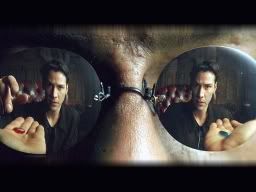
Neo concludes that the one percent who refused the program (and their offspring) constitute the population of Zion. The Architect explains that the solution they came up with was to terminate the inhabitants of Zion at the same time as the next anomaly emerged.
It now becomes clear that the prophecy about the "end of the war" was designed merely as a measure to control both the Zionite rebels and the One.
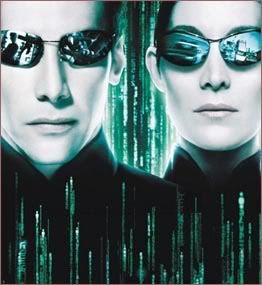
Trinity's Fall
The Choice
The Architect continues to reveal that "the function of the One is now to return to the Source" in order for him to integrate with it and "reinsert the prime program" embedded within him. His final task will be to "select from the Matrix 23 individuals - 16 females, 7 males - to rebuild Zion."
The Architect then warns Neo, "Failure to comply with this process will result in a cataclysmic system crash, killing everyone connected to the Matrix, which, coupled with the extermination of Zion will ultimately result in the extinction of the entire human race."
Neo tries to call the Architect's bluff saying that humans are necessary for machines to survive, but the Architect merely rebuts that claim by saying that machines are prepared to accept "certain levels of survival" and re-states Neo's dilemma, whether he is or is not ready to accept the responsibility for the death of every human being in this world.
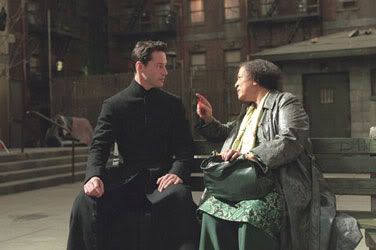
The Architect is then intrigued by Neo's reaction. He says that his predecessors were "by design" made to develop "a profound attachment" with humanity, but he says that Neo is interestingly different. His attachment and his thought is currently focused on one particular individual: Trinity. As a side-note, he adds that she entered the Matrix to save Neo's life at the expense of her own, and shows Trinity being attacked by an Agent just as Neo had seen in his dream. As far as the Architect is concerned, there should be no dilemma—Trinity will die, whether Neo enters the Source or not.
Thus Neo is presented with the ultimate choice of two doors: "The door to your right leads to the Source, and to the salvation of Zion. The door to your left leads back to the Matrix, to her, and to the end of your species. As you so adequately put—'the problem is choice'."
Despite all logical reasoning, Neo chooses to try and save Trinity over the rest of humanity, and for the first time every screen shows the same decision, demonstrating his belief in this reaction to the dichotomy. The Architect sardonically offers one final conclusion:

"Hope. It is the quintessential human delusion, simultaneously the source of your greatest strength and your greatest weakness." The Architect assures Neo that they will never again meet after this moment, and with that, Neo leaves the conduit between the Matrix and the Source to save Trinity. Defying both his visions and the Architect, he catches her before impact and in turnabout fashion, brings her back to life.
Neo's powers transcend the confines of the Matrix.
The Revolution
Morpheus is very dismayed when he hears that the Prophecy has been unfulfilled. Neo tells Morpheus that the Prophecy was just "a lie" and "another system of control." Morpheus refuses to believe it, and, echoing the words of his mentor in the first film, Neo says "I know it isn't easy to hear, but I swear to you it's the truth."
The Nebuchadnezzar comes under attack by Sentinels outside the range of their EMP and the crew must abandon ship. In the sewers outside, they flee, but Neo senses something has changed; he can "feel" the Sentinels' presence. He halts the Sentinels as he would bullets in the Matrix, but immediately loses consciousness. As his shipmates rush to his aid, they are rescued by another craft, the Mjolnir (referred to as the Hammer, a reference to the hammer of Thor). The film concludes with the news that Zion's counter-attack with carefully positioned ships has failed. An electromagnetic pulse was activated too early, downing five hovercraft immediately. The break in the ships' lines allowed the machines to overrun them all. The only survivor of this massacre is revealed to be Bane — the red pill overwritten by Smith's consciousness, and the only human who desires to kill Neo. The final shot shows Bane's unconscious body lying inches away from Neo's.
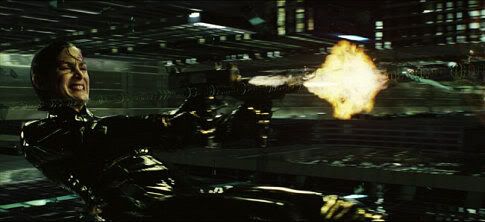
The story is concluded in the last film of the trilogy, The Matrix: Revolutions.
Discussion
In this film, Neo returns the favor to Trinity by bringing her back to life this time. The scene used visual effects which some see as illustrating a healing energy coming from Neo, that merges with the rapidly fading energy of lifeless Trinity. It could also be seen as another manifestation of Neo's ability to manipulate items (in this case, a human heart) within the Matrix.
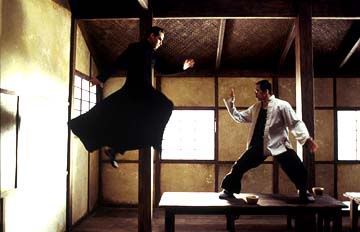
There are various references to philosophy, mythology and computer science. The scene in which Neo fights Seraph is a simultaneous reference to the spirituality of martial arts and to challenge-response authentication. It is also suggested that the Oracle is actually an oracle machine. A cleverly constructed technical detail is Trinity's use of an SSH exploit, which had not yet been discovered (and thus fixed) in 1999 (the year which The Matrix simulates), to break into a computer. The "hidden floor" is floor number 65 (a multiple of 13).
Characters throughout the movie continually remind us that Neo is still only human. At the beginning Agent Johnson says, "Only human." The Merovingian says, "You see, he is just a man," when Neo's hand bleeds briefly. The Architect tells Neo, "You remain irrevocably human ...". This is also conceivably another parallel drawn between Neo and Jesus of Nazareth. In the Bible, Pilate presents Jesus to a hostile crowd with the words "Behold the man". Likewise, Jesus often refers to himself as the 'Son of Man', and the name "Anderson" (Neo's given name) means 'Son of Man'. This phrase in biblical text was often used to mean 'human', except in reference to Jesus, where it is generally accepted as a reminder of his simultaneous humanity and divinity.
Existentialism can also be seen throughout the movie, as so much emphasis is put on choice and self definition rather than predestination. Neo insists he is not governed by causality or rules, through such actions as bringing Trinity back to life or sitting when the Oracle says she knows he will stand. The Architect attributes the imperfectness of the Matrix to humanity's stubborn will to defy reality and authority, a theme which can be seen throughout many of Fyodor Dostoevsky's novels, and Jean-Paul Sartre's plays. The film does however place an emphasis on human need to use logic and causality when the councilor relates to Neo the irony that they are dependent on the same machines that threaten to control them (the machines symbolic of causality and reason).
In the Architect scene, some of the screens show images from Neo waking up in the real world. It is unclear how these images supposedly from outside the Matrix could be known to the Architect inside of the Matrix, unless perhaps the Architect can read Neo's memories or the outside world is part of a yet unidentified parallel matrix.
Scrollbar from OhMySpace.com